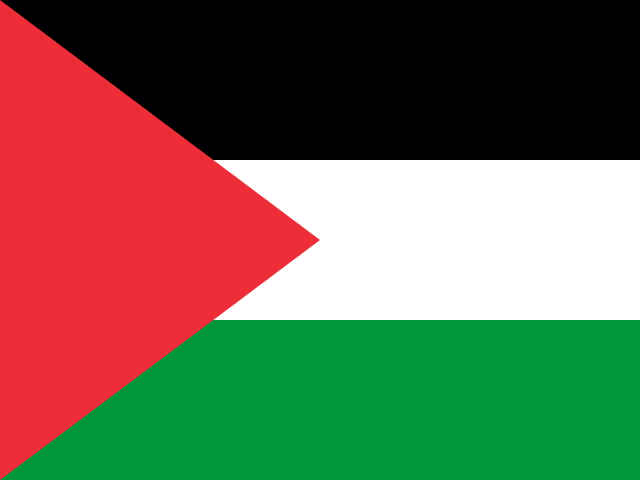
Ramallah — Capital of Palestine
Ramallah functions as the de facto administrative capital of the Palestinian Authority, hosting most of its ministries, its legislative offices, and the headquarters compound known as the Muqataa — but it is not, and has never been claimed as, Palestine's intended capital. That role is reserved by Palestinian law and the 1988 declaration of statehood for East Jerusalem, which sits only about 10 kilometers away but remains under full Israeli administration, a status Palestinians dispute and most of the international community does not recognize as final.
Ramallah's own history predates any of this by centuries. Local tradition traces the town's founding to the 16th century, established by Palestinian Christian clans — most prominently the Haddadin — and its Arabic name is generally understood to mean 'height of God' or 'God's height,' a reference to the town's elevated position in the hill country north of Jerusalem.
Ramallah took on its administrative role only after the Oslo Accords of 1993–95 created the Palestinian Authority and granted it limited self-government over parts of the West Bank and Gaza; with Jerusalem access restricted, Ramallah emerged as the practical seat of Palestinian civil administration by necessity rather than by any prior historical status as a political center.
The Muqataa compound became internationally recognizable during the Second Intifada, when Israeli forces besieged the headquarters in 2002, largely destroying the surrounding complex and confining then-PLO chairman Yasser Arafat to a small section of the building for the final years before his death in 2004; he is now buried within the rebuilt compound, which functions today as both a government headquarters and, informally, a national memorial site.
Historically a majority-Christian town, Ramallah has become significantly more religiously mixed over the 20th and 21st centuries as it grew into the West Bank's most cosmopolitan city, home to a relatively young, internationally connected population, a concentration of NGOs and diplomatic missions that maintain relations with the Palestinian Authority, and a nightlife and cultural scene distinct from more conservative towns elsewhere in the West Bank.
Birzeit University, located just north of Ramallah, is one of the most prominent Palestinian institutions of higher education and has long served as a center of Palestinian intellectual and political life, drawing students from across the West Bank and helping cement the greater Ramallah area's reputation as the territory's de facto cultural and academic capital as well as its administrative one.
Ramallah's population swelled considerably after 1948 and again after 1967, as Palestinian refugees and displaced families from other parts of historic Palestine settled in and around the town, transforming what had been a relatively small hill community into a much larger urban center whose growth closely tracked the successive waves of displacement that have shaped modern Palestinian demography more broadly.
Ramallah and its twin city Al-Bireh have effectively merged into a single urban area, sharing infrastructure and municipal boundaries so thoroughly that many residents treat the two as one city despite their formally separate municipal governments — a distinction that matters administratively but rarely comes up in daily life. Manara Square, at the city's commercial center, anchors a downtown built up rapidly since the 1990s around banks, telecom offices, and the headquarters of Palestinian companies like Paltel, reflecting Ramallah's emergence as the West Bank's financial as well as political hub.
Rukab's, a family-run ice cream shop on Rukab Street operating since 1941, is one of the city's most enduring landmarks, known for a distinctive booza made with sahlab and mastic gum rather than standard dairy ice cream, and it has outlasted several rounds of conflict and closure that shut down other long-running Ramallah businesses over the decades. Travel between Ramallah and nearby Jerusalem, despite the short physical distance, routinely requires passing through the Qalandia checkpoint, an Israeli-controlled crossing point that can add hours to what would otherwise be a twenty-minute drive — a daily reality that shapes commuting, family visits, and commerce far more than the map distance between the two cities would suggest.
Quick facts
- Ramallah's official resident population is only around 38,000, far smaller than the daytime population created by commuters working in the city's concentration of PA ministries, NGOs, and diplomatic offices.
- Birzeit University's roots trace to a girls' school founded in Birzeit village in 1924, decades before it grew into a full university in the 1970s.
- Rukab's ice cream parlor, founded in 1941, still pounds its booza by hand in large mortars, a labor-intensive method that predates the mechanical churns used by most modern ice cream shops.
- Ramallah sits roughly 880 meters above sea level in the central West Bank hills, giving it a noticeably cooler climate than nearby Jericho and the Jordan Valley below.
- Ramallah and Al-Bireh, its neighboring twin city, have grown into a single built-up urban area even though the two retain separate municipal councils and boundaries on paper.