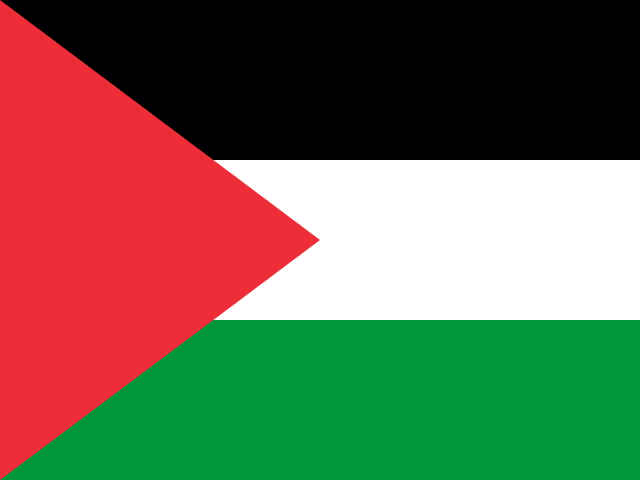
The Flag of Palestine
Asia · Adopted 1964 (Palestine Liberation Organization); reaffirmed 1988
The Palestinian flag was formally adopted by the Palestinian National Council, the PLO's legislative body, in 1964, and reaffirmed as the flag of the State of Palestine when independence was symbolically declared in Algiers in November 1988. But the design itself is far older than either date: it is drawn directly from the Flag of the Arab Revolt, first raised in June 1916 when Sharif Hussein bin Ali of Mecca led an Arab uprising against Ottoman rule during the First World War.
That 1916 flag is credited to Sir Mark Sykes, the British diplomat who helped design it as part of Britain's wartime effort to encourage and coordinate Arab opposition to the Ottoman Empire — the same Sykes who, in the same period, co-authored the Sykes-Picot Agreement secretly carving up Ottoman Arab territory into future British and French spheres of influence, a historical irony not lost on later commentators given how the flag he helped design would go on to symbolize Arab nationalist and anti-colonial movements he had no part in supporting.
The Arab Revolt flag's black, white, green, and red color scheme draws on a 14th-century poem by the Iraqi poet Safi al-Din al-Hilli, which associated each color with a different historic Arab or Islamic dynasty: black for the Abbasids, white for the Umayyads, green for the Fatimids, and red for the Hashemites or, in some readings, for the bloodshed of the Kharijites. Because of this shared lineage, the same four-color palette, arranged in different layouts, appears on the flags of several other Arab states with a direct historical connection to the 1916 revolt.
Jordan's flag is the closest relative: both Jordan and Palestine use the black-white-green horizontal stripes with a red triangle at the hoist, tracing back to the same Sharifian Arab Revolt banner, because the Hashemite family that led the 1916 revolt went on to found the Kingdom of Jordan, while Palestinian nationalist organizations separately adopted a version of the same flag as their own symbol during the 20th century. The two flags are near-identical apart from a white seven-pointed star centered in Jordan's red triangle, a star Palestine's flag does not carry.
Palestine's flag has flown under several different degrees of formal recognition since 1964: as the flag of the PLO through the late 20th century, as the flag of the Palestinian Authority established by the Oslo Accords in the 1990s, and, since a 2012 United Nations General Assembly vote granting Palestine non-member observer state status, as a flag now permitted to fly at the UN headquarters in New York alongside those of full member states.
The State of Palestine that formally uses this flag does not exercise full sovereign control over the territory it claims: the West Bank remains partially under Israeli military administration and partially under Palestinian Authority civil administration depending on the zone, while Gaza has been governed separately, a fractured territorial reality that makes Palestine's flag, more than almost any other national flag in use today, a symbol of a claimed and internationally recognized statehood that does not yet correspond to a single fully governed territory.
Because the black-white-green-red combination is shared with several Arab Revolt-descended flags, Palestine's is most often confused specifically with Jordan's, Kuwait's, Sudan's, and the flag of Western Sahara, all of which use some arrangement of the same four pan-Arab colors even though each traces its own specific adoption story back through a different 20th-century national movement.
For more than two decades, simply displaying the flag was a criminal act in the territories where most Palestinians lived: Israeli military authorities banned the flag across the West Bank and Gaza after taking control of both territories in the 1967 war, a prohibition that remained in force until the 1993–95 Oslo Accords, meaning a generation of Palestinians who came of age under occupation grew up with the flag as an act of open political resistance rather than a routine national symbol, and arrests for flying or painting it were common during that period.
Before the PLO formalized the current design in 1964, Palestinian Arab communities under the British Mandate for Palestine (1920–1948) had already been informally using versions of the Arab Revolt flag at demonstrations and nationalist gatherings during the interwar period, meaning the symbol carried decades of grassroots political meaning among Palestinians well before any official body adopted it as a defined national flag.
The flag reached a further symbolic milestone on 30 September 2015, when it was formally raised for the first time at United Nations headquarters in New York, alongside the flags of full UN member states, following a General Assembly vote earlier that month permitting non-member observer states to fly their flags at the complex — a largely symbolic gesture, since it did not change Palestine's UN membership status, but one widely covered internationally as a marker of the flag's growing formal recognition abroad even as the underlying territorial and political situation on the ground remained unresolved.
Often confused with
- Kuwait — uses the same four pan-Arab colors — black, white, green, red — but in a different horizontal-stripe-with-trapezoid layout rather than Palestine's stripes-with-triangle arrangement. Compare side by side →
Palestine at a glance
- Capital
- Ramallah (de facto administrative seat; East Jerusalem is the claimed capital)
- Population
- 5.5 million (2024)
- Currency
- No independent currency; Israeli New Shekel (ILS) and Jordanian Dinar (JOD) both circulate
- Language(s)
- Arabic (official)
Population figure as of 2024, source: Palestinian Central Bureau of Statistics / UN OCHA estimates (2024). See methodology for how facts are sourced and kept current.