Port Moresby — Capital of Papua New Guinea
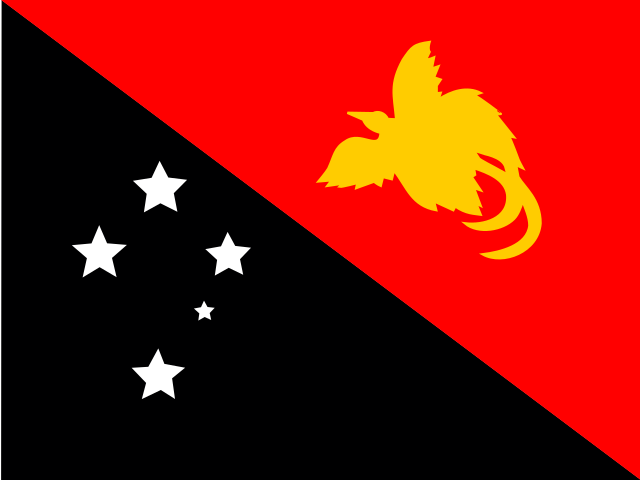
See the flag of Papua New Guinea →
Port Moresby takes its European name from British naval officer Captain John Moresby, who charted the harbor in 1873 and named it after his father, Admiral Fairfax Moresby, during a period when Britain, Germany, and other colonial powers were actively surveying and dividing up New Guinea's coastline. The site had already been inhabited for generations before that by the Motu and Koitabu peoples, whose villages, including Hanuabada ('big village'), a stilt village built out over the harbor's shallow waters, remain a landmark of the city today.
The town grew into an administrative center under British and then Australian colonial rule over Papua (the southeastern portion of the island, distinct from German-administered New Guinea to the north until the two were merged under Australian administration after the First World War), and it retained that role continuously through to independence in 1975, without the kind of capital relocation that shaped several of its Pacific neighbors' histories.
Port Moresby was a critical Allied base during the Second World War's New Guinea campaign — Japanese forces attempted to take it via the brutal overland Kokoda Track campaign of 1942, one of the most significant military engagements fought on Australian-administered territory, and the town's survival as an Allied stronghold is remembered as a pivotal moment in the Pacific War, commemorated today along the Kokoda Track itself, which remains a major trekking route and site of memorial significance for both Papua New Guinea and Australia.
As the capital of a country with more than 800 languages and deeply varied regional cultures, Port Moresby functions as a genuine cultural crossroads, drawing migrants from across PNG's highlands, islands, and coastal regions in search of work and government services — a pattern that has made the city one of the most rapidly growing urban centers in the Pacific, with growth that has periodically outpaced infrastructure and housing capacity.
The city is physically distinctive among Pacific capitals for sitting in a notably dry rain-shadow zone rather than the lush tropical rainforest typical of much of the rest of Papua New Guinea, a climatic quirk caused by surrounding mountain ranges, which gives Port Moresby savanna-like grassland vegetation in contrast to the dense forest just a short distance inland.
Papua New Guinea's National Parliament building, completed in 1984 in Port Moresby, was deliberately designed in the style of a haus tambaran — the traditional spirit house architecture of the Sepik region, thousands of kilometers from the capital — as a way of giving the young nation's central legislative building a visibly indigenous identity rather than borrowing directly from Western parliamentary architecture.
The city hosted the APEC summit in November 2018, a major diplomatic moment that brought world leaders including the presidents of the United States, China, and Russia to Port Moresby and prompted a wave of infrastructure spending, including a new conference center and road upgrades, ahead of the event, though critics at the time questioned whether the spending addressed the capital's more pressing everyday infrastructure needs.
Port Moresby's rapid, largely unplanned growth since independence has also produced significant informal settlements on the city's outskirts, and the capital has periodically ranked among the more challenging Pacific cities on measures of urban crime and settlement infrastructure, a reality city and national authorities have addressed through periodic settlement upgrading programs even as population growth continues to outpace formal housing supply.
The chewing of betel nut (buai), widely popular across Port Moresby and much of the rest of the country, has left a visible mark on the capital in the form of red spit stains on pavements and roadside betel-nut stalls found throughout the city, an everyday cultural practice with deep roots in Melanesian social life that periodic government campaigns have tried, with limited success, to restrict in central business areas for cleanliness reasons.
Quick facts
- Port Moresby's population is estimated at well over 400,000 as of recent estimates, making it by far Papua New Guinea's largest city.
- Port Moresby is not connected by road to any other provincial capital in Papua New Guinea; the country's mountainous terrain means most domestic travel between major towns still goes by air.
- The PNG National Museum and Art Gallery in Port Moresby holds extensive collections of Sepik River carvings and other regional artifacts representing the country's more than 800 distinct language and cultural groups.
- Ela Beach, a stretch of coastline near the city center, was historically used for outrigger canoe racing festivals and remains a popular recreational spot for residents today.
- Varirata National Park, established in 1969 a short drive from the capital, was Papua New Guinea's first national park and offers hiking trails with views back over Port Moresby.