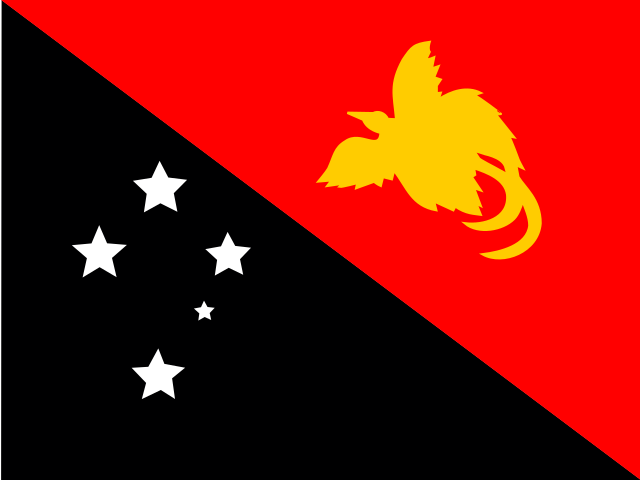
The Flag of Papua New Guinea
Oceania · Adopted 1 July 1971 (pre-independence adoption); retained unchanged at independence, 16 September 1975
Papua New Guinea's flag was designed by Susan Karike, a 15-year-old student from Simbu Province, who won a national design competition held in 1971, four years before the country actually achieved independence from Australian administration. The territory's pre-independence House of Assembly adopted her design on 1 July 1971 as the flag of the Territory of Papua and New Guinea, meaning the flag predates the nation it now represents by more than four years — a genuinely unusual sequence compared with most Pacific flags, which were adopted at or after independence rather than well before it.
The design splits the flag diagonally into two triangles: red in the upper hoist, black in the lower fly. In the red triangle flies a yellow bird-of-paradise, a bird found almost nowhere else on Earth in such striking variety and one that had already been used as a colonial-era emblem on Papua New Guinea's territorial coat of arms under both German and Australian administration, long before independence gave the country the chance to choose its own national symbols freely.
The black triangle carries the five stars of the Southern Cross, the same constellation used on the flags of Australia, New Zealand, and Samoa, chosen for the straightforward reason that it is visible from Papua New Guinea's own skies and situates the young nation within the same Southern Hemisphere geography its neighbors share — though PNG is the only one of the four to render the stars in plain white on solid black rather than against a blue field.
Red and black were not colors imported from any colonial flag; they are drawn directly from the traditional color palette used across many of Papua New Guinea's own indigenous art, body decoration, and bilas (ceremonial dress) traditions, making the color choice itself one of the more genuinely indigenous elements of any Pacific nation's flag, distinct from the far more common practice elsewhere in the region of adapting British Blue Ensigns or colonial coats of arms.
Papua New Guinea is frequently described as the most linguistically diverse country on Earth, with estimates commonly citing more than 800 living languages spoken across its highlands, coastal regions, and islands — a level of diversity the flag's relatively simple, unified design does not attempt to represent directly, in contrast to countries that build ethnic or regional plurality into flag symbolism through multiple stripes or divided fields.
The country's 2021 national census, whose results were released in 2024, recorded a population dramatically higher than earlier international estimates had suggested — roughly 17 million people, compared with United Nations estimates that had previously put the figure closer to 10 million — a discrepancy that sparked genuine debate among demographers about undercounting in earlier surveys versus possible overcounting in the new census, and one that international population datasets had not yet fully reconciled by the time of this writing.
The flag has never been redesigned since its 1971 adoption, remaining unchanged straight through independence on 16 September 1975 and every government since, and it continues to be flown alongside the flags of PNG's individual provinces at Independence Day ceremonies each September.
Susan Karike's winning design was not chosen without controversy at the time: the 1971 competition drew criticism from some members of the pre-independence House of Assembly who favored a design closer to Australia's own Blue Ensign tradition, reflecting broader disagreement within the territory's transitional government over how sharply the new nation's symbols should break from its Australian administrators — the eventual choice of a design with no reference to Australia's flag at all, submitted by a teenager rather than a professional designer or committee, was itself read as a statement about the kind of independent identity the territory wanted going forward.
The bird-of-paradise depicted on the flag is usually identified as the Raggiana bird-of-paradise, PNG's national bird and one of more than 40 bird-of-paradise species found in the country, prized historically for its ornamental plumes, which were both a traditional element of highland ceremonial dress and, from the 19th century onward, a commodity heavily sought by European feather traders for the millinery trade — a demand that drove serious population declines in some areas before conservation measures and changing fashions eased the pressure in the 20th century.
Papua New Guinea's coat of arms, adopted separately in 1971 alongside the flag, features the same bird-of-paradise perched atop a traditional kundu drum and spear, reinforcing the bird's role as the country's primary secular emblem distinct from the flag's own Southern Cross and red-black color symbolism, and both the flag and the coat of arms are protected under national symbols legislation that restricts their commercial use without government permission.
Independence from Australia in 1975 came without the armed conflict that marked many other decolonization movements; Australia had administered the territory under a United Nations trusteeship following the Second World War, during which Japanese and Allied forces fought some of the war's most grueling jungle campaigns on Papua New Guinean soil, including along the Kokoda Track, and the transition to self-government proceeded through a series of negotiated constitutional steps through the late 1960s and early 1970s rather than through revolution, a comparatively peaceful path to sovereignty that the flag — designed by a schoolgirl in a government-run competition rather than imposed from above — has itself come to symbolize in national retrospectives on independence.
A bird on the red half
- Double-sided flag — The bird faces one way across a diagonally split field, so a single-layer flag shows it flying the other way from behind while the red and black halves swap corners as well.
As an Amazon Associate we earn from qualifying purchases made through these links, at no extra cost to you.
Often confused with
- Solomon Islands — genuinely different in overall design — Solomon Islands uses a diagonal yellow stripe dividing blue and green fields with stars, not a plain red-and-black split — but the two are sometimes lumped together in casual conversation simply because they are close Melanesian neighbors sharing a comparable diagonal-split visual structure, even though the colors and symbolism have nothing in common. Compare side by side →
Papua New Guinea at a glance
- Capital
- Port Moresby
- Population
- roughly 10.6 million by UN estimate, though PNG's own 2021 census (results released 2024) recorded closer to 17 million — a discrepancy still being reconciled (2024)
- Currency
- Papua New Guinean Kina (PGK)
- Language(s)
- English, Tok Pisin, and Hiri Motu (official); over 800 indigenous languages spoken, making PNG the most linguistically diverse country in the world
Population figure as of 2024, source: UN World Population Prospects (2024 revision); PNG National Statistical Office 2021 census results (released 2024). See methodology for how facts are sourced and kept current.