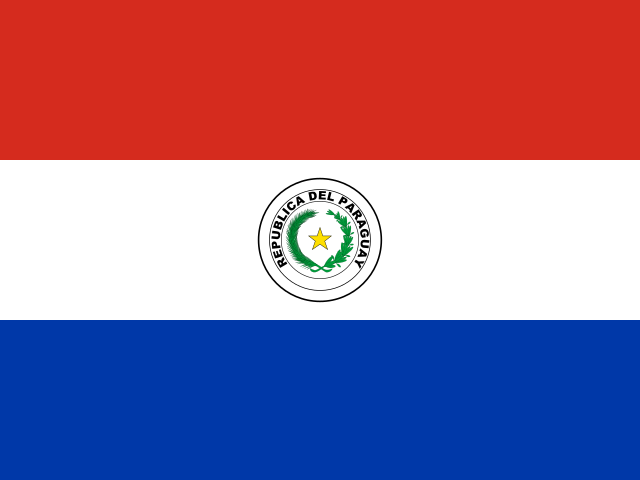
Asunción — Capital of Paraguay
Asunción was founded on 15 August 1537 by the Spanish expedition led by Juan de Salazar de Espinosa, built on the eastern bank of the Paraguay River at a site chosen for its defensible position and access to the river system connecting the interior to the distant Atlantic via Buenos Aires far downstream. The date, the feast of the Assumption of Mary, gave the settlement its name.
Because Asunción developed relatively quickly into a stable, well-provisioned outpost — helped by generally cooperative relations with the local Guaraní population, whose language and culture went on to shape Paraguayan identity more deeply than in most other Spanish colonies — Spanish expeditions launched from the city to found several other major South American settlements over the following decades, including the original 1536 Buenos Aires (later abandoned and only permanently refounded from Asunción in 1580) and Santa Cruz de la Sierra in present-day Bolivia. That role earned Asunción the traditional nickname 'Madre de Ciudades,' Mother of Cities.
Asunción served as the administrative center of the Spanish province of Paraguay throughout the colonial period and became the capital of the independent Republic of Paraguay after the country broke from Spanish colonial rule in 1811 with a notably bloodless transition compared to the drawn-out wars fought elsewhere on the continent — Paraguay's independence movement, led by figures including José Gaspar Rodríguez de Francia, deposed the local Spanish governor without the extended military campaigns Bolívar and San Martín waged further north and south.
The city and the wider nation suffered catastrophically during the War of the Triple Alliance (1864–1870), when Paraguay fought Argentina, Brazil, and Uruguay simultaneously; Asunción itself was occupied by Brazilian forces for years afterward as part of the postwar settlement, and the war's demographic toll on the country as a whole — a large majority of the population lost, by most historical estimates — left the capital and the nation impoverished for decades.
Modern Asunción retains a notable stock of early-20th-century architecture, including the Palacio de los López, the presidential palace begun under dictator Carlos Antonio López in the 1860s and completed only after his death, its construction repeatedly interrupted by the war that devastated the country during the same period.
The city sits on the Paraguay River directly across from Argentine territory, and its riverfront location has made it historically dependent on river trade even after Paraguay, a landlocked country, built out road and rail connections in the 20th century — the Paraguay and Paraná river system remains the country's principal route to Atlantic shipping via Argentina.
Asunción's cathedral, rebuilt several times since the colonial era after fires and structural problems, sits alongside the Casa de la Independencia, a preserved colonial house where the 1811 independence movement's leaders reportedly met to plan the overthrow of Spanish administration — one of the few buildings in the city documented to have survived largely intact from that founding period.
The metropolitan area has expanded well beyond Asunción's original colonial boundaries into a cluster of surrounding municipalities, including Lambaré, Fernando de la Mora, and San Lorenzo, whose combined population now makes up the bulk of Gran Asunción, even though the historic capital proper remains comparatively compact.
Quick facts
- Asunción's metropolitan population is roughly 3.3 million as of 2024 estimates, encompassing well over a third of Paraguay's total national population.
- Founded in 1537, Asunción predates the permanent founding of Buenos Aires by more than four decades, giving it standing as one of South America's earliest surviving Spanish colonial settlements.
- The Palacio de los López, Paraguay's presidential palace, sits directly on the Asunción waterfront and remains the seat of the country's executive branch today.
- Near Asunción's cathedral stands the Casa de la Independencia, the surviving colonial-era building where the 1811 uprising's leaders reportedly plotted the overthrow of Spanish rule.
- Paraguay is one of only two landlocked countries in South America (alongside Bolivia), and Asunción's river port remains the country's principal link to ocean shipping via the Paraná River system through Argentina.