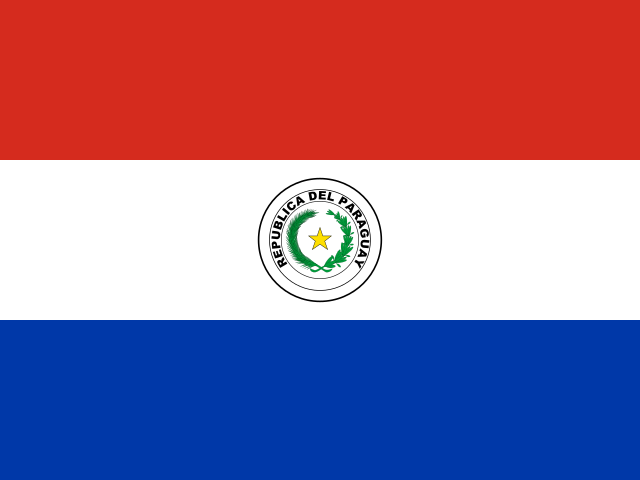
The Flag of Paraguay
South America · Adopted 25 November 1842 (present tricolor and dual-sided design)
Paraguay's flag holds a genuinely unique distinction among the roughly 200 national flags in use worldwide: it is the only one with a different design printed on each side. The front (obverse) carries the national coat of arms — a yellow five-pointed star ringed by a green wreath of palm and olive branches, with 'REPÚBLICA DEL PARAGUAY' lettered around the border. Flip the same flag over, and the reverse shows an entirely different emblem: the seal of the treasury, featuring a lion at the foot of a Phrygian-capped staff (a French Revolution-derived symbol of liberty) under the motto 'Paz y Justicia' — peace and justice. Anyone sewing an official Paraguayan flag has to embroider two separate designs onto the same cloth rather than one that simply shows through from behind.
The horizontal red-white-blue tricolor beneath those emblems dates to Paraguay's early independence period, adopted in something close to its current form in the early 1840s under the rule of Carlos Antonio López, who consolidated the young republic's institutions after Paraguay broke from Spanish colonial administration in 1811 without the same protracted military campaign fought elsewhere on the continent. The specific dual-emblem structure was formalized by an 1842 law, and later constitutions, including the current one from 1992, have preserved the arrangement rather than simplifying it to a single-sided design the way most nations eventually did.
Color meanings follow the pattern common across many Latin American flags shaped by the era's revolutionary vocabulary: red for the equality and courage of the Paraguayan people, white for peace, and blue for liberty. These readings are traditional rather than spelled out in the founding legal text itself, but they're the version taught in Paraguayan schools and repeated in most official government material.
Paraguay's flag survived the country's most catastrophic period essentially unchanged: the War of the Triple Alliance (1864–1870), fought against the combined forces of Argentina, Brazil, and Uruguay, killed a staggering share of Paraguay's population — modern demographic estimates, though disputed in their exact figures, generally agree the country lost well over half its pre-war population, with adult male losses even higher — and left the nation impoverished for generations. That the same dual-sided tricolor flew through the war, the subsequent Chaco War against Bolivia in the 1930s, and decades of 20th-century political instability without redesign reflects how firmly the symbol had been fixed by the 1840s, even as almost everything else about the country changed around it.
Because the treasury seal on the reverse is visually distinct enough from the obverse coat of arms, mistakes are common even within Paraguay — flags manufactured for casual retail or tourist use sometimes print the same emblem on both sides out of simple manufacturing shortcut, which is technically an incorrect rendering of the national flag even though it's a common one.
Stripped of its central emblems, Paraguay's plain red-white-blue horizontal tricolor is visually close to a handful of other flags built from the same three colors in the same order, most notably the Netherlands' — a coincidence of shared 19th-century revolutionary color vocabulary rather than any historical connection between the two countries.
Paraguay's flag flies most prominently around Independence Day, 15 May, and Flag Day itself, observed 14 May as part of the same independence commemorations, when schools nationwide hold ceremonies specifically focused on the flag's dual-emblem design.
Asunción is home to a dedicated Museo de la Bandera (Flag Museum), one of relatively few such institutions anywhere in the world, reflecting how central the dual-sided design has become to Paraguayan civic identity — a level of institutional attention that's unusual for a national symbol most other countries treat as settled and rarely revisit in dedicated exhibition space.
The five-pointed yellow star on the obverse coat of arms is specified by law to have precise proportions and placement within its surrounding wreath, a level of legal detail that traces to the same 1842 codification that fixed the dual-emblem structure, and later governments — including the 1992 constitution written after the fall of the Alfredo Stroessner dictatorship in 1989 — have reaffirmed rather than altered those specifications, treating the flag's exact geometry as settled national law regardless of who holds power.
Paraguay's very first independence-era flag, used briefly around 1811–1812 before the current tricolor was settled, is not well documented in surviving records, and historians generally treat the early 1840s as the point when the flag's design, rather than its underlying red-white-blue color scheme, was actually fixed — meaning the familiar dual-sided emblem structure is a slightly later addition to a color choice that had already been in informal use for roughly three decades.
Producing an official Paraguayan flag correctly is genuinely more labor-intensive than producing almost any other national flag: rather than a single printed or dyed pattern, a compliant flag requires the obverse coat of arms and reverse treasury seal to be embroidered, appliquéd, or separately printed and joined so that neither emblem shows through to the wrong side, a manufacturing requirement that adds cost and time most flag-makers elsewhere never have to account for, and one reason mass-produced novelty and tourist versions so often cut the corner of printing the same emblem on both sides.
The two faces carry different emblems
- True double-sided flag — This is the flag that genuinely differs front to back: one face carries the arms with lettering round the border and the other carries a different seal entirely, so a single- layer print can only ever be half of it.
- Detail-accurate printed flag — The star's size and its placement inside the surrounding wreath are set by law, which makes a wreath drawn too tight around the star a checkable fault rather than a matter of taste.
As an Amazon Associate we earn from qualifying purchases made through these links, at no extra cost to you.
Often confused with
- Netherlands — the plain red-white-blue horizontal bands, stripped of Paraguay's central emblems, are visually close to the Dutch flag's identical color order — coincidental, not historically connected. Compare side by side →
Paraguay at a glance
- Capital
- Asunción
- Population
- 6.9 million (2024)
- Currency
- Paraguayan Guaraní (PYG)
- Language(s)
- Spanish and Guaraní (both official — a majority of Paraguayans speak Guaraní, unusually high for an indigenous language's official status in the Americas)
Population figure as of 2024, source: UN World Population Prospects (2024 revision). See methodology for how facts are sourced and kept current.