Lisbon — Capital of Portugal
Lisbon is one of Europe's oldest cities, founded as a Phoenician trading port called Olisipo more than two and a half thousand years ago, later a Roman municipality, then held under Moorish rule from the 8th century until Afonso Henriques, Portugal's first king, captured it in 1147 during the Second Crusade with the help of northern European crusaders passing through by sea on their way to the Holy Land — a genuinely opportunistic alliance, since the crusaders had no original plan to stop in Portugal at all before local negotiators persuaded them to help take the city.
The city's defining catastrophe struck on the morning of 1 November 1755: an enormous earthquake, estimated at magnitude 8.5 to 9.0, devastated Lisbon within minutes, followed by a tsunami that swept through the low-lying riverside districts and fires that burned for days afterward, destroying much of the city and killing tens of thousands of people on a religious holiday when churches were full. It remains one of the deadliest earthquakes in recorded European history and struck at the height of Portugal's colonial and commercial power, a blow the country's global standing never fully recovered from.
The rebuilding that followed, directed by the Marquis of Pombal, King José I's powerful chief minister, became a landmark of early urban planning: the new downtown, the Baixa Pombalina, was laid out on a strict grid with uniform building heights, and its structures incorporated the 'Pombaline cage,' a wooden lattice frame embedded within the masonry designed specifically to flex and absorb seismic shock — widely regarded as one of the earliest examples of intentional earthquake-resistant building design anywhere in the world, tested, according to a probably apocryphal but often-repeated story, by having troops march in formation around a model to simulate tremors before construction began.
Lisbon had already been Portugal's capital for centuries before the earthquake, having overtaken Coimbra — Portugal's earlier medieval capital and the seat of the country's oldest university, founded in 1290 — sometime in the 13th century as royal administration gravitated toward Lisbon's port and its access to Atlantic trade routes. That maritime position later made Lisbon the launching point for the Age of Discovery voyages of the late 15th and 16th centuries, including Vasco da Gama's 1497–1499 expedition that opened a sea route to India.
Lisbon today houses the Portuguese parliament and the country's busiest port, and its downtown grid is still recognizably the Pombaline plan laid out after 1755 — a city whose current street pattern is, in a very literal sense, the direct product of the disaster that nearly destroyed it.
Two districts spared by the 1755 earthquake — the hillside Alfama, Lisbon's oldest surviving quarter, with its narrow Moorish-era lanes largely intact, and Belém, home to the Jerónimos Monastery built to commemorate Vasco da Gama's voyage — preserve a version of the city that predates the disaster, standing in direct visual contrast to the uniform Pombaline grid built to replace everything the earthquake, tsunami, and fires destroyed nearby.
Lisbon's yellow trams, particularly the historic Tram 28 route that winds through the Alfama, Graça, and Baixa districts, have become one of the city's most recognizable everyday symbols, running on narrow-gauge tracks laid out in the early 20th century specifically to navigate the city's steep, winding hillside streets that predate the Pombaline grid. Praça do Comércio, the grand riverside square built as part of Pombal's post-earthquake reconstruction, was deliberately oriented to face the Tagus River and served historically as Lisbon's ceremonial gateway for arrivals by sea, a role it held until the assassination of King Carlos I there in 1908 gave the square a second, darker layer of historical significance.
Fado, the melancholic traditional Portuguese musical genre built around themes of longing and fate, is generally traced to Lisbon's working-class Alfama and Mouraria neighborhoods in the early 19th century and was added to UNESCO's Intangible Cultural Heritage list in 2011, cementing its status as one of the clearest cultural through-lines connecting the modern capital to the older city that survived the 1755 disaster largely intact.
Quick facts
- Lisbon's metropolitan population is roughly 2.9 million, out of Portugal's total national population of around 10.5 million.
- The 1755 earthquake, tsunami, and fires killed an estimated tens of thousands of people and destroyed much of the city in a matter of hours.
- The Marquis of Pombal directed Lisbon's post-earthquake reconstruction, introducing the 'Pombaline cage,' an early earthquake-resistant timber-frame building technique.
- Coimbra, home to Portugal's oldest university (founded 1290), served as an earlier medieval capital before Lisbon's rise to prominence.
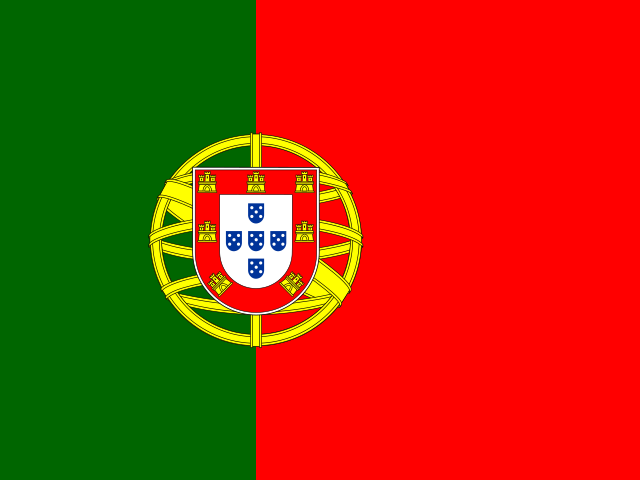
- Vasco da Gama's expedition departed from Lisbon in 1497 and reached India by sea in 1498, a voyage commemorated by the armillary sphere on Portugal's national flag.