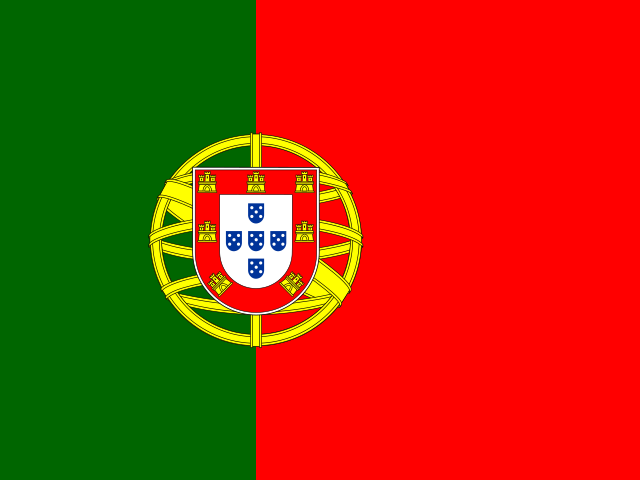
The Flag of Portugal
Europe · Adopted 30 June 1911
Portugal's current flag — green in the hoist two-fifths, red in the remaining fly, with the national coat of arms straddling the boundary between them — was adopted on 30 June 1911, less than a year after the 5 October 1910 revolution that overthrew the Portuguese monarchy and established the First Republic. It replaced a blue-and-white flag that had represented the House of Braganza monarchy for generations, and the switch to green and red was a deliberate political break, not a stylistic preference: green and red were the colors of the Portuguese Republican Party, the movement that had led the revolution, and putting party colors on the new national flag was a way of stamping the republic's own identity onto the state from the outset.
The meanings later attached to the colors reflect that origin. Green is generally read as hope, tied to the republic's founding optimism, while red is tied to the blood of those who died bringing the republic into being — the 1910 revolution, though brief, was not bloodless, with fighting in Lisbon's streets before the monarchy's collapse. These associations were assigned after the fact to colors chosen first for their party identity, a sequence worth noting because it runs the opposite direction from flags where symbolic colors came first and political parties adopted them later.
The coat of arms centered on the flag is far older and considerably more layered than the 1911 field around it. At its heart is the shield of Portugal, showing five smaller blue shields (the quinas) arranged in a cross, each bearing five white dots, or bezants — a design tradition traced to the 12th-century reign of Afonso Henriques, Portugal's first king, though the specific symbolism of the five shields is genuinely disputed: one tradition ties them to the five wounds of Christ, received (according to legend) by Afonso Henriques in a vision before a decisive battle against the Moors; another reads them as representing five Moorish kings defeated during the Reconquista. Neither account has definitive documentary support, and Portuguese sources themselves present both as traditional rather than settled fact.
Surrounding that central shield is a red border bearing seven gold castles, added to the arms progressively during the medieval period to represent Portuguese victories and territorial gains — most directly the conquest of the Algarve, the southernmost region of Portugal, from Muslim rule in the 13th century, an event closely associated with the castle symbolism. Behind the whole shield sits a golden armillary sphere, an astronomical navigation instrument that became strongly associated with the Age of Discovery and specifically with King Manuel I, under whose reign Vasco da Gama reached India by sea in 1498 — the armillary sphere is the one major element of the current flag with no medieval royal pedigree at all, added centuries later specifically to commemorate Portugal's maritime exploration.
Because the arms combine medieval Reconquista-era heraldry with a Renaissance-era navigation instrument on a field defined by an early-20th-century republican party's colors, Portugal's flag is unusually explicit about layering three genuinely different historical periods into one design, rather than presenting a single unified origin story the way some national flags do.
No redesign has occurred since 1911, through the end of the First Republic in 1926, the subsequent decades of the Estado Novo authoritarian regime under António de Oliveira Salazar, and the 1974 Carnation Revolution that restored democracy — a political history with at least as much upheaval as many countries that did redesign their flags during comparable periods, making Portugal's more than century-long flag continuity notable in its own right.
The flag flies at government buildings nationwide and is especially prominent on Portugal Day (Dia de Portugal) on 10 June, commemorating the death of the poet Luís de Camões in 1580 and celebrating Portuguese national identity more broadly, alongside Republic Day on 5 October, marking the 1910 revolution that led directly to the current flag the following year.
Several former Portuguese colonies inherited some visual DNA from the same coat-of-arms tradition on their own independence-era flags before ultimately breaking from it, a pattern that says something about how loaded the quinas-and-armillary-sphere imagery had become by the mid-20th century: both Angola and Mozambique, gaining independence in 1975 after long liberation wars against Portuguese colonial rule, deliberately avoided any reference to the Portuguese shield or sphere in their new flags, choosing instead symbols tied to their own liberation movements — a pointed rejection of the very emblem that Portugal's own 1911 republicans had chosen specifically to mark a break from monarchy, now itself being broken from in turn by former colonies marking a break from Portugal.
Brazil is the notable exception: its own flag, adopted at independence in 1822, kept its own version of the Portuguese royal armillary sphere at the design's center for decades under the Brazilian Empire, before the 1889 republican revolution there replaced it with the starfield-and-motto design still used today — meaning Brazil's break from the shared Portuguese heraldic tradition came considerably earlier than Angola's or Mozambique's, tied to its own republican transition rather than to the end of colonial rule.
Green at exactly two fifths
- Proportion-accurate flag — The arms straddle the line between the green and the red, so the green has to be exactly two fifths of the length or the emblem ends up sitting in one colour instead of across both.
As an Amazon Associate we earn from qualifying purchases made through these links, at no extra cost to you.
Portugal at a glance
- Capital
- Lisbon
- Population
- 10.5 million (2024)
- Currency
- Euro (EUR)
- Language(s)
- Portuguese (official)
Population figure as of 2024, source: UN World Population Prospects (2024 revision). See methodology for how facts are sourced and kept current.