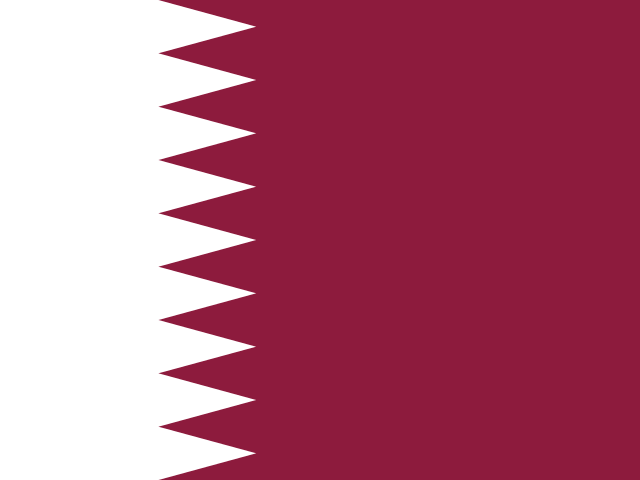
Doha — Capital of Qatar
Doha started out as a modest fishing and pearling settlement on Qatar's eastern coast, generally dated to around the early 1820s and originally referred to as Al Bidda before the wider settlement came to be known by its current name. Like much of the pre-oil Gulf, its economy for over a century rested almost entirely on pearl diving and small-scale maritime trade.
The town's rise to political prominence tracks the rise of the Al Thani family, who established themselves as the leading local power in the mid-19th century and made Doha their base; Sheikh Jassim bin Mohammed Al Thani, whose 1878 accession is now marked as Qatar's National Day, consolidated the family's authority from Doha and is regarded as the founder of the modern Qatari state.
The pearling economy that had sustained Doha for generations collapsed rapidly in the 1920s and 1930s after Japan developed cultured pearl farming, undercutting the natural pearl trade Gulf states like Qatar had relied on; the discovery of oil in the late 1930s, though development was delayed by the Second World War until commercial extraction began in the 1940s, arrived just as Doha's traditional economy badly needed a replacement.
The far larger transformation came later: the 1971 discovery of the offshore North Field, the world's largest known natural gas field, shared with Iran's neighboring South Pars field, turned Qatar from a modest oil producer into, by some per-capita measures, one of the wealthiest nations on Earth once large-scale liquefied natural gas exports ramped up from the 1990s onward — wealth that rebuilt Doha almost entirely within two generations.
That rebuilding produced a skyline of large-scale architectural statements largely absent from the city a few decades earlier, including the Museum of Islamic Art (2008, designed by I. M. Pei), the Msheireb Downtown Doha redevelopment of the historic city center, and the stadiums built for the 2022 FIFA World Cup, which Doha hosted as the first Middle Eastern country to stage the tournament.
Souq Waqif, Doha's historic marketplace, was extensively restored in the 2000s after decades of informal redevelopment had eroded much of its traditional character, using original building techniques and materials to recreate the look of the market as it would have appeared in the pearling era — a deliberate act of heritage reconstruction rather than pure preservation, since much of what stands today was rebuilt rather than simply repaired.
Education City, a large campus on Doha's outskirts developed by the Qatar Foundation from the late 1990s onward, hosts branch campuses of several major international universities, part of a broader state strategy to position Doha as a regional hub for higher education and research alongside its established role in energy, aviation, and global sports hosting.
Doha is also home to Al Jazeera, the pan-Arab satellite news network launched by the Qatari government in 1996, whose headquarters in the capital gave Qatar an outsized voice in regional and global media well beyond what its small population would otherwise suggest, and whose coverage of events like the Arab Spring uprisings of 2011 significantly raised Doha's international profile as a media hub.
Ahead of the 2022 World Cup, Doha built an entirely new metro system, expanded its airport, and constructed or renovated eight stadiums across the city and its surroundings, several of which — including the 974 Stadium, built from shipping containers and designed for full disassembly after the tournament — were explicitly designed with a post-tournament second life in mind rather than as permanent structures.
The Corniche, Doha's curving waterfront promenade tracing the edge of the bay, offers views across to the city's dense cluster of modern towers and has become the capital's most used public recreational space, its gradual expansion tracking the same decades of land reclamation and rapid development that reshaped virtually every other part of the city.
Quick facts
- Doha's population has swelled to roughly 2.4 million across the metropolitan area by 2024 estimates, up from well under 100,000 residents in the years before oil revenue began arriving in the 1950s.
- The National Museum of Qatar, opened in 2019 and designed by French architect Jean Nouvel, takes the form of interlocking discs modeled on the desert rose mineral formations found in Qatar's sand.
- Education City's campuses include branches of Georgetown, Northwestern, Cornell, and Carnegie Mellon among other foreign universities operating in Doha under agreements with the Qatar Foundation.
- Doha's Corniche stretches roughly 7 kilometers along the bay, built up in stages through decades of land reclamation that also created much of the ground beneath the city's downtown towers.
- The 974 Stadium, built for the 2022 World Cup entirely from shipping containers and modular steel, was engineered to be fully dismantled after the tournament rather than remain as a permanent structure.