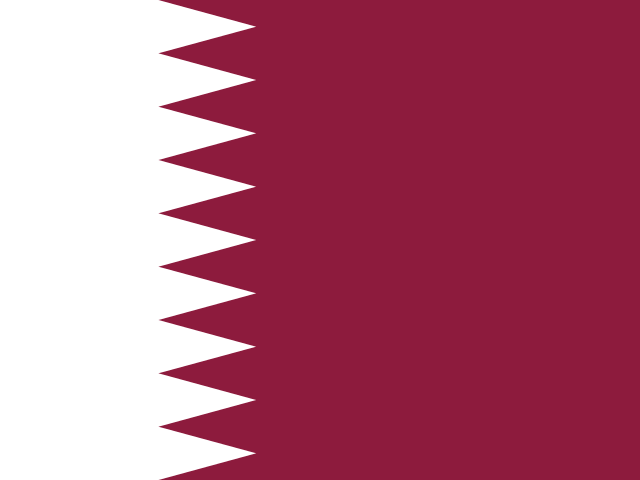
The Flag of Qatar
Asia · Adopted 9 July 1932
Qatar formally adopted its current flag on 9 July 1932, though the essential elements — a maroon field with a serrated white band along the hoist — had already been taking shape for decades before that date, growing out of the same regional tradition of plain red flags that historically marked Gulf Arab territories and their ships.
That color is the flag's most distinctive feature, and its origin is one of the more unusual stories among national flags: the deep maroon Qatar now uses officially began as an accident of chemistry rather than a deliberate design choice. Gulf states in the 19th and early 20th centuries commonly dyed their flags using a plant-derived red pigment; under the region's intense sun and after years of exposure at sea and on flagpoles, that dye faded and oxidized toward a darker, brownish-red maroon rather than staying a bright true red. Rather than fight the fade, Qatar eventually formalized the weathered maroon shade as the flag's official color.
The serrated edge — nine white triangular points cutting into the maroon field along the hoist border — sets Qatar's flag apart from its nearest visual relative, Bahrain's, which uses the same basic layout of a white band and colored field but with only five points and a true red rather than maroon field. The two countries' flags are close enough in structure that they are frequently mixed up by non-specialists, even though the color and point-count differences are fixed and specific to each state.
Accounts of why Qatar settled on nine points specifically vary. One commonly cited explanation ties the number to Qatar's position as what would become the ninth member reconciled among the Gulf's 'trucial' emirates under 19th-century British-brokered maritime agreements, though this explanation is disputed by some historians as an after-the-fact rationalization rather than a documented original intent; other accounts simply treat the nine-point serration as a practical design choice made to visually distinguish Qatar's flag from Bahrain's once the two, historically linked under shared Al Khalifa influence before Qatar's own ruling Al Thani family consolidated control, needed clearly separate national symbols.
White in Qatari flag symbolism represents peace, a meaning consistent with the color's use across many regional flags, while the maroon field is generally understood today simply as Qatar's distinctive national color rather than carrying a specific separate symbolic meaning beyond marking the country's identity — a contrast with flags whose colors are tied to more explicit political or religious narratives.
Qatar's flag has an unusually elongated shape compared to most national flags, with an official length-to-width ratio of 28:11 — nearly two and a half times as long as it is tall — making it one of the most visually distinctive flags in the world by proportion alone, independent of its color or serration.
The flag has remained unchanged through Qatar's transformation from a modest pearling and fishing economy in the early 20th century into one of the wealthiest nations per capita in the world following the development of its oil reserves from the 1940s and, more significantly, its offshore North Field natural gas reserves — the largest single gas field on Earth — discovered in 1971 and developed from the 1990s onward.
Qatar celebrates its National Day on 18 December, commemorating the 1878 accession of Sheikh Jassim bin Mohammed Al Thani, considered the founder of modern Qatar, rather than any date tied to the flag's own adoption — a reminder that the flag and the national founding narrative it represents trace back to somewhat different historical moments.
Qatar and Bahrain share more than a similar flag layout: both were historically linked under the influence of the Al Khalifa family, which ruled parts of the Qatari peninsula before the Al Thani family established separate, independent leadership over Qatar during the 19th century, a split later formalized through 19th-century British-brokered treaties that recognized Qatar and Bahrain as distinct protected states — the diverging flags followed the same political divergence.
The flag's outsized visibility rose sharply during the 2017–2021 diplomatic blockade, when Saudi Arabia, the UAE, Bahrain, and Egypt cut ties with Qatar and closed their borders and airspace to it; within Qatar, the maroon-and-white flag became a widely displayed symbol of national unity and defiance during the standoff, appearing on building facades, vehicles, and clothing at a scale unusual even for a country that already treats its flag with considerable formality.
Qatar also observes a dedicated Flag Day on 9 September, distinct from National Day in December, established specifically to mark the anniversary of the flag's own adoption — a rarer practice than a general national day, since relatively few countries formally set aside a separate annual holiday for the flag alone rather than folding flag ceremonies into a broader independence or founding-day celebration.
The most elongated flag there is
- Flag cut to 28:11 — At 28:11 this is far longer for its height than any stock size, so a flag sold in a standard cut is not this flag: the nine serrations are spread across a much shorter field.
- Colourfast maroon flag — The page explains the maroon came about because the original dye oxidised in sun and salt air, which is exactly what still happens to a poorly dyed reproduction until it no longer matches the specified colour at all.
As an Amazon Associate we earn from qualifying purchases made through these links, at no extra cost to you.
Often confused with
- Bahrain — shares the same basic white-band-plus-serrated-edge layout, but Bahrain's field is a true red rather than maroon and its serration has five points instead of Qatar's nine — the two flags historically diverged from a shared regional design once the countries needed distinct national symbols. Compare side by side →
Qatar at a glance
- Capital
- Doha
- Population
- 3.0 million (2024)
- Currency
- Qatari Riyal (QAR)
- Language(s)
- Arabic (official); English widely used in business
Population figure as of 2024, source: UN World Population Prospects (2024 revision). See methodology for how facts are sourced and kept current.