Moscow — Capital of Russia
Moscow's first documented mention comes from a 1147 chronicle entry recording a meeting there between two rival princes, making that year the traditional founding date still celebrated as the city's anniversary, even though archaeological evidence suggests some settlement on the site predates the written record. It grew over the following centuries as the seat of the Grand Duchy of Moscow, which gradually absorbed rival Russian principalities and, after throwing off Mongol Tatar overlordship in stages through the 15th century, emerged as the dominant power among the Rus' principalities.
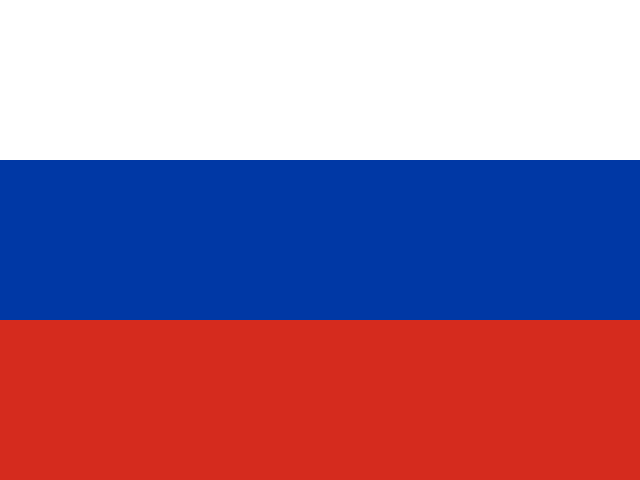
Moscow lost its status as Russia's capital for just over two centuries starting in 1712, when Peter the Great — the same tsar who modeled the Russian flag on the Dutch tricolor he studied abroad — moved the seat of government to St. Petersburg, a new city he had built essentially from marshland on the Baltic coast specifically to give Russia a modern, Western-facing capital with direct sea access to Europe. Moscow remained hugely important culturally and as the traditional site of imperial coronations even while St. Petersburg governed, but it was not the political capital for that entire period.
The capital returned to Moscow in March 1918, under the new Bolshevik government led by Vladimir Lenin, a decision driven substantially by wartime security: with German forces advancing toward Petrograd (as St. Petersburg had been renamed in 1914) during the final stages of the First World War, the more centrally located and better-defended Moscow offered a safer seat for a fragile new government fighting for its survival in the opening stages of the Russian Civil War.
The Kremlin — a fortified complex whose walls in their current form date mainly to the 15th century, though the site had been fortified in some form since Moscow's earliest years — has remained the seat of Russian state power through the Tsarist, Soviet, and post-Soviet periods with only that one 206-year interruption during the St. Petersburg era, making it one of the longest continuously used seats of government anywhere in the world when its two separate spans are combined.
Today Moscow is Russia's political, economic, and cultural capital by a wide margin, home to the Russian government, the country's largest stock exchange, and a metro system, opened in 1935, whose ornately decorated stations remain a distinctive symbol of Soviet-era civic architecture and are themselves treated as heritage sites by many visitors and residents alike.
Moscow suffered its own near-catastrophe during the Second World War when German forces advanced to within roughly 30 kilometers of the city center in late 1941 before a fierce Soviet counteroffensive, aided by the onset of a brutally harsh winter, pushed them back — the closest any Axis army came to capturing the Soviet capital during the entire war, and a defense still commemorated annually as one of the pivotal turning points of the Eastern Front.
Red Square, immediately outside the Kremlin walls, takes its name not from any association with communism or the later Soviet red flag but from an older Russian word, krasnaya, which historically meant 'beautiful' before the modern meaning of 'red' became dominant — meaning the square's name predates the 20th-century political symbolism it is now most often assumed to reference by several centuries.
Quick facts
- Moscow's metropolitan population is roughly 13 million within city limits, with a wider metropolitan region well above 20 million, making it by far Russia's largest city.
- Moscow's name is thought to come from the Moskva River, itself possibly from a Finno-Ugric or Baltic-language root meaning something like 'dark' or 'turbid' water, though linguists still dispute the exact origin.
- Even while St. Petersburg governed the empire, Russian tsars continued to be crowned inside the Kremlin's cathedrals, a coronation tradition that ran unbroken until the monarchy ended in 1917.
- Lenin and the Bolshevik government arrived in Moscow by train in March 1918 and initially worked out of rooms inside the Kremlin's former Senate building, which still serves as a presidential office today.
- The Moscow Metro carries an estimated seven million-plus passengers on an average weekday, ridership levels that rank among the highest of any urban rail system in the world.