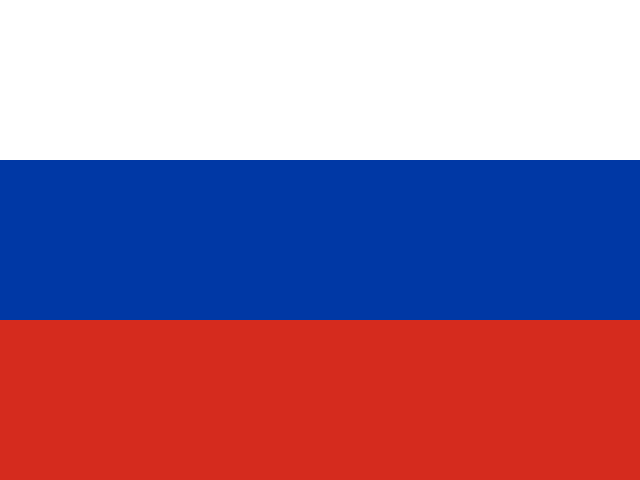
The Flag of Russia
Europe · Adopted 22 August 1991 (reconfirmed by law, 2000)
Russia's white-blue-red horizontal tricolor was restored as the national flag on 22 August 1991, in the immediate aftermath of the failed hardline coup against Mikhail Gorbachev — the coup collapsed within three days, and the tricolor, already flown by protesters defending the Russian parliament building during the standoff, was formally adopted days later as the flag was raised over the Kremlin in place of the Soviet hammer-and-sickle banner, months before the USSR's formal dissolution that December. The choice was not a new invention; it revived a flag design roughly three centuries old that had been suppressed for the entirety of the Soviet period.
That older design traces directly to Peter the Great, who studied shipbuilding in the Dutch Republic in the late 17th century as part of his broader project to modernize Russia along Western European lines. Impressed by the Dutch merchant and naval ensign — the red-white-blue tricolor the Netherlands had itself only recently standardized — Peter adapted it for Russia's own fledgling navy, rearranging the stripe order into white-blue-red, first documented in the late 1690s and formally established as Russia's merchant flag by decree in 1705. The direct, acknowledged Dutch influence makes Russia's tricolor one of the clearer cases of one country's flag genuinely descending from another's, rather than an independently invented coincidence of shared colors.
The tricolor did not have an uncontested run as Russia's national symbol even before the Soviet era interrupted it. Through the 19th century it competed with a separate black-yellow-white flag associated with the Romanov imperial house and used more for dynastic and state occasions, particularly under Tsar Alexander II; the white-blue-red tricolor was more closely tied to commerce and the navy. It was not formally confirmed as Russia's national flag for all purposes until 1896, under Nicholas II, resolving decades of dual usage in favor of the older Petrine design.
The Bolshevik Revolution of October 1917 ended the tricolor's official use almost entirely. The Soviet Union adopted a plain red flag bearing a gold hammer and sickle beneath a red star in 1922, and flying the old imperial-era tricolor became politically dangerous, associated with the White movement that had fought and lost against the Bolsheviks in the Russian Civil War — for most of the 20th century, the white-blue-red flag survived mainly among anti-Soviet émigré communities abroad rather than inside Russia itself.
Its reappearance in 1991 was therefore a genuinely loaded symbolic choice: reviving a flag associated with the losing side of the civil war, seven decades later, to replace the flag of the government that had won it, at the exact moment that government was collapsing. The flag's return to official Kremlin use, replacing the Soviet flag on 25 December 1991, the day Gorbachev resigned and the USSR ceased to exist, is one of the more precisely dated flag transitions of any modern state.
The exact legal specifications of the flag — its 2:3 proportions and the precise shades of white, blue, and red — were reconfirmed by a constitutional law passed in December 2000 under President Vladimir Putin, part of a broader package that also restored the Soviet-era national anthem's melody with new lyrics, a combination that drew criticism at the time for mixing symbols from openly contradictory periods of Russian history within a few months of each other.
Because Russia's tricolor directly inspired several Pan-Slavic flags in the 19th century — Slavic nationalist movements across the Balkans and Central Europe adopted variations of white, blue, and red in solidarity with Russia as the largest independent Slavic state — a family resemblance runs through flags including Serbia's and Slovakia's, though each rearranges the stripe order and none is a direct copy of Russia's specific sequence.
The Russian Navy flies a different flag entirely from the civil tricolor: the Andreevsky flag, a white field crossed diagonally by a blue saltire representing Saint Andrew, the apostle traditionally regarded as the patron of Russian sailors. Peter the Great introduced this naval ensign alongside the merchant tricolor around the same period in the late 17th and early 18th centuries, and it was restored to active naval use in 1992, shortly after the tricolor itself returned as the state flag, having been replaced during the Soviet era by a naval ensign bearing the hammer and sickle.
Russia's vast size means the tricolor is flown across eleven time zones and a huge range of climates and cultures, from Kaliningrad on the Baltic coast to the Bering Strait facing Alaska, a geographic span that makes it one of relatively few national flags flown as the sole official state symbol over territory spanning more than half the globe's longitudinal width.
Russia's constituent republics, including Tatarstan and Chechnya, are permitted under the constitution to fly their own regional flags alongside the national tricolor, a formal accommodation of the country's ethnic and religious diversity that dates to the early 1990s constitutional settlement negotiated as the Russian Federation was establishing its post-Soviet structure of semi-autonomous republics within a single federal state.
A 2:3 cut in even thirds
- Stitched 2:3 flag — Three equal horizontal bands at 2:3 is the whole specification, and on a flag with no emblem the only fault available to a maker is bands that are not equal thirds.
As an Amazon Associate we earn from qualifying purchases made through these links, at no extra cost to you.
Often confused with
- Netherlands — the direct historical source of Russia's tricolor — Peter the Great modeled Russia's flag on the Dutch ensign he studied in the 1690s — with the stripe order rearranged from the Dutch red-white-blue to Russia's white-blue-red. Compare side by side →
- Slovakia — shares the same three Pan-Slavic colors, adopted independently in the 19th century partly in solidarity with Russia as the largest Slavic state, though Slovakia's flag adds a coat of arms and a different stripe arrangement. Compare side by side →
Russia at a glance
- Capital
- Moscow
- Population
- 143.8 million (2024)
- Currency
- Russian Ruble (RUB)
- Language(s)
- Russian (official)
Population figure as of 2024, source: UN World Population Prospects (2024 revision). See methodology for how facts are sourced and kept current.