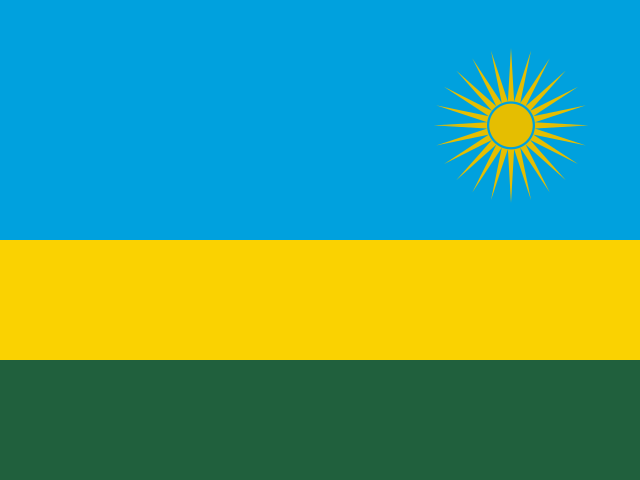
Kigali — Capital of Rwanda
Kigali began as a small administrative post founded in 1907 by German colonial authorities, who had established a protectorate over the kingdom of Rwanda a few years earlier; the site, chosen for its central position within the kingdom's territory and its hilltop setting, remained a fairly minor outpost through the German period, which ended when Belgian forces occupied the territory during the First World War.
Belgium administered Rwanda under a League of Nations mandate and, later, a United Nations trusteeship from 1922 until independence in 1962, running much of the colony's administration through the older, more established centers, particularly Butare (then called Astrida) in the south, which developed into the territory's intellectual and educational hub, home to a major seminary and later a university campus. When independence approached, however, Rwandan authorities chose Kigali over Butare as the new nation's capital, favoring its more central location within the country over Butare's stronger existing colonial-era infrastructure.
Kigali's most defining modern association is with the 1994 genocide against the Tutsi, during which the city was both the site of some of the earliest and most concentrated killing and, later that year, the location where the Rwandan Patriotic Front's advance effectively ended the genocide in July 1994. The Kigali Genocide Memorial at Gisozi, opened in 2004, holds the remains of more than 250,000 victims and serves as the central site of national remembrance during the annual Kwibuka commemoration period each April.
In the decades since 1994, Kigali has undergone a deliberate and widely noted transformation, becoming known internationally for its cleanliness and orderliness — plastic bags have been banned since 2008, and the city holds a mandatory monthly community clean-up morning called Umuganda, on the last Saturday of each month, during which most residents, including government officials, take part in public sanitation and small infrastructure work, a practice with roots in pre-colonial communal labor traditions that the post-genocide government revived and formalized.
Built across Rwanda's characteristic hilly terrain — the country's nickname, 'land of a thousand hills,' applies especially visibly to Kigali itself, whose neighborhoods are spread across a series of ridges and valleys — the city has seen substantial new construction since the 2000s, including the Kigali Convention Centre, opened in 2016 with its distinctive dome shape inspired by traditional Rwandan basket-weaving patterns, part of a broader push to position Kigali as a regional hub for conferences and business tourism.
Kigali has also become a base for Rwanda's growing role as a host for major international meetings and sporting events, including Commonwealth Heads of Government Meeting in 2022 and several rounds of top-tier professional cycling racing, part of a deliberate government strategy to position the city — and by extension the country — as a stable, business-friendly hub in a region whose other capitals have often struggled with instability.
Kigali's public transport and road-safety record, including a longstanding and strictly enforced motorcycle-taxi helmet law, is regularly cited by regional urban-planning commentators as unusually well organized compared with other East African capitals of similar size, part of a broader municipal governance reputation the city has built deliberately since the early 2000s.
Quick facts
- Kigali's population runs to roughly 1.3 million per 2024 estimates — Rwanda's largest city by a wide margin, in a country that is otherwise one of the most densely populated in Africa.
- Kigali was chosen as capital at independence in 1962 over Butare, the larger colonial-era educational and administrative center in the south.
- The International Criminal Tribunal for Rwanda, though seated in Arusha, Tanzania rather than Kigali, worked alongside the Gacaca community-court system that heard the great majority of genocide-related cases within Rwanda itself, including many in and around the capital.
- Plastic bags have been banned in Rwanda since 2008, a policy closely associated with Kigali's reputation as one of Africa's cleanest capital cities.
- The former Presidential Palace in Kigali, now a museum, displays wreckage of the jet carrying President Juvénal Habyarimana that was shot down over the city on 6 April 1994, the event that triggered the genocide.