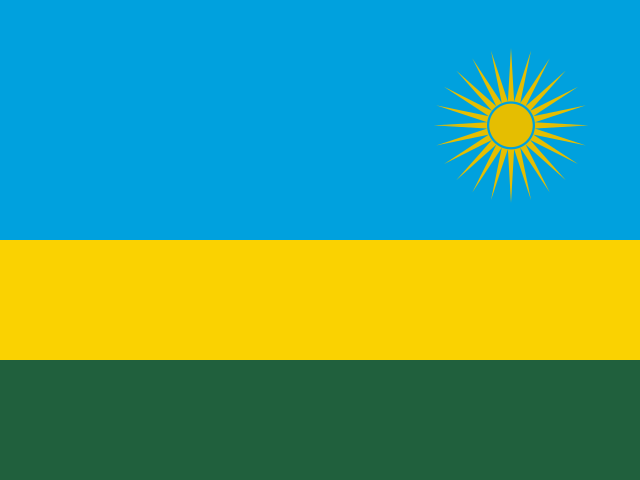
The Flag of Rwanda
Africa · Adopted 25 October 2001
Rwanda's current flag is a relatively recent creation, adopted on 25 October 2001, and it replaced a design that had flown since Rwanda's 1962 independence — vertical (later horizontal) bands of red, yellow, and green with a large black 'R' in the center, associated with the government of President Juvénal Habyarimana, who ruled from 1973 until his death in April 1994 sparked the Rwandan genocide, in which an estimated 800,000 people, mostly Tutsi and moderate Hutu, were killed over roughly 100 days.
The post-genocide government, formed after the Rwandan Patriotic Front ended the killing in July 1994, made a deliberate decision in the years that followed to redesign the country's core national symbols — the flag, the national anthem, and the coat of arms — as part of a broader program of reconciliation and nation-rebuilding, on the reasoning that the old flag, anthem, and other symbols were too closely tied to the Habyarimana-era state and to the period leading into the genocide to remain viable unifying emblems for the country going forward.
The new flag replaced the old red-yellow-green tricolor and its black 'R' with three horizontal bands: a wide band of blue at the top, a narrower band of yellow beneath it, and a band of green at the bottom, with a golden sun bearing twenty-four rays placed in the upper fly corner against the blue field. None of the original three Habyarimana-era colors, red, yellow, and green, was carried over wholesale — red in particular was dropped entirely, a choice widely understood as avoiding any visual association with the bloodshed of 1994, even though the government has not always framed the change in those explicit terms in official messaging.
The new colors carry meanings tied to the country's post-genocide priorities: blue represents happiness and peace, yellow represents economic development and the country's mineral and agricultural wealth, and green represents hope and prosperity drawn from Rwanda's agricultural base. The sun, placed prominently in the blue field, is described in official symbolism as representing enlightenment and unity, and its rays are sometimes read as a reference to transparency, one of the stated governing values of the post-1994 Rwandan state.
Because the redesign happened alongside a broader set of institutional changes — a new constitution in 2003, a new national anthem ('Rwanda Nziza,' replacing the Habyarimana-era 'Rwanda Rwacu'), and a new coat of arms also adopted in 2001 — the flag change is best understood as one piece of a coordinated symbolic break with the pre-genocide state rather than an isolated design update, and Rwandan government materials consistently present all three changes together as part of the same reconciliation-era package.
The flag is flown prominently on Liberation Day, 4 July, marking the day the Rwandan Patriotic Front declared the genocide over in 1994, and on Independence Day, 1 July, and it appears throughout the annual Kwibuka commemoration period each April, when Rwanda formally remembers the genocide — occasions where the flag's break from the pre-1994 symbol it replaced is often explicitly noted in official remarks.
Rwanda's twenty-four-ray sun is visually distinct from other African flags that also use a sun emblem, such as Namibia's twelve-ray design or Malawi's rising half-sun, and Rwandan government explanations have specifically emphasized the higher ray count as symbolizing broad-based unity rather than any particular numerical significance tied to regions, provinces, or historical dates.
The old Habyarimana-era flag is now rarely displayed publicly inside Rwanda; its association with the one-party MRND state and the period immediately preceding the genocide has made it, unlike some other superseded national flags elsewhere in Africa, a symbol that is deliberately not preserved in everyday civic use, appearing mainly in historical museum displays such as the Kigali Genocide Memorial's exhibits on the pre-1994 state.
Rwanda's post-1994 government has also gone further than most post-conflict states in restricting genocide-linked speech and symbolism by law: the country's 2008 and subsequent genocide-ideology laws criminalize public glorification of the 1994 genocide, and while these laws are aimed primarily at speech rather than flags specifically, they form part of the same broader legal and symbolic framework that made replacing the old red-yellow-green flag politically necessary in the first place rather than merely a matter of aesthetic preference.
Rwanda's economy and international profile have both changed substantially since the flag's 2001 adoption, with the country pursuing an ambitious 'Vision 2020' and later 'Vision 2050' development strategy explicitly tied to the flag's yellow band symbolism of economic development — government messaging around major infrastructure and technology initiatives since the 2010s has repeatedly invoked that specific flag symbolism as a stated national goal rather than treating it as empty design language.
Rwanda's national football and basketball teams, along with the country's growing profile as a host of continental sporting events including the Basketball Africa League finals, regularly display the blue-yellow-green flag internationally, part of a broader, deliberate government strategy of using sport and international hosting as a form of national rebranding distinct from the country's pre-1994 international image. Rwanda's sponsorship deals with major European football clubs since 2018, promoting tourism under the 'Visit Rwanda' campaign, have likewise placed the flag's colors in front of large international sporting audiences well beyond the country's own borders.
Twenty-four rays in the corner sun
- Double-sided flag — The sun sits in the upper fly rather than the centre, so on a single-layer flag it appears in the upper hoist from behind. Two layers keep it in the corner the page describes from either side.
As an Amazon Associate we earn from qualifying purchases made through these links, at no extra cost to you.
Often confused with
- Gabon — shares the exact same green-yellow-blue palette, but Gabon's bands are arranged in a different order (green-yellow-blue rather than blue-yellow-green) and Gabon's flag carries no sun emblem, which keeps the two flags from being genuinely difficult to tell apart in practice. Compare side by side →
Rwanda at a glance
- Capital
- Kigali
- Population
- 14.3 million (2024)
- Currency
- Rwandan Franc (RWF)
- Language(s)
- Kinyarwanda, English, French, and Swahili (all official)
Population figure as of 2024, source: UN World Population Prospects (2024 revision). See methodology for how facts are sourced and kept current.