Basseterre — Capital of Saint Kitts and Nevis
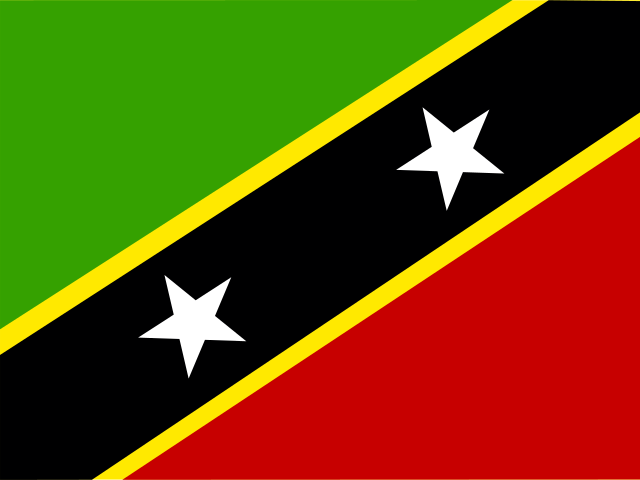
See the flag of Saint Kitts and Nevis →
Basseterre was founded in 1627 by French colonists under Pierre Belain d'Esnambuc, who had arrived on Saint Kitts the previous year and established one of the earliest permanent French and English settlements in the Caribbean — the island became, unusually, jointly colonized by both France and England for much of the 17th century before passing fully to British control by the Treaty of Utrecht in 1713. Basseterre's name is French for "low land," describing the flat coastal terrain of the site chosen for the settlement, distinct from the island's mountainous interior.
The town grew as a center of the sugar plantation economy that dominated Saint Kitts from the 17th through the 19th centuries, an economy built on the forced labor of enslaved Africans transported to the island under both French and British colonial administrations; the demographic and cultural legacy of that history is central to the island's present-day population and to the flag's own black diagonal band, which specifically references this heritage.
Basseterre has been struck by disaster more than once, including a major fire in 1867 that destroyed much of the town's colonial-era architecture, after which the town was substantially rebuilt — meaning much of what appears historic in central Basseterre today actually dates to late-19th-century reconstruction rather than surviving directly from the 17th or 18th centuries.
As the administrative center first of the British colony and later of the independent federation, Basseterre has functioned as the seat of government continuously since the colonial period, and it remains the only true urban center on Saint Kitts, with the much smaller island of Nevis — which shares statehood but retains its own island administration and legislature — governed locally from its own capital, Charlestown, a genuinely two-tiered arrangement unusual for a country this small.
The city's Independence Square, originally laid out in the 18th century as a slave market before its later renaming and repurposing as a public park, is one of the more historically weighted public spaces in the Eastern Caribbean, its name change reflecting the same historical arc — from a colonial slave economy to independent nationhood in 1983 — that the flag's own black band and red field are meant to commemorate.
Basseterre also carries a documented link to early transatlantic colonization more broadly: Saint Kitts's status as one of the first English footholds in the Caribbean under Thomas Warner in 1624 meant Basseterre's harbor served for decades afterward as a staging point from which subsequent English colonizing expeditions departed for other islands, a role local historians point to when explaining why the island earned its old nickname as the "mother colony" of the English Caribbean despite its small size.
Basseterre's status as a joint French-English settlement for much of the 17th century was formalized under an unusual shared-sovereignty arrangement that divided the island itself between the two powers rather than one simply dominating the other outright, an arrangement that lasted for decades of uneasy coexistence and periodic conflict before France finally ceded its portion of Saint Kitts to Britain under the 1713 Treaty of Utrecht, ending the dual-colonial period entirely.
Quick facts
- Only about 14,000 people live within Basseterre's city limits, a small figure even by Caribbean-capital standards, yet it remains the largest town anywhere in the federation.
- The town was founded in 1627 by French settler Pierre Belain d'Esnambuc, making it one of the earliest permanent European settlements in the Eastern Caribbean.
- Basseterre was substantially rebuilt after a major fire in 1867 destroyed much of its earlier colonial-era architecture.
- Saint Kitts and Nevis is governed as a federation, and while Basseterre is the national capital, Nevis retains its own local government seated in the separate town of Charlestown.
- Independence Square in central Basseterre began as an 18th-century slave market before being repurposed as a public park, and was renamed to mark the country's 1983 independence.