The Flag of Saint Kitts and Nevis
North America · Adopted 19 September 1983
Saint Kitts and Nevis adopted its flag on 19 September 1983, the day the two-island federation became independent from Britain, the last of Britain's Caribbean colonies to gain independence and, to this day, the smallest sovereign state in the Americas by both area and population. The design was selected through a national competition, a common approach among Caribbean nations designing their first independent flags in this era, and it replaced the earlier British colonial ensign, which had carried a Union Jack canton over the territory's colonial badge.
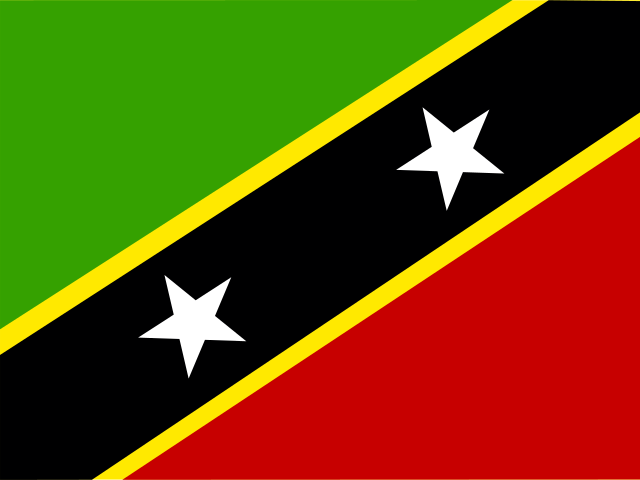
The flag is built from a diagonal band running from the lower hoist to the upper fly, colored yellow-bordered green on one side and yellow-bordered black on the other, with two white five-pointed stars set on the black diagonal band, over a field split diagonally into a green upper-hoist triangle and a red lower-fly triangle. Green represents the islands' fertile land and vegetation; the black diagonal band represents the African heritage of the majority of the population, descended from enslaved people brought to work the islands' sugar plantations under British and earlier French colonial rule; red stands for the historical struggle against slavery and colonialism; and the yellow borders represent the year-round sunshine the islands receive.
The two white stars carry a dual meaning specific to the federation's political structure: they represent the two islands, Saint Kitts and Nevis, joined together in a single state, and are also read as symbols of hope and liberty for the nation's future — a design choice that visually encodes the federation's core political fact, that this is one country made of two islands with a degree of internal self-government reserved to each, directly into the flag itself.
That two-island structure has not been free of tension: Nevis has held referendums on seceding from the federation, most notably in 1998, when a secession vote fell short of the two-thirds majority required to pass but still reflected genuine and sustained separatist sentiment on the smaller island, a political reality that gives the flag's two-star symbol of unity a more contested real-world backdrop than the design's official explanation alone conveys.
The flag has not been redesigned since independence in 1983, and its diagonal band structure — dividing the field along a hoist-to-fly diagonal rather than horizontal or vertical stripes — is a design approach shared with several other Caribbean and African nations of the same independence-flag-design era, though the specific color combination and star placement are unique to Saint Kitts and Nevis.
Because the flag was designed relatively recently, in the early 1980s, and specifically to represent a two-island federation rather than a single traditional territory, it lacks the kind of centuries-deep symbolic layering some older national flags carry; its meanings are instead documented relatively precisely in the government's own independence-era design explanation, leaving less of the historical ambiguity found in flags whose origin stories predate reliable written records.
Saint Kitts, the larger and more populous of the two islands, was among the earliest English and French colonies in the Caribbean, settled by English colonist Thomas Warner in 1624 and quickly nicknamed "the mother colony of the West Indies" because subsequent English settlements on other Caribbean islands were frequently launched from bases established there — a founding-colony status that gives Saint Kitts a disproportionately large historical footprint relative to its small modern size, a history the flag's black band and its African-heritage symbolism sits directly on top of.
Nevis, separated from Saint Kitts by a narrow channel roughly three kilometers wide, developed its own distinct plantation-era identity and was, in the 18th century, wealthy enough from sugar production to be nicknamed "Queen of the Caribees"; the island is also the birthplace of Alexander Hamilton, a detail Nevisian tourism and civic material references frequently, and one that adds a specific point of shared trans-Atlantic historical interest to a flag that otherwise commemorates a union forged much more recently, in the 20th century.
The federation's constitution grants Nevis a degree of autonomy unusual among small Caribbean states, including its own island assembly, premier, and the constitutional right to hold a secession referendum, which is precisely the mechanism used in the unsuccessful 1998 vote; this built-in provision means the flag's two-star symbol of unity coexists, by law, with an acknowledged formal path for one island to leave the union it represents — a structural tension baked into the country's founding documents rather than merely a matter of political sentiment. Sugar production, the economic backbone that shaped both islands for centuries, was formally wound down as a state-run industry on Saint Kitts only in 2005, one of the last Caribbean territories to end large-scale sugar cultivation, which had by then survived far longer there than on most neighboring islands thanks to sustained government subsidy — an economic history the flag's green field and its reference to the islands' fertile land sits directly on top of, right up into the 21st century. The 2005 closure of the state sugar corporation forced a rapid, government-led economic diversification toward tourism and offshore financial services, a transition the flag's own gold sun-and-sunshine symbolism has since been repurposed to support in the country's tourism marketing, even though that symbolism was originally written in 1983 with the older plantation economy still very much intact.
A band across the diagonal
- Stitched diagonal-band flag — The black band with its yellow edging runs hoist-to-fly across the field rather than dividing it in stripes, and the two stars sit on that band, so the band's angle sets everything else.
As an Amazon Associate we earn from qualifying purchases made through these links, at no extra cost to you.
Saint Kitts and Nevis at a glance
- Capital
- Basseterre
- Population
- 48,000 (2024)
- Currency
- Eastern Caribbean Dollar (XCD)
- Language(s)
- English (official)
Population figure as of 2024, source: UN World Population Prospects (2024 revision). See methodology for how facts are sourced and kept current.