Castries — Capital of Saint Lucia
Castries was founded by French settlers in the 1650s around a natural harbor on Saint Lucia's northwest coast, and was named in 1785 in honor of Charles Eugène Gabriel de La Croix, Marquis de Castries, a French naval minister — a naming choice typical of the period, when French colonial towns across the Caribbean were often named after officials in Paris rather than for local geographic or indigenous features.
Saint Lucia itself changed hands between France and Britain an unusually high number of times during the colonial era, reportedly around fourteen times across the 17th and 18th centuries, as the two powers fought repeatedly over the island's strategic harbors; Castries, as the primary port, was central to that contested history and bears the marks of both colonial administrations, including its French place name retained even after the island's final and lasting transfer to Britain in 1814.
The city has been repeatedly devastated by fire, a recurring hazard in Caribbean port towns built largely of wood; major fires in 1796, 1927, and again in 1948 destroyed large portions of Castries, and the 1948 fire in particular leveled most of the town's remaining older colonial-era buildings, which is why relatively little historic architecture survives in central Castries compared with some other Caribbean capitals — most of what stands today dates to post-1948 rebuilding.
Castries became the capital of the British colony of Saint Lucia in the 19th century, taking over that role from the earlier town of Soufrière, and it retained the position through the island's path to self-governance in 1967 and full independence in 1979, giving it an unbroken run as the island's seat of government spanning more than 150 years.
The city's deep, well-protected harbor made it an important coaling station for steamships in the late 19th and early 20th centuries, a role that shaped its economic development before the rise of Caribbean tourism, which today anchors Castries's economy alongside its continuing function as Saint Lucia's main port, government seat, and largest urban center.
Because so little pre-1948 architecture survived the city's repeated fires, Castries today presents a noticeably more modern streetscape than several neighboring Eastern Caribbean capitals that retained more of their colonial-era building stock; Saint Lucian heritage discussion tends to point instead to sites like Pigeon Island and the Derek Walcott Square gardens — renamed for the island's Nobel Prize-winning poet — as the city's more prominent historical and cultural landmarks rather than surviving colonial architecture.
Pigeon Island, once a genuinely separate islet off Castries's coast before being connected to the mainland by a causeway in the 1970s, served in earlier centuries as a British naval lookout post used to monitor French shipping movements during the long 18th-century contest between the two powers for control of Saint Lucia, and its restored garrison ruins are now maintained as a national landmark that draws directly on that contested colonial-era military history.
Castries harbor also served as a British coaling station of genuine strategic significance during the era of steamship travel, positioned along key transatlantic and inter-American shipping lanes, and the Royal Navy maintained a coaling depot in the harbor into the early 20th century — an infrastructure role that faded as ships converted to oil power but that left the city with a deep-water port capacity later repurposed for the cruise-ship tourism that dominates its harbor traffic today.
Quick facts
- Castries has a population of roughly 20,000 within city limits, with the wider metropolitan area home to a substantially larger share of Saint Lucia's population of around 180,000.
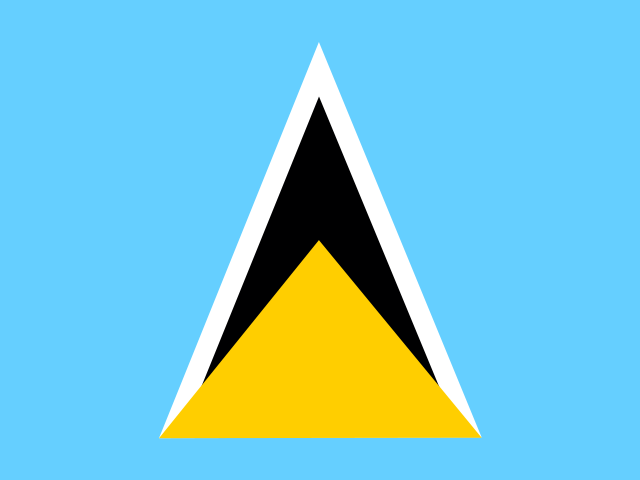
- The Minor Basilica of the Immaculate Conception in central Castries, rebuilt after the 1948 fire, is known for brightly painted interior murals completed in the 1980s by Saint Lucian artist Dunstan St Omer, whose work also influenced the design of the country's national flag.
- Saint Lucia changed hands between France and Britain roughly fourteen times during the colonial era, more than almost any other Caribbean territory, before its final transfer to Britain in 1814.
- Major fires in 1796, 1927, and 1948 successively destroyed much of Castries's historic architecture, meaning most of the city's current building stock postdates the 1948 fire.
- Castries replaced Soufrière as Saint Lucia's colonial capital in the 19th century and has remained the seat of government through self-governance in 1967 and independence in 1979.