The Flag of Saint Lucia
North America · Adopted 1 March 1967 (design refined 1979)
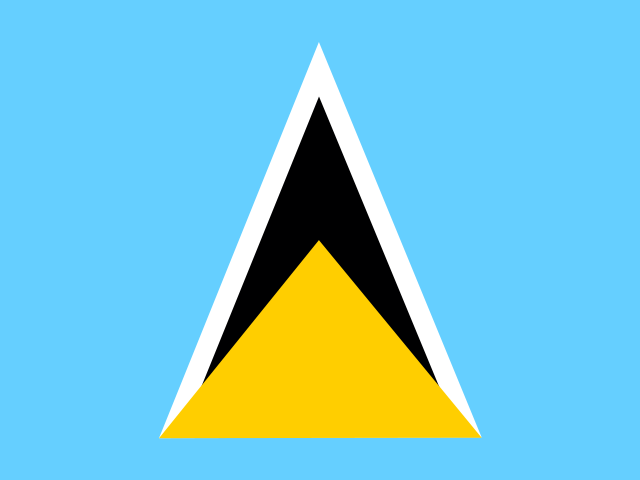
Saint Lucia's flag was designed by local artist Dunstan St Omer and first adopted on 1 March 1967, when the island became a self-governing State associated with Britain, several years before full independence followed on 22 February 1979. St Omer, who went on to become one of Saint Lucia's most celebrated painters and a close collaborator of Nobel laureate poet Derek Walcott, based the design on a motif he had already been developing in his artwork before it was chosen for the flag — a black-and-white triangle set against blue, representing the volcanic twin peaks the Pitons rising from the sea, among the island's most recognizable natural landmarks and, decades later, a UNESCO-listed site in their own right.
The design was refined in 1979, at the time of full independence, when the shade of blue was changed to a richer cerulean and the proportions of the central triangular device were adjusted — a deliberate touch-up rather than a wholesale redesign, meaning the core symbolism St Omer created in 1967 survived the transition to full sovereignty essentially intact, unlike many former British Caribbean colonies that adopted an entirely new flag design specifically at the moment of independence.
The blue field represents the surrounding Atlantic and Caribbean waters and also, by extension, Saint Lucia's fidelity to the sea that has shaped its history and economy; the black and white triangles together are read as representing the union of the island's African and European cultural heritage, while the golden-yellow triangle at the design's center is said to represent the sunshine the island enjoys and, in some official explanations, the aspiration toward prosperity.
The two Pitons the design evokes — Gros Piton and Petit Piton, twin volcanic spires on the island's southwest coast — are specific, named, real geographic features rather than a generic mountain motif, which makes Saint Lucia's flag unusually concrete in what it depicts compared with many national flags that rely on more abstract color symbolism; the black and white triangular shapes are widely understood locally as a direct stylized rendering of the two peaks as seen from offshore.
Saint Lucia's flag has not been redesigned since the 1979 refinement, and Dunstan St Omer's authorship is a matter of clear public record and national pride, commemorated in Saint Lucian civic culture alongside his later, larger body of painting, including murals in island churches — a level of individual-artist credit rarely seen elsewhere, since most national flags trace to a committee or an unnamed government drafter rather than a single celebrated painter.
Because the flag's triangular device is a relatively simple abstract shape, Saint Lucia's flag is occasionally confused in casual description with other Caribbean and Indian Ocean island flags that also use triangular or wedge motifs, though none shares Saint Lucia's specific combination of cerulean blue field with a black-bordered-white-bordered gold triangle — the design is distinctive enough in practice that confusion tends to be more about vague category recall than genuine visual similarity.
Dunstan St Omer's connection to the flag deepened over his career rather than ending with the 1967 design: he went on to paint murals inside several Saint Lucian Catholic churches, including a well-known depiction of a Black Christ at the Minor Basilica of the Immaculate Conception in Castries, and Saint Lucian cultural institutions frequently present the flag and these later murals together as part of a single body of national visual art rather than treating the flag as a separate, purely governmental commission.
The Pitons themselves — Gros Piton at roughly 798 meters and the more slender Petit Piton at roughly 743 meters — earned UNESCO World Heritage status in 2004, recognized specifically for their exceptional natural beauty and the biodiversity of the surrounding volcanic landscape, a designation that postdates the flag by decades but that Saint Lucian tourism material now frequently pairs with the flag's own triangular imagery when marketing the island internationally.
Saint Lucia's repeated changes of colonial hands left it with a distinctly Creole cultural layer atop its eventual British administration: French remained the language of daily life for much of the population well into the 20th century even after Britain's final 1814 acquisition of the island, and the Kwéyòl Creole still widely spoken today developed from that sustained French-colonial and West African linguistic mixing rather than from Saint Lucia's later, comparatively brief period of intensive British administrative control.
Saint Lucia's economy shifted decisively away from its historic sugar and, later, banana export base toward tourism over the final decades of the 20th century, a transition that reshaped how the flag's own golden-sun and fertile-green symbolism gets used in practice today — increasingly deployed in tourism branding and resort marketing rather than solely in the more traditional civic and agricultural contexts the original 1967 and 1979 design explanations had in mind. Saint Lucia's banana industry itself, once the island's dominant export earner through much of the 20th century under preferential trade access to the United Kingdom, declined sharply from the 1990s onward as European trade preferences were phased out under World Trade Organization rulings, accelerating the same tourism-driven economic shift the flag's imagery has since been folded into.
A richer blue since 1979
- Dyed-through flag — The blue was deliberately deepened at independence, so a flag printed in a pale sky blue is showing the older shade rather than the one currently specified.
As an Amazon Associate we earn from qualifying purchases made through these links, at no extra cost to you.
Saint Lucia at a glance
- Capital
- Castries
- Population
- 180,000 (2024)
- Currency
- Eastern Caribbean Dollar (XCD)
- Language(s)
- English (official); Saint Lucian Creole French (Kwéyòl) widely spoken
Population figure as of 2024, source: UN World Population Prospects (2024 revision). See methodology for how facts are sourced and kept current.