Kingstown — Capital of Saint Vincent and the Grenadines
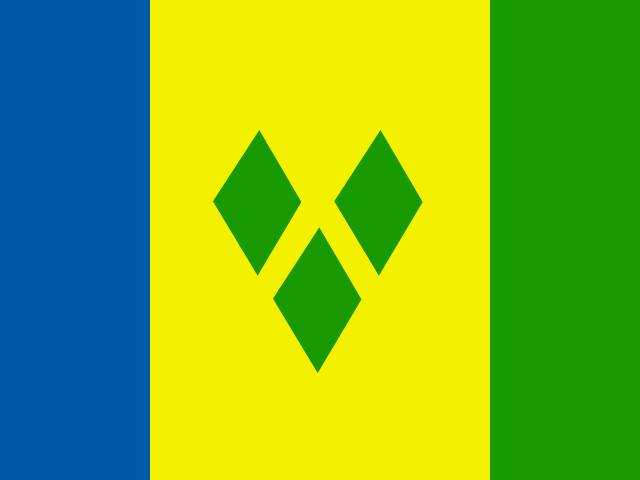
See the flag of Saint Vincent and the Grenadines →
Kingstown was founded by French settlers in the 1720s on the sheltered southwestern coast of Saint Vincent, at a time when the island was still contested territory that Britain and France disputed for decades, complicated further by the presence of the Garifuna people (also known historically as Black Caribs), descendants of shipwrecked or escaped enslaved Africans who had intermarried with the indigenous Kalinago and maintained substantial independent control of much of the island well into the 18th century.
British control was formalized by the Treaty of Paris in 1763, lost briefly back to France, and then confirmed again by the Treaty of Versailles in 1783, but Britain's actual authority over the island's interior remained limited until the Second Carib War of 1795–1797, after which most of the surviving Garifuna population was forcibly deported by British forces to the island of Roatán off the coast of Honduras — a mass expulsion that permanently altered the island's demographic makeup and remains a defining, difficult chapter in Saint Vincent's history.
Kingstown developed as the island's main port and administrative center under British colonial rule through the 19th and 20th centuries, growing an economy first around sugar and later arrowroot cultivation, and it retained its position as capital without significant rivalry from any other town on Saint Vincent through the island's path to full statehood within the Grenadines chain and eventual independence in 1979.
The city sits in the shadow of the Soufrière volcano, an active stratovolcano roughly 33 km to the north whose eruptions have periodically affected the wider island, most severely in 1902 (killing over 1,000 people) and most recently in April 2021, when a series of explosive eruptions forced the evacuation of thousands of residents from the island's northern communities and blanketed Kingstown itself in volcanic ash.
Kingstown's Botanic Gardens, established in 1765, are among the oldest botanical gardens in the Western Hemisphere and were originally used by British colonial administrators to cultivate breadfruit and other transplanted crops, including breadfruit trees grown from cuttings brought by Captain William Bligh's second breadfruit expedition in 1793 — a direct link between the city and one of the more famous botanical transplant projects of the colonial Caribbean.
Bligh's first breadfruit voyage, aboard HMS Bounty, ended in the famous 1789 mutiny before reaching the Caribbean at all; his second, successful expedition several years later did deliver breadfruit plants intended as a cheap food source for enslaved plantation laborers, a colonial agricultural project whose surviving trees in Kingstown's gardens are now maintained instead as a heritage and tourism attraction rather than for their originally intended purpose.
Kingstown's cathedral district reflects the same French-then-British layering seen elsewhere in the Eastern Caribbean: St. Mary's Roman Catholic Cathedral, built in stages from the 1820s onward in a mix of architectural styles including Romanesque, Gothic, and Moorish influences, stands close to the Anglican St. George's Cathedral, dating to 1820, a juxtaposition of denominations local guides often point to as a visible record of the island's successive French Catholic and British Anglican colonial administrations.
Quick facts
- Kingstown has a population of roughly 17,000 within city limits, with the wider urban area accounting for a substantial share of the country's total population of around 104,000.
- The city's Botanic Gardens, founded in 1765, are among the oldest in the Western Hemisphere and include breadfruit trees descended from Captain William Bligh's 1793 shipment.
- Fort Charlotte, completed by British forces in 1806 on a ridge overlooking Kingstown harbor, today houses a small museum with exhibit panels on the island's history and offers one of the best panoramic views of the capital and the southern Grenadines from its ramparts.
- The Soufrière volcano, roughly 33 km north of Kingstown, erupted most recently in April 2021, forcing large-scale evacuations and covering the capital in volcanic ash.
- Kingstown has served continuously as Saint Vincent's administrative capital since British colonial rule was consolidated in the late 18th century, through independence in 1979 to the present.