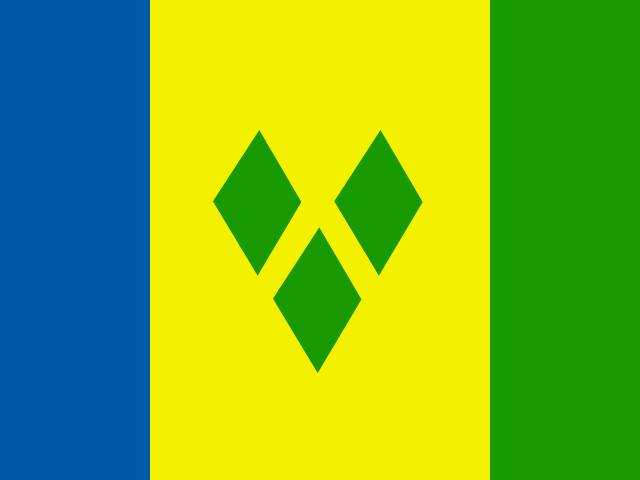
The Flag of Saint Vincent and the Grenadines
North America · Adopted 21 October 1985
Saint Vincent and the Grenadines adopted its current flag on 21 October 1985, replacing an earlier post-independence design that had been in use since the country's 1979 independence from Britain but was widely felt, within just a few years, not to have caught on as a distinctive national symbol — a rare example of a Caribbean nation revising its flag again within a decade of first independence rather than sticking with its original choice.
The 1979 flag had used a breadfruit-leaf motif on a similar tricolor base, but the shape and its arrangement were criticized locally as too visually cluttered and not easily reproducible at small sizes; the 1985 redesign, credited to Saint Vincentian artist Lauri King, simplified the central device to three green diamonds arranged in a distinctive "V" formation on the central gold band, a shape read both as a literal V for Vincent and as a stylized evocation of the Grenadines, the chain of smaller islands strung out south of the main island that share sovereignty with it.
The flag's three vertical bands — blue at the hoist, gold in the center, green at the fly — carry meanings tied specifically to the country's geography and economy: blue represents the sea and sky and, by extension, the vigilance of the Vincentian people; gold represents the warmth and sunshine of the islands as well as the golden sands of its beaches; and green represents the lush vegetation of the island's forests and its agricultural land, historically centered on arrowroot and, in earlier centuries, sugar and cotton production under British colonial rule.
The three-diamond "gems" device is also popularly described locally as representing the country's status as the "Gems of the Antilles," a phrase used in tourism and civic branding, tying the flag's central emblem to a specific national self-image the government has actively promoted since the mid-1980s redesign, distinct from the more historically weighted symbolism found on flags of nations that trace their emblems to independence-era struggle rather than a later branding-conscious update.
Saint Vincent and the Grenadines is unusual among Caribbean nations for having revised its post-independence flag design this quickly and this deliberately, treating the 1979 flag as a genuine misstep to be corrected rather than something to persist with out of institutional inertia; the 1985 design has remained unchanged in the decades since and is the version flown today.
Because the flag uses the same blue-gold-green vertical tricolor structure loosely associated with several small island states' "sea, sun, land" symbolism, it is sometimes mixed up in casual description with other tricolor Caribbean flags, though its specific three-diamond central device, unlike any single emblem or plain band used elsewhere in the region, is what distinguishes it once the color scheme alone is not enough to tell flags apart.
The Grenadines themselves, the string of more than thirty small islands and cays stretching south from the main island of Saint Vincent toward Grenada, are shared politically between two different countries — the northern Grenadines belong to Saint Vincent and the Grenadines, while the southern end, including Carriacou and Petite Martinique, belongs to Grenada — a division dating to colonial-era administrative boundaries that the flag's own name and its V-shaped diamond motif both implicitly reference, without depicting the archipelago literally.
Saint Vincent and the Grenadines shares its independence date, 27 October 1979, with the fact that it remains, like several of its Eastern Caribbean neighbors, a Commonwealth realm, keeping the British monarch as its ceremonial head of state through a locally appointed governor-general — a constitutional structure that has occasionally been the subject of domestic debate about moving to a republic, though no such change had been enacted as of 2026, and the flag's design carries no reference to the monarchy either way.
Saint Vincent's own Garifuna history parallels and predates the flag by two centuries: the island's indigenous Kalinago population and later Garifuna community — descended in part from shipwrecked and escaped enslaved Africans who intermarried with the Kalinago from the 17th century onward — mounted sustained resistance to British colonization through the 18th century, culminating in the Second Carib War of 1795–1797 and the forced mass deportation of most surviving Garifuna to Roatán, off Honduras, a history that predates the flag's own 20th-century design but that Vincentian civic material increasingly credits as foundational to the nation's identity. Descendants of the deported Garifuna population in Honduras, Belize, and Guatemala maintain cultural and, in recent decades, renewed direct ties back to Saint Vincent, and Garifuna heritage organizations on the island have pushed in recent years for greater official recognition of that history within national symbols and school curricula, a debate that runs alongside, rather than through, the flag's own comparatively recent 1985 redesign. Arrowroot cultivation, referenced in the flag's own green band as part of the island's agricultural identity, once made Saint Vincent the world's leading producer of the starch during the 20th century, prized for its use in manufacturing computer paper and other specialty products, before synthetic alternatives sharply reduced global demand and the industry contracted to a much smaller scale than it held at its mid-century peak.
Three diamonds in a V
- Geometry-accurate flag — The diamonds are arranged in a V rather than a row or a triangle, and a version that sets them level is showing the pre-1985 arrangement or a redraw of it.
As an Amazon Associate we earn from qualifying purchases made through these links, at no extra cost to you.
Saint Vincent and the Grenadines at a glance
- Capital
- Kingstown
- Population
- 104,000 (2024)
- Currency
- Eastern Caribbean Dollar (XCD)
- Language(s)
- English (official); Vincentian Creole widely spoken
Population figure as of 2024, source: UN World Population Prospects (2024 revision). See methodology for how facts are sourced and kept current.