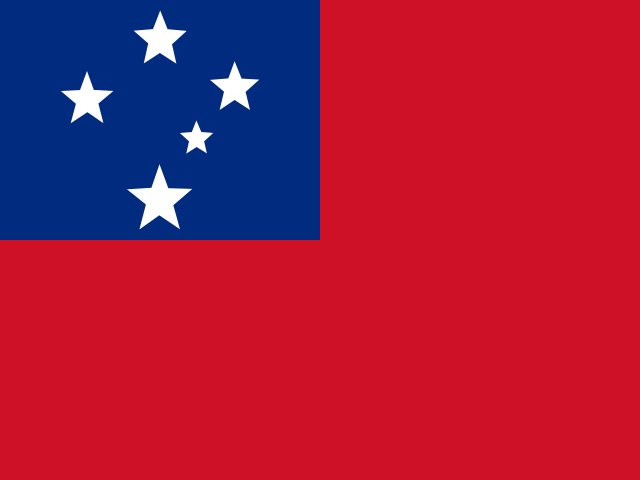
Apia — Capital of Samoa
Apia grew out of a cluster of traditional Samoan villages along the north coast of Upolu island, and it became the country's dominant town during the 19th century largely because of its harbor — one of the better natural anchorages in the Samoan islands — which drew whalers, traders, and eventually the competing colonial interests of Germany, Britain, and the United States, all of which maintained consular representation in Apia during the late 1800s.
That three-way colonial rivalry came to a head in Apia harbor itself in March 1889, when a standoff between German, British, and American warships was broken not by combat but by a massive cyclone that wrecked most of the ships anchored there — a natural disaster that abruptly ended the immediate crisis and pushed the powers toward negotiated partition of the islands rather than continued naval confrontation, an unusually literal case of weather altering the course of colonial diplomacy.
Germany took control of Western Samoa (including Apia) in 1900 following that partition, and Apia served as the German colonial capital until New Zealand forces occupied it in 1914 at the outbreak of the First World War, beginning the New Zealand administration — first as a wartime occupation, then as a League of Nations mandate, then a UN trusteeship — that ran until independence in 1962.
Apia was the site of the most consequential single event in Samoa's path to independence: the Black Saturday shootings of 28 December 1929, when New Zealand colonial police opened fire on a peaceful march by the Mau movement, killing at least eight Samoans including the paramount chief Tupua Tamasese Lealofi III, an event that hardened Samoan resistance to colonial rule for decades afterward and is still commemorated in the city.
The writer Robert Louis Stevenson spent his final years at Vailima, his estate in the hills just outside Apia, from 1890 until his death in 1894, and is buried on nearby Mount Vaea; his home is preserved today as a museum and remains one of Apia's most visited cultural sites, a literary connection unusual among Pacific capitals of Apia's size.
Samoa became the first Pacific island nation to gain independence in the 20th century when it separated from New Zealand administration on 1 January 1962, and Apia's central government buildings, including the Legislative Assembly, took on their national roles at that point after decades functioning under the more limited authority of a trusteeship administration answering to the United Nations.
Samoan social and political life outside formal government structures still runs substantially through the fa'amatai chiefly system, in which matai (chief) titles carry both village authority and, historically, eligibility to stand for national parliament, and Apia's own city districts and surrounding villages continue to hold fa'a Samoa (traditional Samoan) ceremonial and decision-making practices alongside the country's parliamentary institutions based in the capital.
The Congregational Christian Church of Samoa and other denominations introduced by 19th-century missionaries remain deeply embedded in Apia's civic rhythm, with Sunday observance still shaping business hours and public activity across the capital far more strictly than in most other Pacific capitals of similar size.
Apia hosts the annual Teuila Festival, established in the 1990s and centered on traditional dance, sports, and craft competitions, which has grown into the country's largest cultural tourism event and draws overseas Samoans back to the capital from New Zealand, Australia, and the United States, where large Samoan diaspora communities have settled over recent decades.
Quick facts
- Apia's urban population is roughly 40,000 as of recent estimates, though the greater urban area extends further along Upolu's north coast.
- The March 1889 Apia cyclone destroyed most of the German, British, and American warships anchored in the harbor during a period of colonial tension over the islands.
- Germany administered Western Samoa, including Apia, as a colony from 1900 until New Zealand occupied it in 1914.
- The Cathedral of the Immaculate Conception of Mary in central Apia, rebuilt and reopened in 2014 after the earlier building was demolished over structural concerns, remains the seat of Samoa's Catholic archdiocese and one of the capital's most prominent landmarks.
- Apia is Samoa's only real city; most of the country's roughly 200,000 people live across small villages on Upolu and the larger, more sparsely populated island of Savai'i.