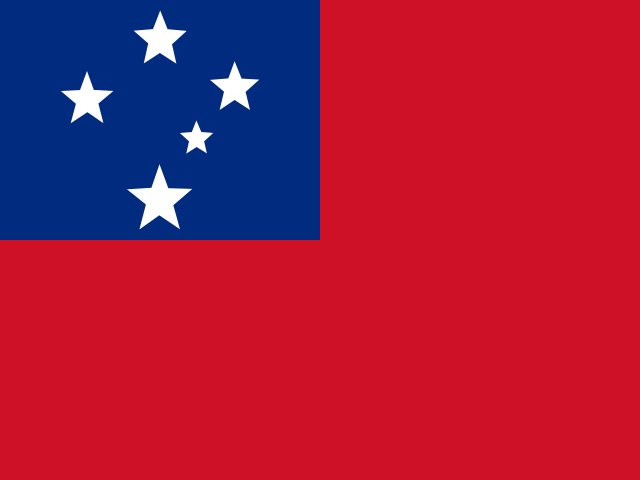
The Flag of Samoa
Oceania · Adopted 26 May 1948 (original design); fifth star added 24 February 1949; readopted as the national flag at independence, 1 January 1962
Samoa's flag has a longer working life than its independence does. It was first adopted on 26 May 1948, while Samoa was still administered by New Zealand under a United Nations trusteeship following the earlier German and then New Zealand colonial periods, and it was retained essentially unchanged when the country — then called Western Samoa — became the first Pacific Island nation to gain full independence from colonial rule, on 1 January 1962.
The original 1948 design carried four stars in its blue canton; a fifth, smaller star was added on 24 February 1949 so the arrangement would more accurately mirror the actual shape of the Southern Cross constellation as it appears in the sky, a small but deliberate correction made while the flag was still a trusteeship-era territorial flag rather than a national one.
Red fills most of the field, and it is explained in Samoan civic tradition as representing courage — a value with deep roots in Samoan fa'a Samoa (the traditional way of life) and its emphasis on bravery and service to family and village. Blue, confined to the canton, represents freedom, a meaning that took on particular resonance once the flag carried through into the 1962 independence it had been flying years ahead of. White, used in the stars' outlines, represents purity.
Samoa's path to independence was notably peaceful and negotiated rather than won through armed conflict, following decades of the Mau movement — a nonviolent Samoan resistance and self-determination campaign that began under German rule in the early 20th century and continued through the New Zealand administration, including the December 1929 Black Saturday incident in Apia, when New Zealand colonial police shot and killed Mau demonstrators, an event that hardened Samoan resolve toward eventual self-rule over the following decades.
The Southern Cross motif ties Samoa's flag visually to Australia's, New Zealand's, and Papua New Guinea's, all of which use the same constellation for the same basic reason of shared Southern Hemisphere visibility — but Samoa's overall design, a red field with a blue canton rather than a full blue field, sets it apart from that group at a glance, and its five-star arrangement (four large, one small) closely echoes New Zealand's own four-star Southern Cross with an added fifth point.
Samoa should not be confused with American Samoa, the separate, unincorporated US territory covering the eastern islands of the Samoan archipelago, which uses an entirely different flag design featuring a bald eagle grasping traditional Samoan symbols — the shared name and shared archipelago frequently cause the two flags and the two territories to be mixed up internationally despite having different governments, different flags, and different political status entirely.
Samoa made two unusually visible changes to its national infrastructure in the years after the flag had already long settled into its permanent form: in 2009 the government switched the country from driving on the right side of the road to driving on the left, aligning with Australia and New Zealand and making vehicle imports from those larger, closer markets cheaper and easier; and in December 2011 Samoa jumped across the International Date Line entirely, skipping 30 December 2011 altogether to move from the eastern to the western side of the line, again to sync its working week with Australia and New Zealand rather than with American Samoa and the United States just to its east.
Samoan society continues to operate under the fa'amatai system, in which extended families are led by chiefly title-holders (matai) who represent their families in village and national affairs, a structure written into Samoa's own constitution and one that runs alongside, rather than beneath, the country's parliamentary government — a genuine constitutional hybrid unusual even among other Pacific nations that retain traditional leadership roles.
The flag has not been redesigned since the 1949 addition of the fifth star, and Independence Day, 1 January, along with the anniversary of Samoa's 1997 name change from 'Western Samoa' to simply 'Samoa,' remain the flag's principal annual occasions.
The split between Samoa and American Samoa that makes the two flags so easy to confuse dates back to the 1899 Tripartite Convention, in which Germany, the United States, and Britain formally carved up the Samoan archipelago after decades of rival colonial jockeying: Germany took the larger western islands (administered later by New Zealand after the First World War, and eventually becoming independent Samoa), while the United States took the eastern islands around Pago Pago, which remain an unincorporated US territory today and have never held their own independence movement or vote. That 1899 division, not any difference in Samoan culture between the two island groups, is the direct historical reason the two flags, currencies, and governments diverge so completely despite a shared language and shared pre-colonial history.
Samoa's flag is unusually elongated for a national banner, built to a 1:2 length-to-width shape rather than the squarer 2:3 common elsewhere, and the five stars in the canton are arranged in the same asymmetric pattern the Southern Cross forms in the night sky — four stars marking the crossbar's main points and a fifth, smaller star offset to represent Epsilon Crucis, the dimmer fifth star astronomers include in the full constellation but that several other Southern Cross flags, including Australia's, omit from their smaller four-star renderings.
Samoa's National Flag Day is observed annually on 26 May, marking the original 1948 adoption rather than the later 1949 correction or the 1962 independence date, giving the flag itself a distinct commemorative day separate from Independence Day — a detail that reflects how the flag's institutional history, stretching back into the trusteeship era, is treated in Samoa as worth marking on its own terms rather than folded entirely into the independence narrative.
Five stars, one of them smaller
- Detail-accurate printed flag — A fifth and smaller star was added in 1949 to match the constellation more closely, so the count and the size difference are both checkable and both are things a redraw evens out.
As an Amazon Associate we earn from qualifying purchases made through these links, at no extra cost to you.
Often confused with
- New Zealand — shares the same core device — a Southern Cross rendered as red, white-bordered stars, with a near-identical five-versus-four star count — but the two flags are otherwise easy to tell apart at a glance because Samoa's stars sit in a small blue canton on a red field, while New Zealand's fill the entire fly of a solid blue field. Compare side by side →
Samoa at a glance
- Capital
- Apia
- Population
- 225,000 (2024)
- Currency
- Samoan Tālā (WST)
- Language(s)
- Samoan and English (both official)
Population figure as of 2024, source: UN World Population Prospects (2024 revision). See methodology for how facts are sourced and kept current.