San Marino — Capital of San Marino
The City of San Marino occupies the upper slopes and summit of Monte Titano, a limestone peak rising to about 750 meters, and traditional accounts date the settlement to 3 September 301 AD, when Marinus, a Christian stonemason fleeing persecution under the Roman emperor Diocletian, is said to have taken refuge on the mountain and gathered a small community of followers around him. As with many foundation stories from this period, no contemporary Roman-era document confirms the exact date, but the settlement's presence on Monte Titano is documented with reasonable confidence by the early medieval period, and the republic itself has never been credibly displaced from that original site.
What makes the city's continuity unusual is not any single dramatic event but the absence of one: unlike almost every other European capital, San Marino's city has never been conquered, sacked, or forced to relocate its seat of government in its documented history, largely because Monte Titano's steep, narrow approaches made it a genuinely difficult target for the larger powers that surrounded it over the centuries, including the Papal States, various Italian city-states, and eventually the unified Kingdom of Italy.
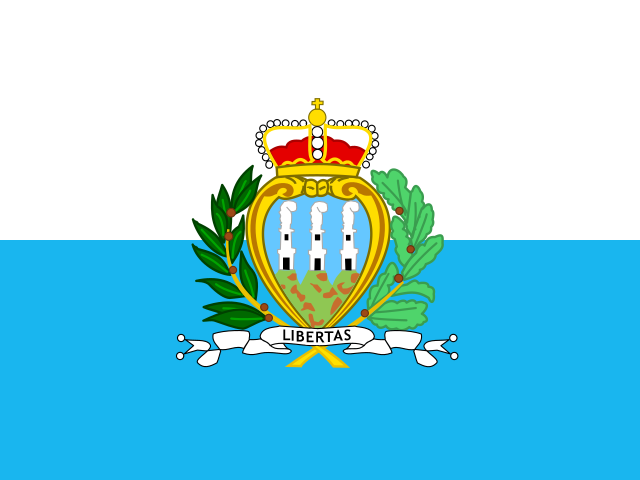
The city's skyline is defined by its three medieval towers strung along the mountain's ridge — Guaita, the oldest, dating in its earliest form to the 11th century; Cesta, built atop the mountain's highest point on the ruins of an earlier Roman fortification; and Montale, the smallest and least accessible of the three, never open to the public. All three appear together on San Marino's coat of arms, making the towers simultaneously the city's actual skyline and its most literal national symbol.
During the Second World War, San Marino declared neutrality, but the city and republic nonetheless sheltered an estimated 100,000 refugees from surrounding Italian territory at various points during the conflict — a striking number relative to San Marino's own tiny population — even as Allied bombing briefly struck the republic in 1944 due to mistaken reports that retreating German forces were sheltering there.
Today UNESCO lists the historic center of the City of San Marino, together with Monte Titano itself, as a World Heritage property, added to the list in 2008 as a reference for the continuity of a republican government and city built on the same site, largely unbroken, for over a thousand years — a claim to civic continuity that few other capital cities anywhere can make with comparable historical weight.
The Basilica di San Marino, built in the early 19th century on the site of an earlier medieval church, holds what tradition identifies as the remains of Saint Marinus himself, making it the closest thing the city has to a physical link back to its own 4th-century founding legend, even though the current building is a considerably later neoclassical structure rather than anything dating to Marinus's own era.
Because the entire city is built on and around a steep peak, much of its historic core is only accessible on foot along narrow stone streets and stairways, and a cable car connecting the lower town of Borgo Maggiore to the historic center atop Monte Titano, first built in the 1950s and rebuilt since, remains one of the more distinctive ways visitors and residents move between the city's upper and lower districts.
Quick facts
- The City of San Marino's own population is small, only a few thousand residents, while the wider republic's total population is around 34,000 across its nine municipalities.
- San Marino's system of two Captains Regent, elected jointly to serve as co-heads of state for fixed six-month terms, has continued in some form since the medieval period and remains unique among the world's states.
- The Palazzo Pubblico, San Marino's seat of government, was completed in 1894 in neo-Gothic style on the foundations of an earlier medieval town hall, and it still hosts the investiture ceremony for each new pair of Captains Regent.
- San Marino's 2008 UNESCO listing covers both the historic center and Monte Titano itself, recognizing the site jointly for its architecture and for the surrounding natural landscape that helped preserve the republic's independence.
- San Marino is often cited, on the strength of its 1600 Statutes, as having one of the oldest written constitutions of any sovereign state still partly in force today.