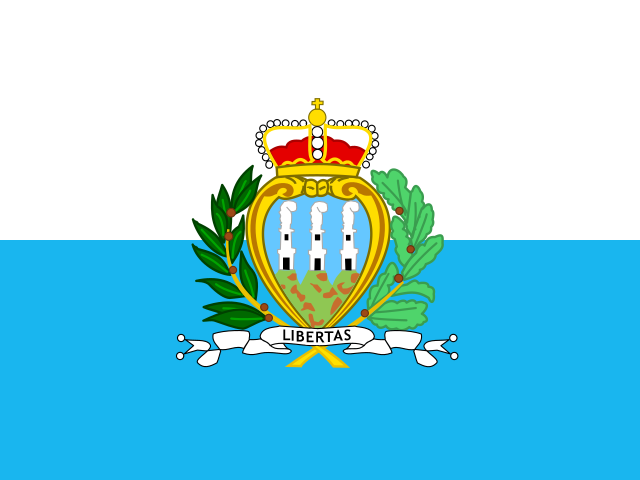
The Flag of San Marino
Europe · Adopted 6 April 1862
San Marino's flag — a simple horizontal bicolor, white on top and light blue below — was formally adopted on 6 April 1862, though the colors themselves are read as representing the two things that have defined the republic's landscape for as long as it has existed: the white of the snow and clouds that gather over Monte Titano, the mountain the entire republic is built on and around, and the blue of the sky above it. There is no dynastic house, conquering ruler, or revolutionary movement behind the color choice the way there is for many European flags — the palette is drawn directly from the terrain itself.
The plain bicolor is San Marino's civil flag, used by ordinary citizens and on everyday occasions. The state flag, reserved for government buildings and official functions, adds the national coat of arms centered across the boundary between the two stripes: three towers, each topped with an ostrich plume, representing the three historic fortifications built along Monte Titano's ridge — Guaita, Cesta, and Montale — which have watched over the republic's territory since the medieval period and remain standing today as San Marino's most recognizable landmark.
Beneath the towers, a wreath of laurel on one side and oak on the other frames the shield, and above it sits a crown — a detail that catches people off guard once they realize San Marino has never actually been ruled by a king or queen. The crown is not a claim to royal rule; it is a heraldic statement of sovereignty, asserting San Marino's status as an equal, fully independent state alongside the kingdoms and empires that historically surrounded it, at a time when a crown was the visual shorthand for sovereign standing in European heraldry regardless of a state's actual system of government.
Below the shield runs a ribbon bearing the word 'LIBERTAS' — Latin for liberty — the republic's motto and, arguably, the closest thing San Marino has to a founding statement. Tradition holds that San Marino was founded on 3 September 301 AD by Marinus, a Christian stonemason from the Dalmatian island of Rab who fled to Monte Titano to escape the religious persecutions of the Roman emperor Diocletian and established a small community of fellow refugees there; if the traditional date is taken at face value, it makes San Marino the oldest continuously sovereign state in the world, a claim the republic itself actively promotes and one that, while not verifiable with the same documentary certainty as its more recent history, is treated as broadly plausible by most historians even if the precise founding date can't be confirmed.
San Marino's mountaintop position gave it a genuine, lasting practical advantage: the difficulty of besieging or annexing a small fortified republic perched on a steep peak allowed it to remain independent through the rise and fall of the Papal States, the unification of Italy in the 19th century, and both World Wars, even as it became entirely surrounded by Italian territory. Giuseppe Garibaldi himself took refuge in San Marino in 1849 while fleeing Austrian forces after the fall of the Roman Republic, and the republic's decision to shelter him — despite the diplomatic risk — is still cited domestically as an example of the country living up to its 'LIBERTAS' motto under real pressure.
No redesign has altered the flag's basic white-and-blue field since 1862, though the exact heraldic rendering of the coat of arms used on the state flag has been refined by law over the following century and a half to standardize details like the number of plumes and the precise style of the towers, changes that tidied the emblem's presentation without touching its underlying symbolism.
The flag flies year-round above the three towers it depicts and is especially prominent during Founding Day celebrations on 3 September, commemorating Marinus's traditional 301 AD arrival, and on 1 and 2 April and 1 and 2 October, when San Marino installs its two Captains Regent — the republic's unusual system of two co-heads of state, elected jointly every six months, a structure that has remained essentially unchanged since the medieval period and is itself frequently cited as evidence for San Marino's claim to being the world's oldest surviving republic.
San Marino joined the United Nations only in 1992, a surprisingly late date for a state that had already been functioning independently for over sixteen centuries by that point, a gap explained less by any doubt about its sovereignty than by San Marino's longstanding policy of minimal formal involvement in international bodies, preferring close bilateral treaties with Italy — which entirely surrounds it — over broader multilateral entanglements for most of the 20th century.
Because San Marino's white-and-blue field carries no crest of its own on the civil version, San Marino residents and visitors alike most often encounter the country's identity through the state flag's tower emblem instead, reproduced on everything from postage stamps to the small country's well-known numismatic and philatelic exports, two of the tiny republic's genuinely significant sources of revenue given its lack of any large domestic industry.
With the towers, or without
- Flag with the arms — Two versions are in use and only one carries the shield of three towers in the middle; the plain white-over-blue bicolour is the other one, so check which the listing actually shows.
As an Amazon Associate we earn from qualifying purchases made through these links, at no extra cost to you.
San Marino at a glance
- Capital
- San Marino
- Population
- 34,000 (2024)
- Currency
- Euro (EUR) — used unilaterally under a monetary agreement with the EU, San Marino is not an EU member
- Language(s)
- Italian (official)
Population figure as of 2024, source: UN World Population Prospects (2024 revision). See methodology for how facts are sourced and kept current.