São Tomé — Capital of Sao Tome and Principe
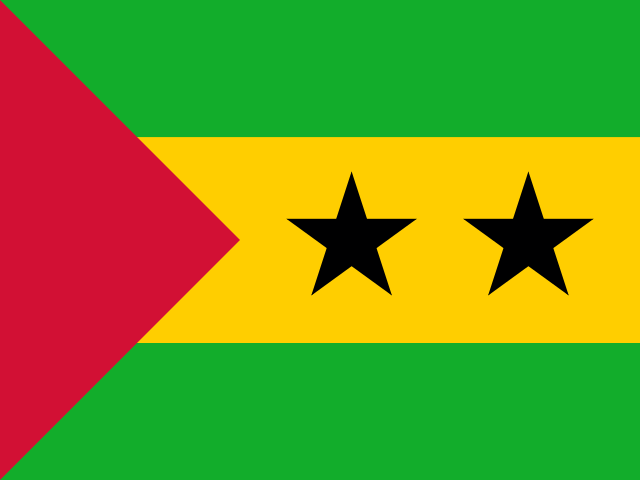
See the flag of Sao Tome and Principe →
São Tomé, the city, shares its name with the island it sits on and with the country as a whole, a coincidence that reflects just how central the original settlement was to the entire colonial project: Portuguese navigators reached the uninhabited island in 1470, reportedly on 21 December, the feast day of St. Thomas, and founded the town not long after, making it one of the earliest European settlements anywhere in the tropics, predating most Portuguese colonial cities in Africa, Asia, or the Americas.
The city's early economic importance came first from sugar, grown on plantations worked largely by enslaved Africans brought to the island beginning in the late 15th century, making São Tomé one of the first places in the world where a sugar-plantation economy dependent on African slave labor was established — a template later exported, with Portuguese and other European involvement, to Brazil and the Caribbean. The island later became a key staging and provisioning point in the broader transatlantic slave trade before its own economy shifted toward coffee and, later, cocoa in the 19th century.
Fort São Sebastião, built by the Portuguese starting in 1575 to defend the harbor against raids by rival European powers and pirates, still stands at the edge of the old town and today houses the national museum, its thick stone walls one of the most visible physical reminders of the city's origins as a fortified colonial trading post rather than a planned administrative capital.
São Tomé remained the seat of Portuguese colonial administration for the archipelago throughout the colonial period and continued as capital without interruption when the country gained independence in July 1975, unlike many African states that relocated their capitals after independence — the transition here changed who governed the city, not where the government sat.
As the country's only sizable urban center, São Tomé today hosts nearly all of the nation's government offices, its main port, and its limited but growing tourism infrastructure, serving both islands' roughly quarter-million residents from a city that, by the standards of African national capitals, remains notably small and low-rise, with much of the old Portuguese colonial-era architecture still intact along the waterfront.
The Presidential Palace in São Tomé, a pale-pink colonial-era building originally constructed as the residence of Portuguese colonial governors, has continued in that same function since independence, now housing the country's president rather than a colonial administrator — one of several instances in the city where the physical buildings of Portuguese rule were repurposed directly for the institutions of the independent state rather than replaced.
Because cocoa remains central to both the national economy and the flag's own yellow-band symbolism, São Tomé's harbor still handles the export of cocoa grown on the old roça plantations inland, many of which have shifted in recent decades from large state-run operations toward smaller cooperative and organic-certified production aimed at premium export markets in Europe.
São Tomé's small size has not stopped it from developing a distinct urban character: the city's low-rise, pastel-colored colonial architecture, largely undisturbed by the kind of high-rise development seen in many larger African capitals, remains one of its most frequently noted features among visitors, giving the capital a markedly different visual character from the far larger and more industrialized capitals of nearby mainland Gabon and Equatorial Guinea.
Quick facts
- São Tomé city is home to roughly 80,000 people in 2024 UN estimates — a small figure in absolute terms, yet it accounts for well over a third of the entire nation's population of just over 230,000.
- The island of São Tomé sits almost exactly on the Equator, and the small volcanic islet Ilhéu das Rolas just off its southern coast is often marketed to visitors as straddling the Equator line itself.
- Fort São Sebastião, completed in the late 16th century, now houses the National Museum of São Tomé and Príncipe.
- São Tomé was one of the earliest European tropical settlements anywhere, founded in the 1470s, decades before Portuguese colonization reached most of coastal Africa, Brazil, or Asia.
- The city and the country share the same name because the settlement predates any distinction between 'the island' and 'the colony' — the whole territory grew outward from this single original town.