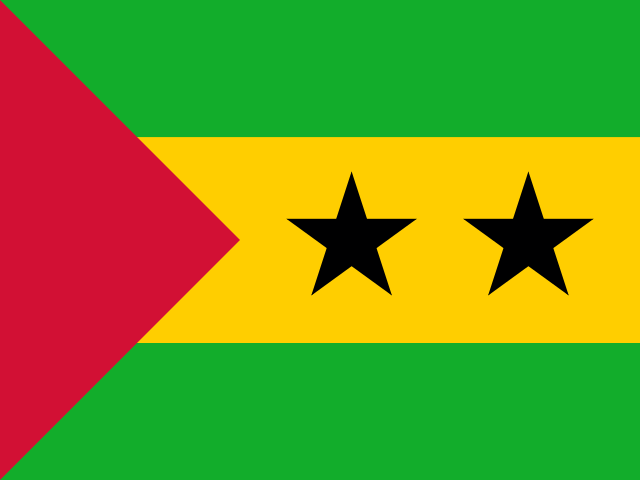
The Flag of Sao Tome and Principe
Africa · Adopted 5 November 1975
São Tomé and Príncipe adopted its flag on 5 November 1975, ahead of the archipelago's independence from Portugal that was formalized on 12 July of that year, giving the country its own flag before the formal date of independence had even fully settled the transition. The design was drawn up under the influence of the MLSTP (Movimento de Libertação de São Tomé e Príncipe), the liberation movement that led the independence campaign and became the country's sole legal party for its first years of self-rule.
The flag consists of three horizontal bands — green, yellow, and green again, with the yellow band roughly twice the width of each green one — carrying a red triangle at the hoist and two black five-pointed stars placed side by side on the yellow band. The design deliberately draws on the pan-African color palette of green, yellow, red, and black shared with several other former Portuguese African colonies that gained independence in the same mid-1970s wave, including Mozambique, Angola, and Guinea-Bissau, all of whose liberation movements maintained close ties during the anti-colonial struggle against Portugal.
The two black stars have a specific, literal meaning distinct from most other flags' star symbolism: they represent the two main islands that make up the country, São Tomé and Príncipe, placed together on the flag exactly as the two islands sit together in the Gulf of Guinea, a rare case of a flag's star count mapping directly onto the physical geography of the state rather than standing for an abstract number of provinces, unity, or independence years.
Green stands for the archipelago's dense tropical vegetation, yellow references the cocoa that made the islands one of the world's leading cocoa producers by the early 20th century and remains central to the national economy and identity, and red represents the struggle for independence and the effort and sacrifice involved in achieving it — a set of meanings that closely tracks the islands' actual economic and political history rather than being generic pan-African boilerplate.
São Tomé and Príncipe's economy was built almost entirely around cocoa and coffee plantations, the roças, established under Portuguese colonial rule using forced and contract labor systems that persisted in various forms well into the 20th century; the yellow band's reference to cocoa is inseparable from that history, since the crop that gave the young nation its main source of wealth at independence was also the product of a labor system widely criticized internationally, including a well-documented early-20th-century British cocoa-boycott campaign tied to labor conditions on the islands' plantations.
The flag has not been altered since its 1975 adoption, remaining in continuous use through the country's transition from one-party MLSTP rule to a multiparty constitutional system formalized in a new constitution in 1990, one of the earliest peaceful transitions to multiparty democracy among Portuguese-speaking African states.
The archipelago's small size and population have not stopped the flag's imagery from being taken seriously as a matter of national identity distinct from its larger Lusophone neighbors: government and school civic materials consistently distinguish São Tomé and Príncipe's two-star, plain-band design from Mozambique's and Angola's more heavily emblemed flags, presenting the simplicity of the design as reflective of the country's own more modest post-independence path, which avoided the prolonged civil wars that followed independence in both of those larger former Portuguese colonies.
São Tomé and Príncipe's national holiday calendar ties directly back to the flag's 1975 origin: both Independence Day (12 July) and the anniversary of the flag's formal adoption in November are marked with public ceremonies, though Independence Day remains by far the larger and more widely observed of the two nationally.
The island of Príncipe, the smaller of the two main islands referenced by the flag's two black stars, has followed a somewhat different modern path than São Tomé itself: it was granted its own autonomous regional government in 1995, with its own regional assembly and president, a devolution arrangement unusual for such a small territory and one that gives Príncipe a degree of self-governance the flag's shared two-star symbolism does not, on its own, fully convey.
Because São Tomé and Príncipe is one of Africa's smallest countries by both population and land area, its flag is sometimes used in geography education specifically as an example of how national symbolism scales down: unlike larger nations whose stars or emblems often stand for numerous provinces, ethnic groups, or historical dates, its two stars map onto something as concrete and countable as the two inhabited islands that make up the entire state.
The country's small population and limited diplomatic footprint have not stopped São Tomé and Príncipe from maintaining formal ties abroad reflected in its flag's visibility at regional bodies such as the African Union and the Community of Portuguese Language Countries (CPLP), an organization uniting Portugal, Brazil, and Portuguese-speaking African states that gives the tiny archipelago nation a diplomatic forum where its flag appears alongside those of far larger economies.
A yellow band twice the others
- Sewn-stripe flag — The middle band is specified at roughly double the width of each green one, which is a proportion a stitched flag fixes at the seam and a printed one can quietly get wrong.
As an Amazon Associate we earn from qualifying purchases made through these links, at no extra cost to you.
Often confused with
- Mozambique — uses the same green-yellow-black-red pan-African palette from the same wave of Portuguese-colony independence movements, but Mozambique's flag carries a detailed emblem of a rifle, hoe, star, and book rather than plain stars, and its bands are arranged differently, making the two easy to distinguish beyond the shared color family. Compare side by side →
- Guinea-Bissau — shares the red hoist triangle and a black star, but Guinea-Bissau has only one star, not two, and its green-yellow bands are stacked horizontally on the fly side rather than forming a green-yellow-green sandwich. Compare side by side →
Sao Tome and Principe at a glance
- Capital
- São Tomé
- Population
- 231,000 (2024)
- Currency
- São Tomé and Príncipe Dobra (STN)
- Language(s)
- Portuguese (official); Forro and other Portuguese-based creoles widely spoken
Population figure as of 2024, source: UN World Population Prospects (2024 revision). See methodology for how facts are sourced and kept current.