Riyadh — Capital of Saudi Arabia
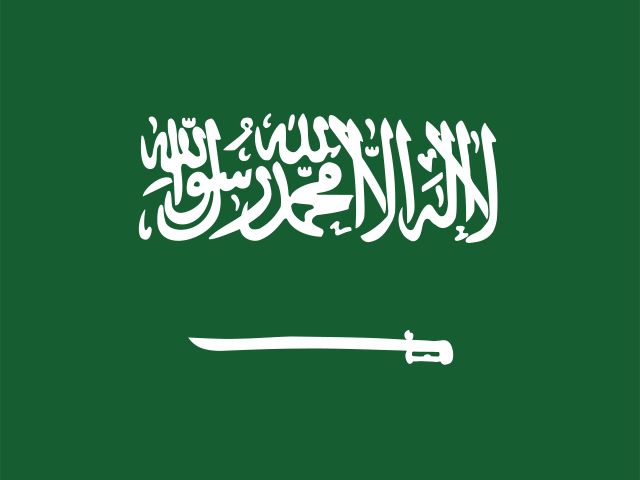
See the flag of Saudi Arabia →
Riyadh's status as the seat of Saudi power traces back to Diriyah, a nearby oasis settlement that served as the capital of the First Saudi State, founded in 1744 through an alliance between the Al Saud family and the religious reformer Muhammad ibn Abd al-Wahhab. Diriyah's ruins, including the mudbrick At-Turaif district, are now a UNESCO World Heritage Site and sit just northwest of modern Riyadh.
Riyadh itself became the Al Saud family's stronghold under the Second Saudi State in the 19th century, and the city's recapture is the founding legend most closely associated with the modern kingdom: in January 1902, a young Abdulaziz ibn Saud led a small raiding party in a night attack on Masmak Fortress in Riyadh, then held by the rival Al Rashid dynasty, retaking the city and beginning the campaign of conquest and unification across the Arabian Peninsula that culminated three decades later in the 1932 proclamation of the Kingdom of Saudi Arabia.
Riyadh sits in the Najd, the central Arabian plateau, historically more isolated, conservative, and inward-looking than the coastal Hejaz region to the west, home to the holy cities of Mecca and Medina and long more connected to Red Sea trade and pilgrimage traffic — a regional divide that shaped Saudi Arabia's internal politics and religious character for much of the 20th century even after national unification.
The Masmak Fortress where Abdulaziz's 1902 raid took place still stands in central Riyadh and now functions as a museum dedicated to the kingdom's founding, one of the few pre-oil-era structures preserved amid the city's otherwise overwhelmingly modern development.
Riyadh's population and skyline have grown explosively since the mid-20th-century discovery of oil transformed Saudi government revenue; the city is now home to landmarks like the Kingdom Centre tower and is a focal point for the government's Vision 2030 economic diversification program, which includes major planned developments in and around the capital aimed at reducing the kingdom's long-term economic dependence on oil exports.
One of the largest of those Vision 2030 projects, the Diriyah Gate development, is rebuilding and restoring large parts of the historic Diriyah site itself into a major cultural and tourism destination, an effort that effectively brings the story of the Saudi state full circle by turning the birthplace of the First Saudi State into one of modern Riyadh's flagship redevelopment projects.
Riyadh also hosts the King Abdullah Financial District, a large purpose-built business and banking complex developed over the 2010s as part of the government's push to establish the capital as a regional financial center independent of the older, oil-revenue-dominated state economy, alongside longstanding institutions like King Saud University, one of the largest universities in the Middle East.
Riyadh has also become the staging ground for the kingdom's rapid social liberalization under Crown Prince Mohammed bin Salman, including the lifting of the driving ban on women in 2018 and the introduction of public entertainment previously unavailable in Saudi Arabia, such as the large annual Riyadh Season festival launched in 2019, which brings concerts, sporting events, and amusement attractions to venues across the capital that would have been unthinkable in the city a decade earlier.
The King Abdulaziz Historical Center, adjoining the Murabba Palace where King Abdulaziz governed after founding the modern kingdom, and the National Museum housed within it trace Saudi and Arabian history from prehistoric times through unification, giving Riyadh a formally curated national narrative that complements the more grassroots historic site at nearby Diriyah.
Riyadh's rapid growth has also strained water and infrastructure planning in a city with no permanent river or natural water source, relying instead on desalinated water piped from the Gulf coast and on extensive groundwater extraction, a logistical challenge shared with much of the rest of arid central Arabia.
Quick facts
- Riyadh opened a six-line, fully driverless metro system in phases starting in 2024, ranking among the largest automated transit projects built anywhere in a single program.
- Riyadh's population was well under 200,000 as late as the 1960s; oil-funded growth since has pushed the city past seven million residents, one of the fastest sustained urban expansions anywhere in the Gulf.
- King Khalid International Airport, opened in 1983 roughly 35 kilometers north of the city center, was built at a scale reflecting Saudi Arabia's oil-era ambitions, with a terminal complex that briefly ranked among the largest airports in the world by land area.
- Foreign nationals make up a substantial share of Riyadh's population, drawn by decades of labor demand in construction, domestic service, and the oil-funded public sector.
- Riyadh is the single biggest beneficiary of Vision 2030 spending, with new metro lines, entertainment districts, and financial-sector projects concentrated in the capital as the kingdom works to reduce its long-term reliance on oil revenue.