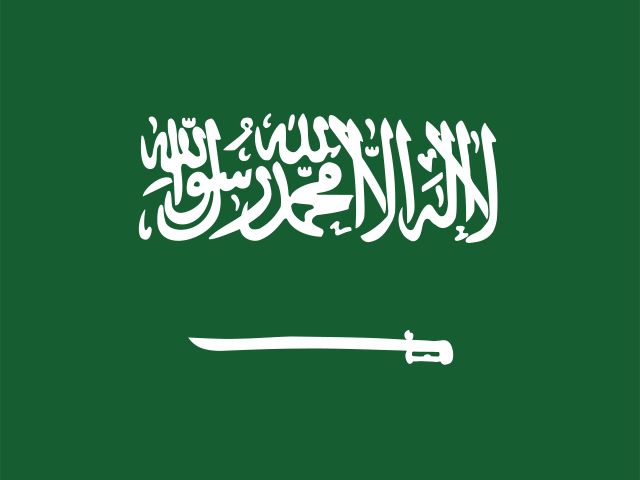
The Flag of Saudi Arabia
Asia · Adopted 1973 (current proportions); underlying design traces to the early 20th-century House of Saud
Saudi Arabia's flag carries text as its central feature rather than a purely graphic emblem: written across a plain green field in white Thuluth calligraphy is the Shahada, the Islamic declaration of faith — 'There is no god but God; Muhammad is the messenger of God' — with a horizontal white sword beneath it. That basic combination has represented the House of Saud's territory since the family's early 20th-century military campaigns to unify the Arabian Peninsula, well before the modern Kingdom of Saudi Arabia was formally proclaimed in 1932 under Abdulaziz ibn Saud.
The flag's exact modern form, including its standardized proportions and precise calligraphic style, was fixed in 1973, consolidating design elements that had varied somewhat across earlier Saudi state flags used since the early 1900s. Green is closely associated with Islam generally, and the sword beneath the Shahada is understood to reference the military conquests through which Ibn Saud unified the fractious tribal and regional territories of the Arabian Peninsula, including the recapture of Riyadh in 1902, into a single kingdom.
Because the flag carries sacred religious text, Saudi Arabia observes flag protocols found on almost no other national flag: it is never flown at half-mast, even during official periods of mourning, because lowering a flag bearing the Shahada would be considered disrespectful to the religious declaration itself rather than an appropriate gesture of respect for the dead.
For the same religious reason, Saudi flags are manufactured as true double-sided designs, with the calligraphy and sword mirrored on the reverse side so the Arabic text reads correctly left-to-right no matter which face of the flag a viewer sees — most national flags, by contrast, show backwards or mirrored text on their reverse side when a design element like text is simply printed through a single layer of fabric, but Saudi Arabia specifically avoids this because a reversed, illegible rendering of the Shahada is considered unacceptable.
Saudi Arabia's flag has also never been used on merchandise, clothing, or novelty items in the way many national flags commonly are internationally, again a direct consequence of the religious text it carries; Saudi authorities and religious guidance have historically discouraged uses of the flag that could result in the Shahada being crumpled, discarded, or otherwise handled in ways deemed disrespectful to the sacred phrase.
The kingdom's flag has stayed remarkably stable compared to many nations that redesigned their flags around independence or major political transitions, in part because Saudi Arabia's founding in 1932 was itself a consolidation of existing Saudi-controlled territory rather than a break from a colonial power that required an entirely new national symbol.
Because the combination of a green field, Arabic calligraphy, and a sword is distinctive, Saudi Arabia's flag has no close national lookalike; its closest conceptual cousins are the flags of a small number of other Gulf and Islamic states that also incorporate the Shahada in some form, though none pairs it with the same green field, sword, and Thuluth calligraphic style used by Saudi Arabia specifically.
Green was not always the color associated with Saudi state flags: the First Saudi State (1744–1818) and Second Saudi State (1824–1891), both earlier Al Saud-led polities predating the modern kingdom, are generally associated with plain white banners bearing the Shahada rather than green ones, reflecting the stricter, more austere Wahhabi religious character of those earlier states; green became the standard field color specifically under Ibn Saud's 20th-century unification campaigns, and the modern kingdom's flag descends from that later Al Saud tradition rather than directly from the earlier white-flagged states.
The sword on the flag is sometimes associated specifically with the sword of Abdulaziz ibn Saud himself, though like much of the flag's early symbolism, the exact historical basis for that identification is not rigorously documented and is best understood as a broad reference to the military unification of the peninsula rather than a claim about one specific weapon.
Saudi Arabia designated 11 March as an official Saudi Flag Day by royal decree in 2005, a date set aside specifically to honor the flag itself rather than being folded into the country's broader National Day on 23 September, which instead commemorates the 1932 proclamation of the unified kingdom — giving the flag its own distinct annual observance separate from the country's founding anniversary.
Saudi Arabia's flag proportions and the exact dimensions of its Thuluth calligraphy and sword were fixed by Council of Ministers Resolution No. 2 of 1394 AH (1974), which specifies the ratio at 2:3 and sets out the stroke thickness of the lettering and the sword's length and curve relative to the flag's height — a regulatory precision typical of flags bearing sacred text, since inconsistent hand-lettering of the Shahada across different manufacturers was considered a genuine risk to the phrase's dignity and legibility. Flag production is restricted to government-licensed workshops for the same reason, rather than being open to any commercial textile manufacturer as is common for most national flags.
Iraq briefly produced a flag carrying religious Arabic text of its own: in January 1991, during the Gulf War, Saddam Hussein's government added the takbir, 'Allahu Akbar' ('God is greatest'), in green Kufic script between the three stars of Iraq's existing red-white-black tricolor. That inscription, in Hussein's own handwriting according to Iraqi state media at the time, remained on Iraq's flag even after his fall in 2003 and was not removed until a 2008 redesign restyled the script in a more standard Kufic typeface — a case of Quranic-style text on a national flag that never resembled Saudi Arabia's design closely (different colors, layout, and phrase) but is sometimes raised in the same conversation about Arab states inscribing religious phrases on their flags.
Saudi Arabia at a glance
- Capital
- Riyadh
- Population
- 36.9 million (2024)
- Currency
- Saudi Riyal (SAR)
- Language(s)
- Arabic (official)
Population figure as of 2024, source: UN World Population Prospects (2024 revision). See methodology for how facts are sourced and kept current.