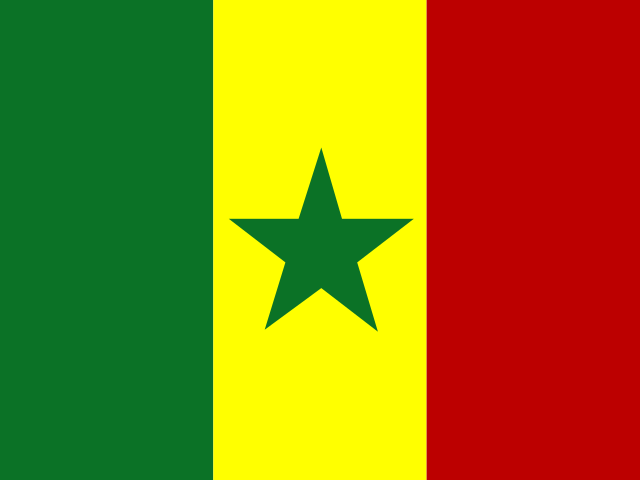
Dakar — Capital of Senegal
Dakar sits on the Cap-Vert peninsula, the westernmost point of the African mainland, a geographic distinction that made it strategically valuable to European and, later, transatlantic shipping long before the modern city existed — the peninsula's tip, the Pointe des Almadies, remains marked today as the mainland's farthest-west point, a fact often noted in local tourism material.
The French founded Dakar formally in 1857 as a colonial port and military post, but the surrounding area had already been shaped for centuries by nearby Gorée Island, a small island just offshore that had served, under successive Portuguese, Dutch, and French control from the 15th century onward, as one of the Atlantic coast's most notorious hubs for the transatlantic slave trade — a history commemorated today at the House of Slaves museum on Gorée, though historians have debated the precise scale of trade that actually passed through the island's small holding facilities compared with larger mainland ports.
Dakar's rise to regional prominence accelerated in 1902, when French colonial authorities moved the capital of French West Africa (Afrique Occidentale Française, or AOF) — the federation governing France's vast West African holdings — from Saint-Louis, further north, to Dakar, drawn by its deep-water port and its position as a natural stopover point on shipping and, later, transatlantic flight routes between Europe, South America, and the rest of Africa.
When Senegal became independent in 1960, first briefly as part of the Mali Federation and then as its own state after the federation's collapse, Dakar continued as national capital without interruption, retaining the administrative infrastructure built up over nearly six decades as the seat of French West African government.
The city is home to Cheikh Anta Diop University, founded in 1957 as the University of Dakar and later renamed for the Senegalese historian and physicist known for his scholarship on African civilizations, and to the African Renaissance Monument, a roughly 49-meter bronze statue overlooking the city completed in 2010 with North Korean construction assistance, commissioned to mark the 50th anniversary of Senegal's independence and remaining one of the tallest statues in Africa.
Dakar was also, for decades, the finish line of the original Paris–Dakar Rally, an overland motorsport race first held in 1978 that ran from Europe across the Sahara to Senegal's capital until security concerns in the Sahel led organizers to relocate the event to South America starting in 2009, ending Dakar's long association with the race that still carries its name.
The city's Sandaga Market and its distinctive multicolored ferry boats connecting the mainland to Gorée Island remain daily fixtures of Dakar life, while the newer Blaise Diagne International Airport, opened in 2017 well outside the city center, was built specifically to relieve the older, land-constrained Léopold Sédar Senghor International Airport, whose runway had been hemmed in for decades by Dakar's dense urban growth on the narrow Cap-Vert peninsula.
Dakar hosts the annual Dakar Biennale (Dak'Art), first held in 1990 and now one of the most prominent contemporary art exhibitions on the African continent, drawing artists and curators from across Africa and its diaspora and reinforcing the city's longstanding claim, dating back to the Senghor era, as a leading center of Francophone African arts and literature.
Quick facts
- Dakar's metropolitan area had grown to roughly 3.9 million residents by 2024 estimates, making it Senegal's largest city and one of the largest urban areas in West Africa.
- Dakar became capital of French West Africa in 1902, a role it held until the federation dissolved with decolonization in 1960.
- UNESCO placed Gorée Island on its World Heritage List in 1978, citing the small island's weight as a memorial site tied to the Atlantic slave trade.
- The African Renaissance Monument, completed in 2010, stands taller than the Statue of Liberty and was built with North Korean construction assistance, a choice that drew both domestic and international controversy over its cost.
- The Paris-Dakar Rally finished in the city from 1978 until 2007; security concerns in the Sahara led organizers to move the race to South America from 2009 onward, though it still carries the Dakar name.