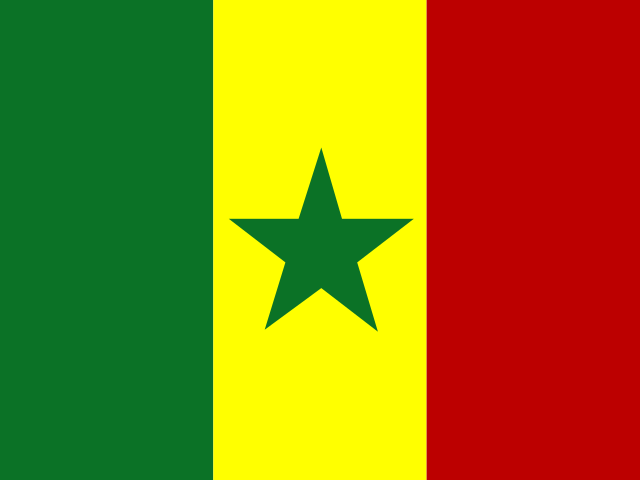
The Flag of Senegal
Africa · Adopted 20 August 1960
Senegal's current flag dates to 20 August 1960, but that date marks a specific split rather than a clean break from colonial rule: Senegal and neighboring Sudan (present-day Mali) had briefly joined as the Mali Federation earlier that year, gaining independence from France together on 20 June 1960 under a shared flag — green, yellow, and red vertical bands with a black kanaga figure, a stylized human shape drawn from Bambara cultural symbolism, centered on the yellow band. The federation collapsed after barely two months, and Senegal withdrew, formally declaring its own separate independence on the same August date and adopting a modified version of the shared flag as its own.
Rather than design something entirely new, Senegal kept the federation's green-yellow-red vertical tricolor but replaced the black kanaga figure with a simple green five-pointed star centered on the yellow band — a change specific and deliberate enough that the two former federation partners' flags remain visually related today. Mali, for its part, dropped the kanaga figure too when it later readopted its own plain green-yellow-red tricolor, meaning neither successor state kept the original federation emblem, but Senegal's choice of a star rather than no emblem at all is what distinguishes its flag from Mali's completely plain bands.
The three colors follow the same broad pan-African symbolic set used across many former French West African colonies at independence: green is associated with Islam, the majority religion in Senegal, as well as with hope and agriculture; yellow represents the country's savanna landscape and its natural wealth; and red is tied to the sacrifice and struggle involved in the independence movement, along with a more general symbolism of determination and life.
The green star at the center is most commonly explained as a symbol of unity and of Senegal's hopes for the future, though its exact original intended meaning is less precisely documented in official sources than some of the flag's other elements — Senegalese civic materials generally describe it simply as representing unity and a guiding light for the nation, without attaching it to a specific count of regions or ethnic groups the way some other African flags' star symbolism is explained.
Senegal's flag has remained unchanged since the August 1960 adoption, surviving Senegal's status as one of the more politically stable states in West Africa through the long presidency of Léopold Sédar Senghor (1960–1980), the country's first president and a major figure in Francophone African literature, and through every subsequent peaceful transfer of power, including the 2024 election that brought President Bassirou Diomaye Faye to office.
The flag flies prominently on Independence Day, 4 April — a date that actually commemorates Senegal's 1960 transfer of sovereignty within the French Community framework agreed months before the Mali Federation's brief existence, making 4 April and 20 August both meaningful dates in the country's path to full, separate statehood.
Senegal's brief union with Sudan (Mali) is still visible in more than just the flag: the two countries' national anthems, currencies at the time, and early administrative structures were also drawn up jointly during the federation's few months of existence in 1960, and Senegalese school textbooks continue to present the Mali Federation period as a formative, if short-lived, chapter in the country's path to full independence rather than skipping over it.
The green star has occasionally been read by some commentators as echoing the single star used on Ghana's flag and several other early independence-era African flags associated with pan-Africanist politics of the late 1950s and 1960s, though Senegalese officials have generally avoided endorsing any single, fixed political reading of the star beyond the general themes of unity and hope stated in civic education materials.
Léopold Sédar Senghor, Senegal's first president and one of the founders of the Négritude literary and cultural movement, was closely involved in the country's broader early symbolic choices at independence, and the same vertical-tricolor-with-star design has remained the flag under every one of Senegal's presidents since, including through Senegal's reputation, unusual in the region, for never having experienced a successful military coup since independence, a political stability the flag has quietly outlasted several waves of upheaval among its immediate neighbors to represent.
Senegal's flag is also flown, alongside the flags of the other member states, at meetings of the Economic Community of West African States (ECOWAS) and the West African Economic and Monetary Union (UEMOA), both regional bodies in which Senegal has historically played an outsized diplomatic role relative to its size, in part due to Dakar's long institutional history as the former administrative capital of French West Africa.
Senegal's 2024 presidential election, which brought Bassirou Diomaye Faye and his Pastef party to power after a tense pre-election period that briefly saw the vote postponed by the outgoing government, was resolved peacefully and constitutionally, extending Senegal's decades-long record of avoiding the coups and unconstitutional transfers of power that have affected several of its Sahelian neighbors in the 2020s, a stability the flag's green star has been invoked by some commentators to represent even outside its original, more general 1960 symbolism.
The star on the middle band
- Flag with a centred emblem — What separates this from Mali's otherwise identical tricolour is a single green star centred on the yellow, so a flag whose star drifts off centre loses the only distinguishing mark it has.
As an Amazon Associate we earn from qualifying purchases made through these links, at no extra cost to you.
Often confused with
- Mali — shares the exact same green-yellow-red vertical band order because both flags descend from the same short-lived Mali Federation flag of 1960, but Mali's current flag has no emblem at all, while Senegal's carries a green star centered on the yellow band. Compare side by side →
Senegal at a glance
- Capital
- Dakar
- Population
- 18.3 million (2024)
- Currency
- West African CFA Franc (XOF)
- Language(s)
- French (official); Wolof widely spoken as a lingua franca alongside other national languages
Population figure as of 2024, source: UN World Population Prospects (2024 revision). See methodology for how facts are sourced and kept current.