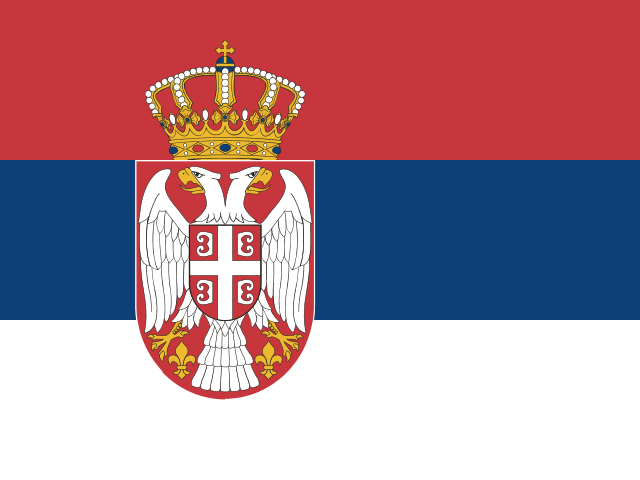
Belgrade — Capital of Serbia
Belgrade sits at the confluence of the Sava and Danube rivers, a position so strategically valuable that the city has been fought over and rebuilt more times than almost any other European capital — historians commonly cite somewhere around forty documented wars fought over control of the site and roughly that many times it has been razed and reconstructed, from Celtic and Roman settlement through Byzantine, Bulgarian, Hungarian, and Ottoman rule to the modern Serbian state.
The name Beograd, 'white city,' is first recorded in a Bulgarian document from 878, referring to the white limestone walls of the fortress that has anchored the site through nearly every subsequent regime; that fortress complex, Kalemegdan, sits on the ridge overlooking the river confluence and remains Belgrade's most visited historic landmark, its layered fortifications showing construction from Roman, medieval Serbian, Austrian, and Ottoman periods stacked on top of one another.
Belgrade became the capital of the modern Serbian state in stages rather than in a single founding moment: it served as capital of the medieval Serbian Despotate briefly in the early 15th century before falling to Ottoman forces in 1521, then returned to prominence as the Principality of Serbia's capital in 1841 after the Principality gained increasing autonomy from Ottoman rule through the first half of the 19th century, and it has held that role continuously since — through full independence in 1878, the Kingdom of Yugoslavia, socialist Yugoslavia (as federal capital), and the independent Republic of Serbia after 2006.
The city was heavily damaged multiple times in the 20th century alone: German bombing in April 1941 killed thousands in the opening days of the Axis invasion of Yugoslavia, and NATO airstrikes in 1999 during the Kosovo conflict targeted government and military buildings in central Belgrade, leaving several bombed structures — including the former Yugoslav Ministry of Defense complex — deliberately left unrepaired for years afterward as a visible reminder of the campaign.
Today Belgrade is Serbia's political, economic, and cultural center and by far its largest city, home to the University of Belgrade (founded 1808, one of the oldest in southeastern Europe), the Serbian parliament, and Skadarlija, a cobblestoned bohemian quarter dating to the 19th century that remains the city's best-known nightlife and traditional-restaurant district.
St. Sava Temple, one of the largest Orthodox Christian church buildings in the world, sits on the site where Ottoman forces are recorded to have burned the relics of Saint Sava — the founder of the Serbian Orthodox Church — in 1595 as a deliberate act against Serbian religious identity; construction of the current church began in 1935 but was interrupted for decades by the Second World War and the socialist period's general discouragement of large religious construction, and the interior mosaics were not completed until 2021, making it a building whose own construction timeline spans nearly the entire turbulent 20th century it commemorates.
Belgrade briefly changed hands during the 1990s wars only in the sense of political upheaval rather than occupation: the city was the site of mass anti-Milošević protests throughout the decade, culminating in the toppling of the Milošević government on 5 October 2000 after disputed election results, an event Serbians commonly refer to simply as the '5th of October' and treat as the symbolic end of the Yugoslav-wars era in the capital's own political life.
Quick facts
- Metropolitan Belgrade has a population of roughly 1.7 million as of 2024, making it by far Serbia's largest city and several times the size of the country's next-largest urban area, Novi Sad.
- Belgrade briefly served as the joint capital of the Kingdom of Serbs, Croats and Slovenes (later Yugoslavia) starting in 1918, and remained the federal Yugoslav capital through the country's socialist period until Yugoslavia's final dissolution in the early 1990s.
- The name 'Beograd' combines the Slavic words for 'white' (beo) and 'city' (grad), a reference to the white stone fortifications of the Kalemegdan citadel.
- Belgrade was named a European Capital of Culture candidate city and hosts the Belgrade International Film Festival (FEST), running since 1971, one of the longest-running film festivals in Southeast Europe.
- The city's Ada Ciganlija peninsula on the Sava River was converted into an artificial island recreation area in the 1960s and remains one of Belgrade's most popular summer destinations for residents.