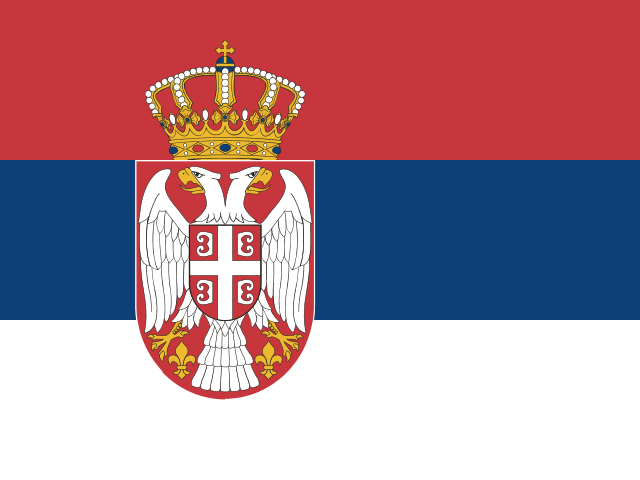
The Flag of Serbia
Europe · Adopted 11 November 2010 (current coat-of-arms version); tricolor in use since 1835
Serbia's red-blue-white tricolor traces back to the pan-Slavic congress held in Prague in June 1848, where delegates from across the Slavic-speaking lands of the Austrian Empire adopted red, blue, and white as a shared set of colors — borrowed from the Russian imperial flag — to signal Slavic solidarity under Habsburg rule. Serbian representatives at that congress carried the colors home, and the Principality of Serbia had formally adopted a red-blue-white flag by 1835, well before full independence from Ottoman suzerainty was internationally recognized at the Congress of Berlin in 1878.
What distinguishes Serbia's flag from its pan-Slavic cousins is the order of the stripes: Serbia flies red over blue over white, the reverse of Russia's white-blue-red. Slovenia and Slovakia, which also trace their tricolors to the same 1848 congress, kept the white-blue-red order closer to Russia's, so Serbia stands out from that whole family by having effectively inverted the sequence rather than copied it directly — a detail vexillologists point to when explaining why the flag looks similar to, but is never mistaken up close for, its Slavic relatives.
The coat of arms occupying the hoist side is where Serbia's specifically national symbolism sits: a red shield bearing a white cross with four stylized firesteels (curved C-shapes, popularly read in Serbia as the Cyrillic letter С, for 'Само слога Србина спасава' — 'Only unity saves the Serbs') sits below a silver double-headed eagle on a red field, itself crowned, with a smaller shield of the House of Nemanjić — the medieval dynasty that ruled Serbia's most powerful pre-Ottoman kingdom — draped across the eagle's breast.
That exact arms-plus-tricolor combination is comparatively recent as state law: Yugoslav-era Serbia flew a plain tricolor without any arms attached, and it was only after Serbia and Montenegro's brief post-Milošević union dissolved in 2006 that the newly independent Republic of Serbia formally readopted the eagle-and-cross arms on its flag, doing so through the Law on the Look and Use of the Coat of Arms, Flag and Anthem of the Republic of Serbia passed 11 November 2010 — the date used as the current design's official adoption even though every element it combines is much older.
During the socialist Yugoslav period (1945–1992), Serbia's republican flag inside the federation carried a red five-pointed star bordered in gold above the tricolor rather than the Nemanjić arms, following the same pattern used across Yugoslavia's other constituent republics; that star was dropped in the early 1990s as Serbia moved away from single-party rule, well before the 2010 law formalized the current heraldic replacement.
Serbia's flag is sometimes casually grouped with Russia's in international coverage because both use red, blue, and white, but Serbians themselves are far more likely to note the resemblance to Slovenia's and Slovakia's flags, which share not just the same three colors but the same 1848 Prague-congress origin story — the practical difference being that Slovenia and Slovakia distinguish themselves with their own national arms placed on a white-blue-red base, while Serbia distinguishes itself by flipping the stripe order to red-blue-white and adding the Nemanjić-eagle arms.
Flag law in Serbia fixes the ratio at 2:3 and specifies the state flag (with arms) for government use, alongside a plainer civil ensign without the coat of arms that ordinary citizens and private buildings may fly — a two-tier system common across the former Yugoslav republics that lets everyday use skip the heraldic detail while official buildings display the full state version.
The firesteel symbol on the shield has its own separate, older documentary trail: four stylized C-shapes arranged around a cross appear on Serbian Orthodox Church seals and ecclesiastical objects going back to the Byzantine period, originally understood as firesteels (ocila) used to strike sparks for fire rather than as letters at all. The reading of the four Cs as the Cyrillic С, standing for the 19th-century nationalist motto 'Само слога Србина спасава,' developed later as a patriotic reinterpretation of an older religious symbol, and both explanations are taught side by side in Serbia today rather than one having fully displaced the other.
During the breakup of Yugoslavia in the 1990s, the plain red-blue-white tricolor — without any arms — was also flown by the self-declared Republika Srpska Krajina and Republika Srpska, Bosnian Serb political entities that emerged during the Croatian and Bosnian wars; that period left the tricolor carrying, for audiences in the wider region, associations with Serb nationalism during the Yugoslav wars that Serbia's own post-2000 governments have had to actively work to separate from the flag's older, pre-war pan-Slavic symbolism.
Kosovo, whose 2008 declared independence Serbia does not recognize, sits at the center of an ongoing dispute over Serbian national symbols more broadly: Serbian communities within Kosovo continue to fly the Serbian tricolor and coat of arms throughout Serb-majority municipalities in the north, a practice that remains a recurring point of friction in Kosovo–Serbia relations and in international mediation efforts over the territory's status.
Serbia's National Assembly building in Belgrade flies the state flag with arms year-round, and Serbian law designates specific additional flag-flying days beyond the two major national holidays, including Statehood Day on 15 February, commemorating the 1804 First Serbian Uprising against Ottoman rule — an anniversary that predates the modern tricolor itself by decades and is treated as the deeper root of Serbian statehood the flag's own 1835 origin ultimately grew out of.
The arms sit toward the pole
- Placement-accurate flag — The shield is set off centre toward the hoist rather than in the middle of the flag, and a version with it centred is a reproduction someone has tidied up.
As an Amazon Associate we earn from qualifying purchases made through these links, at no extra cost to you.
Often confused with
- Slovenia — shares the same 1848 pan-Slavic color set, but Slovenia keeps the white-blue-red order (Serbia flips to red-blue-white) and places Mount Triglav and three gold stars in its arms rather than a double-headed eagle. Compare side by side →
- Slovakia — also descends from the 1848 Prague congress with white-blue-red stripes, but its arms show a white double cross on three blue hills, not Serbia's Nemanjić eagle, and the stripe order again runs opposite to Serbia's. Compare side by side →
Serbia at a glance
- Capital
- Belgrade
- Population
- 6.6 million (2024)
- Currency
- Serbian Dinar (RSD)
- Language(s)
- Serbian (official)
Population figure as of 2024, source: UN World Population Prospects (2024 revision). See methodology for how facts are sourced and kept current.