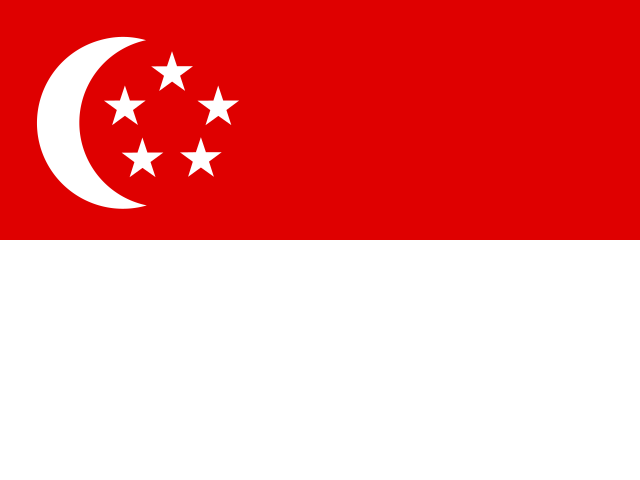
Singapore — Capital of Singapore
Singapore is unusual among the entries on this site because the capital and the country are the same place: there is no separate capital city distinct from the nation, since Singapore has been a fully urbanized city-state since independence, with the entire island functioning as one integrated administrative, economic, and residential unit rather than a capital city serving a larger surrounding country.
Before its modern founding, the island was already inhabited, home to a Malay fishing settlement and periodically part of the Srivijaya and later Johor-Riau sultanates' spheres of influence; its modern transformation began in 1819, when Sir Thomas Stamford Raffles, acting for the British East India Company, negotiated rights to establish a trading post on the island, quickly declaring it a free port that attracted merchants and settlers from across the region free of the tariffs and restrictions common at rival colonial ports.
That free-port status drove explosive early growth, pulling in Chinese, Malay, Indian, Arab, and European traders and laborers within just a few decades and establishing the multiethnic demographic character that still defines Singapore today; by the late 19th century it had become one of the busiest ports in the British Empire and the administrative center of the Straits Settlements.
Japan occupied Singapore from 1942 to 1945 during the Second World War, renaming it Syonan-to ('Light of the South') after a swift and, for the British, deeply humiliating military defeat; the wartime occupation and the perceived failure of British colonial defense during it are widely cited by historians as a major factor accelerating postwar demands for self-government across British Southeast Asian and South Asian colonies generally.
Singapore joined the Federation of Malaysia in 1963 after gaining self-governance, but political and racial tensions between Singapore's Chinese-majority population and the Malay-dominated federal government in Kuala Lumpur led to its expulsion from the federation in August 1965 — an outcome the country's own founding leadership, including first prime minister Lee Kuan Yew, had not sought and initially treated as a crisis, before the newly independent city-state went on to build one of the fastest sustained economic growth records in the world over the following decades.
A cornerstone of that postwar transformation was the Housing and Development Board's public housing program, launched in 1960, which now houses more than three-quarters of Singapore's resident population in government-built apartment blocks — one of the most extensive public housing systems in the world relative to population, and the same HDB flats where flags are distributed for mass display each National Day.
The Merlion, a mythical creature with a lion's head and a fish's body unveiled as a tourism symbol in 1972, has become one of Singapore's most internationally recognized unofficial emblems, standing at the mouth of the Singapore River near landmarks like Marina Bay Sands and Gardens by the Bay that together illustrate how thoroughly the once-modest trading port has been rebuilt as a global business and tourism hub since independence.
Singapore's cityscape has also been substantially reshaped by decades of land reclamation, which has expanded the island's total land area by more than 20 percent since independence and created entire modern districts, including much of the Marina Bay area, from what was previously open water — a program driven by the country's chronic land scarcity as one of the most densely populated sovereign states in the world. The city's hawker centers, open-air food courts descended from street food stalls the government relocated and formalized starting in the 1960s for sanitation reasons, were recognized by UNESCO as an element of Intangible Cultural Heritage in 2020, an unusually food-focused heritage listing that reflects how central hawker food remains to everyday Singaporean life across ethnic lines.
Distinct ethnic enclaves — Chinatown, Little India, and the Malay-Muslim quarter of Kampong Glam — still anchor much of the city's older architecture and retail character, even as most Singaporeans today live in planned HDB new towns spread across the rest of the island rather than in these historic core districts.
Quick facts
- Singapore is formally the Republic of Singapore, a parliamentary republic with a directly elected, largely ceremonial presidency, a role that has existed in its current elected form only since 1991.
- Changi Airport, opened in 1981 on reclaimed land at the island's eastern tip, consistently ranks among the world's top-rated airports and anchors Singapore's status as a regional aviation and logistics hub.
- Singapore recognizes four official languages — Malay, English, Mandarin, and Tamil — with Malay retained as the symbolic national language despite English functioning as the main language of government and business.
- Orchard Road, now Singapore's principal shopping street, began the 19th century as a rural road running past nutmeg and pepper plantations on the city's outskirts.
- Singapore's National Day, marked every 9 August, features one of Southeast Asia's largest annual parades, historically staged at the Padang and in recent decades also at a floating platform on Marina Bay.