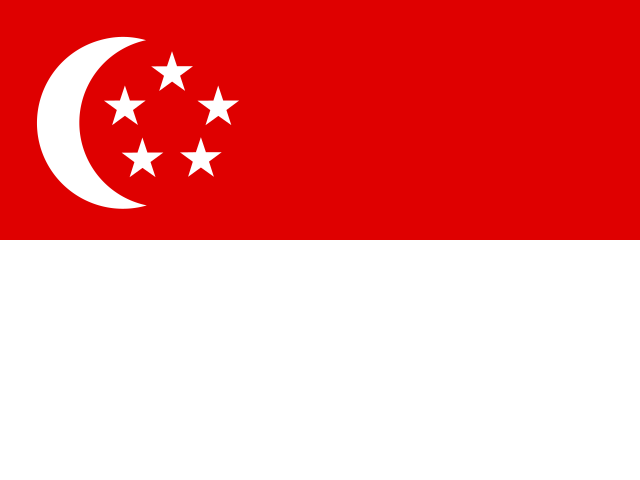
The Flag of Singapore
Asia · Adopted 3 December 1959
Singapore's flag was adopted on 3 December 1959, not at full independence but at the point when Singapore gained self-governance from Britain while still remaining a British territory in transition — it was carried forward unchanged first through Singapore's brief 1963–65 merger with Malaysia and then through full independence as a separate republic in August 1965, making it one of relatively few national flags whose adoption date predates the country's actual independence by several years.
The design was developed by a committee led by Toh Chin Chye, a founding member of the People's Action Party who would go on to serve as Singapore's first deputy prime minister, working with representation intended to reflect Singapore's Chinese, Malay, and Indian communities rather than favoring any single ethnic group's traditional colors or symbols — a deliberate choice given the serious inter-communal tensions of the era, including riots in the years immediately surrounding independence.
The flag is a horizontal red-over-white bicolor with a white crescent moon and a cluster of five white five-pointed stars in the upper hoist corner, all set against the red field. Red represents universal brotherhood and equality; white represents pervading and everlasting purity and virtue. The crescent moon symbolizes a young nation on the rise, and the five stars are explicitly defined by the government as representing the nation's founding ideals: democracy, peace, progress, justice, and equality.
Because a crescent moon commonly reads as an Islamic symbol elsewhere in the world, Singapore's government has been explicit that the crescent on its flag is not intended as a religious reference but specifically as a symbol of a young, ascending nation — a distinction the country's official explanations of the flag consistently emphasize, given Singapore's own religiously and ethnically diverse population, which includes substantial Buddhist, Muslim, Christian, Hindu, and non-religious communities.
Singapore's flag has remained completely unchanged since its 1959 adoption, surviving the country's merger with and subsequent unexpected separation from Malaysia in 1965 — a split driven by political and racial tensions between Singapore's Chinese-majority population and the federal government in Kuala Lumpur — without any redesign, even though the abrupt and largely involuntary path to full independence might have prompted a new national symbol in many other countries' comparable circumstances.
Singapore is unusual among sovereign states in that its capital is not a separate city distinct from the country itself: Singapore is a city-state, so 'Singapore' functions simultaneously as the name of the nation, its government, and its urban center, with no separate capital city designation the way Kuala Lumpur functions for Malaysia or Jakarta for Indonesia.
The flag appears on Singapore's Housing and Development Board flats and other public housing en masse every National Day, 9 August, when the government distributes flags for residents to display, a widely observed tradition that makes flag display around National Day one of the most visible annual expressions of Singaporean national identity.
Because the red-white color combination with a crescent and stars is broadly shared with several other national flags in Southeast Asia and the Islamic world, Singapore's flag can be superficially confused with others sharing red and white fields, though the specific pairing of a red-over-white horizontal bicolor with a crescent-and-five-stars cluster in the canton is unique to Singapore.
The flag's display rules are set out in Singapore's Singapore Arms and Flag and National Anthem Act, which governs everything from correct hoisting procedure to when private citizens may display the flag on their homes and vehicles outside of officially designated periods around National Day — a level of legal formality around everyday civilian flag use that is more detailed than in many other countries.
The flag was flown at half-mast nationwide following the death of Lee Kuan Yew, Singapore's first prime minister and one of the principal architects of its post-1965 development, in March 2015; the week of national mourning that followed, during which hundreds of thousands of Singaporeans queued for hours to view his casket lying in state, is widely regarded as one of the largest public displays of collective national sentiment in the country's history.
Regulations on private flag display were relaxed in 2004, when the government began permitting citizens to fly the flag from their homes year-round rather than only during an officially designated period around National Day as had previously been required, a change intended to encourage more everyday, informal displays of national identity alongside the highly organized annual National Day observances.
By law, Singapore's flag is a 2:3 rectangle, with the government specifying the exact red (close to Pantone 032C) to be used on official versions, and the crescent moon and five stars sized and positioned according to a precise geometric grid published in the country's flag regulations rather than left to a designer's approximation — a level of technical specificity typical of a state that has historically prized administrative precision in its national symbols as much as in its public housing and transport planning.
The flag received unusually visible commemorative treatment during Singapore's 2015 Golden Jubilee (SG50), marking 50 years of independence, when a specially proportioned 50th-anniversary flag emblem was produced and displayed alongside the standard flag on buildings, buses, and merchandise nationwide for the year, distinct from any change to the legal national flag itself, which remained the unaltered 1959 design throughout the celebration.
Because Singapore's flag rules also govern its use in schools, the flag features prominently in the daily pledge-taking assemblies held in Singaporean primary and secondary schools, where students recite the national pledge facing the flag each morning — a routine civic practice that keeps the 1959 design in front of nearly every Singaporean citizen from early childhood, well before most encounter it in any other official context.
Crescent and five stars, correctly placed
- Geometry-accurate flag — The five stars sit in a ring inside the crescent's opening at specified sizes, and the usual fault is stars set too far from the crescent so the two elements read as separate devices.
As an Amazon Associate we earn from qualifying purchases made through these links, at no extra cost to you.
Singapore at a glance
- Capital
- Singapore (city-state; no separate capital city)
- Population
- 6.04 million (2024)
- Currency
- Singapore Dollar (SGD)
- Language(s)
- English, Malay, Mandarin Chinese, and Tamil (all official); Malay is the national language
Population figure as of 2024, source: Singapore Department of Statistics / UN World Population Prospects (2024 revision). See methodology for how facts are sourced and kept current.