Ljubljana — Capital of Slovenia
Ljubljana grew from a Roman-era settlement called Emona, founded around 15 AD along a trade route linking the Italian peninsula to the Danube basin — remnants of Emona's street grid and city walls are still visible in archaeological sites scattered through the modern city center, a rare case of a European capital where the Roman-era layout can still be traced beneath the present streets.
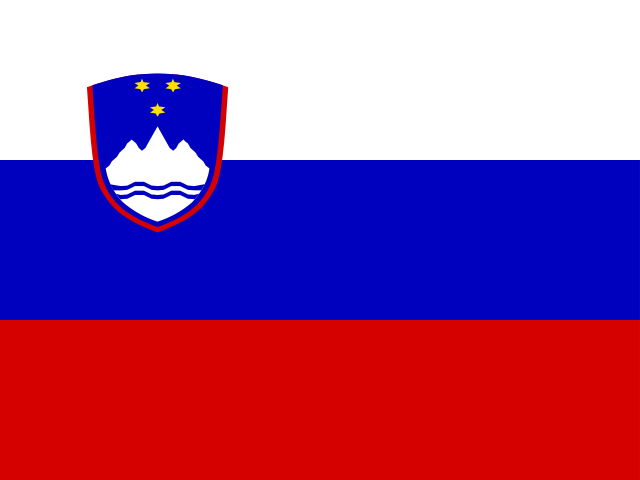
The city's central landmark, Ljubljana Castle, occupies a hilltop that has held some form of fortification since at least the medieval period, with the current structure's oldest surviving sections dating to the 12th century and major additions through the 16th and 17th centuries under Habsburg rule, when the city — then known by its German name, Laibach — served as capital of the Duchy of Carniola, the historic Habsburg province whose blue-and-white heraldic tradition fed into modern Slovenia's own national colors.
Ljubljana briefly became a genuinely international administrative center under Napoleon: from 1809 to 1813, it served as the capital of the Illyrian Provinces, a short-lived French client state carved from Habsburg territory during the Napoleonic Wars, before reverting to Austrian control after Napoleon's defeat — an episode still commemorated in the city with a public square and monument named for the period.
A major earthquake in 1895 destroyed large parts of the historic center, and the reconstruction that followed brought Vienna Secession and Art Nouveau architecture to Ljubljana on a scale unusual for a city its size, giving the rebuilt core a visibly different architectural character from most Habsburg-era towns nearby; the earthquake reconstruction is also credited with modernizing the city's infrastructure decades ahead of many comparable regional centers.
Architect Jože Plečnik reshaped much of Ljubljana's public space between the two World Wars, designing the Triple Bridge across the Ljubljanica River, the riverside colonnaded market, and numerous other landmarks in a distinctive personal style blending classical and modern elements — work so central to the city's identity that UNESCO granted 'The Works of Jože Plečnik in Ljubljana' World Heritage status in 2021.
Ljubljana became the capital of an independent Slovenia only in 1991, after having previously served as capital of Slovenia as a constituent republic within socialist Yugoslavia from 1945 — one of the shorter capital tenures among former Yugoslav republic capitals in terms of full national sovereignty, even though the city's role as the administrative center of Slovene-speaking territory stretches back centuries further under Habsburg rule.
The Ljubljanica River, which winds through the city center beneath Plečnik's Triple Bridge, has yielded an unusually large number of archaeological finds over the past century and a half of dredging and construction work, including Bronze Age dugout canoes and Roman-era coins and tools, pulled from the riverbed in enough volume that some Slovenian archaeologists describe the Ljubljanica as one of the richest single archaeological sites in the country despite being a working urban waterway rather than an excavated dig.
Ljubljana's Dragon Bridge, completed in 1901 and adorned with four bronze dragon statues, was among the first reinforced-concrete bridges built in Europe and is regarded as a landmark of early modern engineering in the region, distinct from the older stone bridges elsewhere in the historic center and often photographed alongside the Triple Bridge as one of the city's two signature crossings.
Quick facts
- Ljubljana's population is roughly 295,000 as of 2024, making it comfortably Slovenia's largest city though modest by European capital standards given Slovenia's total population of about 2.1 million.
- The city's symbol, a green dragon, appears on its coat of arms and is tied to local legend crediting the Greek hero Jason with slaying a dragon at the site — a myth with no historical basis but one still central to the city's branding and tourism imagery today.
- Ljubljana was named European Green Capital in 2016, recognized for banning car traffic from much of its historic center and for its river-cleanup and public-transit investments in the preceding decade.
- The city's name is often folk-derived from the Slovene word for 'beloved' (ljubljena), though linguists generally treat the connection between the river name Ljubljanica and the city name as more securely established than that romantic etymology.
- Ljubljana Castle is reachable by a funicular railway opened in 2006, replacing what had previously been a walking-only ascent up the hill for most visitors.