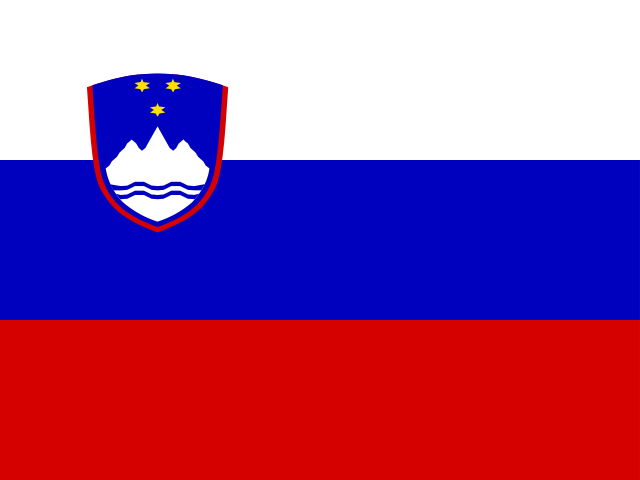
The Flag of Slovenia
Europe · Adopted 24 June 1991
Slovenia adopted its current flag on 24 June 1991, one day before formally declaring independence from Yugoslavia, in the final weeks of a federation that would begin fighting the Ten-Day War over that same declaration almost immediately afterward. Like Serbia's and Slovakia's, the white-blue-red horizontal stripes descend from the 1848 pan-Slavic congress in Prague, but Slovenes also point to a more local precedent: the historic arms of the Duchy of Carniola, the Habsburg crown land covering most of what is now Slovenia, used a blue field with a white eagle for centuries, and 19th-century Slovene nationalists folded those Carniolan blue-and-white associations into the pan-Slavic white-blue-red scheme when they began flying the tricolor during the 1848 revolutions themselves.
What makes the flag unmistakably Slovenian rather than a generic Slavic tricolor is the coat of arms placed in the upper hoist corner, overlapping the white and blue stripes: a blue shield showing Mount Triglav, Slovenia's highest peak at 2,864 meters, rendered in white against the blue field, with two wavy blue lines beneath it representing the country's rivers and its short but economically important stretch of Adriatic coastline, and three six-pointed gold stars arranged in an inverted triangle above.
Those three stars are a direct heraldic borrowing from the medieval Counts of Celje, a powerful noble dynasty that ruled much of Slovene-speaking territory in the 14th and 15th centuries before dying out in 1456 — their arms used three gold stars on blue, and independence-era Slovenia revived the motif specifically to anchor the new state's symbolism in a genuinely Slovene medieval lineage rather than relying only on 19th-century pan-Slavic borrowing.
Slovenia's flag replaced the socialist-era Yugoslav-republic flag, which had used the same white-blue-red tricolor but with a red star bordered in gold centered across all three stripes rather than the Triglav arms; removing the star and substituting the Celje-derived arms was one of the first legislative acts of Slovenia's transition away from single-party Yugoslav rule, passed by the republican assembly in the same June 1991 session that set the stage for independence.
Because Slovenia, Slovakia, and Russia all use the same white-blue-red order in the same proportions, Slovenia's flag is one of the more frequently misidentified in casual contexts — without the Triglav arms in the corner, it is genuinely impossible to tell Slovenia's flag from Slovakia's at a glance, since both are plain horizontal tricolors in identical stripe order; the arms placement is the only reliable distinguishing feature, and Slovenia deliberately positions its arms in the canton corner rather than centered across the stripes the way Slovakia does, partly as a further visual distinction between the two.
Slovenian law fixes the flag's ratio at 1:2, wider than the 2:3 ratio common elsewhere among its Slavic neighbors, and specifies the exact size and position of the coat of arms relative to the stripes; the state flag with the arms is required for official use, while a plain tricolor without arms is permitted for general civilian and decorative use, a two-tier arrangement similar to the one Serbia and other former Yugoslav republics also use.
Triglav's presence on the flag reflects a genuinely deep cultural attachment rather than a generic choice of 'a mountain' as a national symbol: climbing Mount Triglav at least once is widely described in Slovenia as a rite of passage, and the peak's silhouette appears not only on the flag and coat of arms but on the Slovenian euro coins minted after the country adopted the currency in 2007, giving the same mountain image three separate forms of official state recognition.
Slovenia's independence in June 1991 was immediately contested militarily, and the country's flag became a visible marker of that contest almost as soon as it was raised: during the Ten-Day War fought against the Yugoslav People's Army from 27 June to 7 July 1991, Slovenian territorial defense units flew the new tricolor over checkpoints and captured barracks, and the war's comparatively swift end — with a low casualty count relative to the wars that followed in Croatia and Bosnia — meant Slovenia's flag avoided accumulating the heavier wartime associations that shaped how Serbia's and Croatia's symbols were perceived through the rest of the 1990s.
The 1991 arms design was the product of a public competition among Slovene designers rather than a single government-appointed commission, and the winning Triglav-stars-and-waves composition beat out numerous rival proposals that had suggested other Slovene historical symbols, including designs based on the medieval Carantanian principality — an early Slavic polity in the eastern Alps sometimes cited, more loosely than the Counts of Celje connection, as an even older root of Slovene statehood.
Slovenia joined both NATO and the European Union in 2004 and adopted the euro in 2007, transitions that were widely covered domestically as validation of the state the 1991 flag had been raised for; unlike some neighboring post-Yugoslav states whose EU accession talks stretched on for decades, Slovenia's comparatively swift path into Western European institutions is often cited by Slovenes as evidence that the short, low-casualty Ten-Day War let the country avoid the prolonged instability that shaped how Serbia's, Croatia's, and Bosnia's national symbols are perceived internationally.
The shield goes in the corner
- Placement-accurate flag — Without the shield this is Slovakia's and Russia's flag, and the shield belongs in the upper hoist overlapping two bands, not centred; a centred version is the wrong country's arrangement.
As an Amazon Associate we earn from qualifying purchases made through these links, at no extra cost to you.
Often confused with
- Slovakia — an identical white-blue-red stripe order and near-identical proportions; the only reliable difference is arms placement — Slovenia's Triglav-and-stars shield sits in the upper hoist canton, Slovakia's cross-on-hills shield sits centered and overlapping the stripes. Compare side by side →
- Serbia — descends from the same 1848 Prague-congress palette but inverts the stripes to red-blue-white and carries a Nemanjić double-headed eagle where Slovenia places its Triglav-and-stars shield. Compare side by side →
Slovenia at a glance
- Capital
- Ljubljana
- Population
- 2.1 million (2024)
- Currency
- Euro (EUR)
- Language(s)
- Slovenian (official)
Population figure as of 2024, source: UN World Population Prospects (2024 revision). See methodology for how facts are sourced and kept current.