Honiara — Capital of Solomon Islands
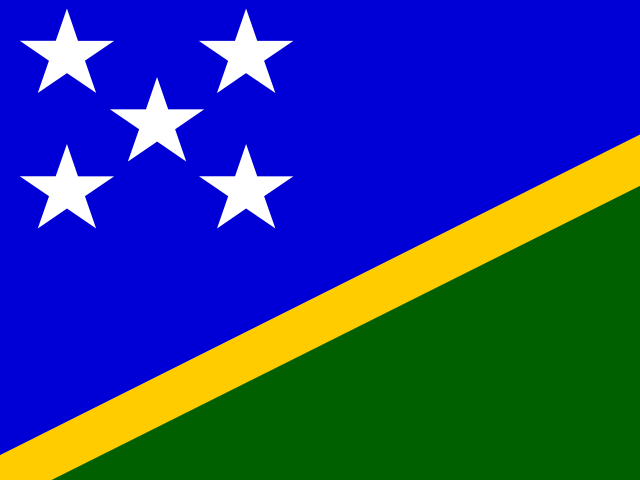
See the flag of Solomon Islands →
Honiara owes its status as capital directly to the Second World War rather than to any pre-colonial or early colonial precedent — before the war, the British protectorate's administrative center was Tulagi, a small island in the Solomons' Nggela group, chosen originally for its compact, easily defended harbor rather than for proximity to the largest population centers.
That changed permanently after the Battle of Guadalcanal (August 1942–February 1943), one of the pivotal campaigns of the Pacific War, fought largely around the airfield the Japanese had begun building near the site of modern Honiara — the same airstrip, expanded and improved by American forces after they seized it, became the core of what grew into Honiara's postwar town, and the wartime infrastructure the Allies left behind made the site a far more practical administrative center than badly damaged Tulagi.
The British protectorate government formally moved its capital from Tulagi to Honiara in 1952, converting a former US Marine base area named after Nalimbiu, and later Honiara — a name derived from the local Guadalcanal word 'Naho ni ara,' loosely meaning 'facing the southeast wind,' referring to the site's exposure to the trade winds — into the seat of colonial and, from 1978, national government.
Because it grew out of a wartime military base rather than an existing town, Honiara's early layout carried a distinctly utilitarian, military-camp character, and physical reminders of the Guadalcanal campaign — including preserved wrecks, memorials, and the Bloody Ridge battlefield just outside the city — remain major landmarks and a significant part of both local memory and Honiara's visitor economy today.
Honiara was also the site of serious unrest during the 1998–2003 ethnic tensions centered on land and political grievances between Guadalcanal and Malaita communities, unrest severe enough that the Australian-led Regional Assistance Mission to Solomon Islands (RAMSI) was deployed to the capital and the country from 2003 until 2017 to restore law and order, a chapter of Honiara's history that shaped policing, governance, and national reconciliation efforts well into the following decade.
The 1998–2003 tensions were not the last time the capital's small Chinatown district was targeted: in November 2021, riots broke out in Honiara after the national government's 2019 decision to switch diplomatic recognition from Taiwan to China, compounded by longstanding grievances from Malaita province, and much of Chinatown was again looted and burned, prompting another round of foreign policing assistance, this time primarily from Australia and Papua New Guinea.
The National Parliament building, a distinctive structure completed in 1993 with design elements evoking a traditional Melanesian meeting house, was a gift funded by the United States government, a reflection of the close postwar ties between Washington and Honiara that trace directly back to the wartime Guadalcanal campaign fought on the same ground decades earlier.
Point Cruz, the small peninsula at the heart of Honiara's harbor, takes its name from the Spanish explorer Álvaro de Mendaña, who charted the Solomon Islands for Spain in the 16th century, centuries before the wartime events that actually built the town — a naming layer from an entirely different colonial encounter sitting alongside the more recent American and British history that shaped the modern capital.
Quick facts
- Honiara's population is roughly 92,000 as of recent estimates, making it by far the Solomon Islands' largest urban center.
- Honiara's Central Market remains one of the largest fresh-produce markets in the South Pacific, drawing goods from across Guadalcanal and the wider archipelago.
- Although it sits on Guadalcanal, Honiara is administratively separate from Guadalcanal Province, governed instead as its own city council area — a distinction that has periodically fed into tensions between the capital and the surrounding province.
- Honiara hosted the 2023 Pacific Games, the largest multi-sport regional event the city had ever staged, using a new national stadium and sporting facilities built largely with Chinese government funding.
- Kukum Highway, Honiara's main coastal road, runs along much of the city's waterfront and roughly follows the route of supply roads built by US forces during the 1942–43 Guadalcanal campaign.
- Betel nut chewing, widespread across Melanesia, is a common sight on Honiara's streets, with small roadside stalls selling nut, lime powder, and pepper leaf as a daily social habit.
- The Solomon Islands National Museum, in central Honiara, houses a modest collection spanning traditional Melanesian artifacts alongside wartime relics recovered from wreck sites and old battle positions scattered across Guadalcanal, from rifles and helmets to salvaged aircraft parts.