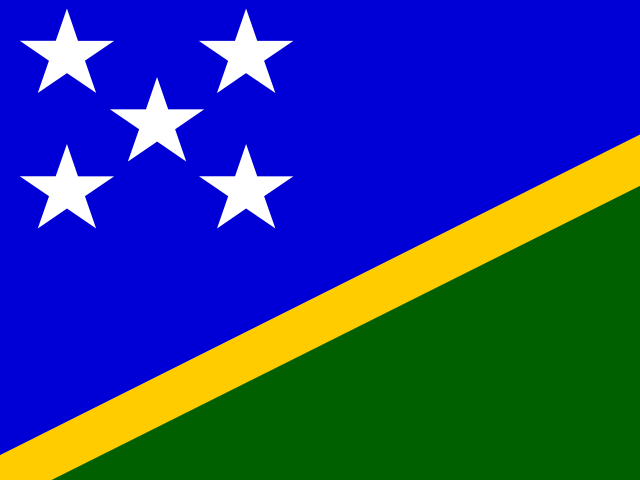
The Flag of Solomon Islands
Oceania · Adopted 18 November 1977 (pre-independence adoption); retained at independence, 7 July 1978
The Solomon Islands adopted its flag on 18 November 1977, about eight months before the country gained independence from Britain on 7 July 1978, following a pattern several Pacific territories used of settling on a national flag design during the final stretch of self-government rather than waiting for independence day itself.
A thin yellow diagonal stripe runs from the lower hoist to the upper fly, splitting the flag into two triangles: blue in the upper hoist, representing the Pacific Ocean surrounding the islands, and green in the lower fly, representing the land and the forests that cover much of the archipelago's mountainous, densely vegetated terrain. The yellow stripe itself is read as representing sunshine, and its diagonal placement — rather than a simple horizontal or vertical divide — was a deliberate design choice intended to give the flag a distinctive, dynamic look compared with more conventional striped designs used elsewhere in the region.
Five white five-pointed stars sit in the blue triangle, arranged in an X-shaped cluster. They represent the five original administrative districts the Solomon Islands were divided into at independence in 1978 — even though the country has since been reorganized into nine provinces plus the capital territory, the star count was never updated to match, meaning the flag now reflects the country's administrative geography as it existed at independence rather than as it exists today, a detail shared by more than one Pacific flag whose star counts froze at the moment of independence.
The Solomon Islands' colonial history began with a British protectorate declared in 1893 over the southern islands, later extended to cover the full archipelago, though the islands themselves had been visited and named far earlier — Spanish explorer Álvaro de Mendaña named them in 1568, reportedly in the mistaken hope that they held the biblical gold of King Solomon, a naming legend the country's own name still carries today regardless of how apocryphal the underlying gold story actually was.
During the Second World War, the Solomon Islands became the site of some of the most intense fighting of the entire Pacific campaign, most notably the Battle of Guadalcanal from August 1942 to February 1943, a six-month land, sea, and air campaign that marked one of the first major Allied offensives against Japan and is remembered as a turning point in the Pacific War — a history entirely separate from the flag's own 1977 design but central to how Guadalcanal, the site of the modern capital, is known internationally.
That same campaign produced one of the more famous individual wartime stories connected to the islands: future US President John F. Kennedy's PT-109 patrol boat was rammed and sunk by a Japanese destroyer near the Solomons in August 1943, and Kennedy and his surviving crew were guided to safety in part through the Allied coastwatcher network, local Solomon Islanders and expatriate observers who reported Japanese ship and troop movements from hidden positions throughout the islands — a wartime intelligence effort now commemorated in Solomon Islands' own national memory alongside the more widely known American accounts of the same events.
The flag has never been redesigned since 1977, despite the star count no longer matching the current number of provinces, and it continues to be flown at Independence Day ceremonies each 7 July alongside the flags of the Solomon Islands' individual provinces.
The country's relatively short post-independence history has included periods of serious internal ethnic tension, most notably between 1998 and 2003, when conflict centered on Guadalcanal and Malaita led to an Australian-led regional peacekeeping mission (RAMSI) that remained in the country until 2017 — a chapter that tested, but did not change, the national symbol adopted in the final months of British rule two decades earlier.
Solomon Islands Pijin, an English-lexified creole that developed out of 19th-century labor trade and plantation contact between Melanesians, Europeans, and other Pacific Islanders, functions as the country's practical common language across its more than 70 distinct indigenous languages, filling much the same unifying role that Tok Pisin plays in neighboring Papua New Guinea, even though English remains the sole official language used in Parliament, courts, and schools.
The Solomon Islands remains a Commonwealth realm, retaining the British monarch as ceremonial head of state represented locally by a governor-general, the same constitutional arrangement it adopted at independence in 1978 and one the flag's design gives no visual indication of, since — unlike Fiji's or Tuvalu's flags of the same era — it carries no Union Jack in its canton, having been designed from the outset around Solomon Islands-specific colors and symbols rather than a modified British ensign.
In September 2019, the Solomon Islands government switched formal diplomatic recognition from Taiwan to the People's Republic of China, ending 36 years of ties with Taipei — a foreign-policy shift that triggered domestic unrest, including riots in Honiara's Chinatown district in November 2021 linked partly to tensions over the switch and broader grievances toward Malaita province, and one of the more consequential geopolitical realignments in the contemporary Pacific, playing out entirely under a flag whose 1977 design predates the controversy by more than four decades.
Officially the flag is longer and narrower than many neighboring Pacific designs, built to a 1:2 shape, and the diagonal yellow stripe is fixed at a specific width and angle by the government's official specifications rather than drawn freehand, ensuring the blue-and-green split remains consistent across manufactured versions used at Honiara's government buildings, provincial offices, and the country's diplomatic missions abroad.
The angle of the yellow stripe
- Geometry-accurate flag — The thin yellow diagonal has both a stated width and a stated angle, and since it is what divides the two fields, getting it wrong shifts the blue and green triangles as well.
As an Amazon Associate we earn from qualifying purchases made through these links, at no extra cost to you.
Often confused with
- Papua New Guinea — stops looking similar the moment the two are set side by side: PNG's field is a bare red-and-black diagonal carrying none of the ocean-and-land color reading behind Solomon Islands' blue and green. The pairing survives mostly as a habit of regional shorthand, both being Melanesian states that left different colonial administrations within the same decade. Compare side by side →
Solomon Islands at a glance
- Capital
- Honiara
- Population
- 740,000 (2024)
- Currency
- Solomon Islands Dollar (SBD)
- Language(s)
- English (official); Solomon Islands Pijin the widely spoken lingua franca; over 70 indigenous languages
Population figure as of 2024, source: UN World Population Prospects (2024 revision). See methodology for how facts are sourced and kept current.