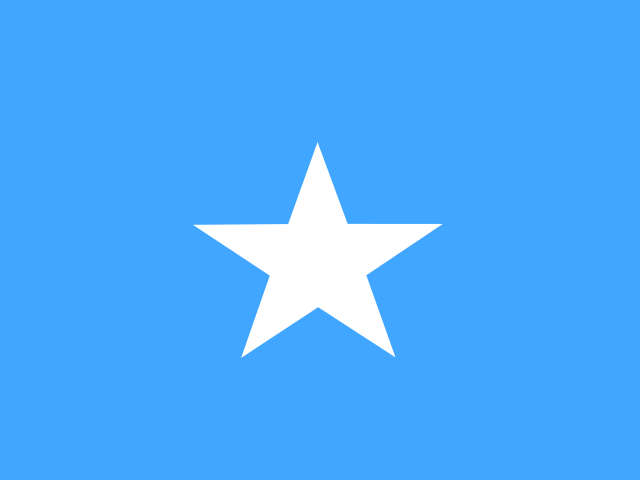
Mogadishu — Capital of Somalia
Mogadishu's history as a trading port stretches back roughly a thousand years, with Arab and Persian merchants establishing settlements along the coast by around the 9th or 10th century, drawn by its position on Indian Ocean trade routes linking East Africa to the Arabian Peninsula, Persia, and eventually India and China. By the time the Moroccan traveler Ibn Battuta visited in 1331, he described it as an exceptionally large and prosperous city, part of a network of Swahili-Arab coastal trading towns whose wealth was built on textiles, ivory, and other goods moving through its harbor.
The city was a major center of the Ajuran Sultanate, a Somali polity that dominated much of the southern Somali coast and interior from roughly the 13th through 17th centuries, and it retained its role as a leading regional port for centuries afterward under a succession of local and, later, Omani and colonial powers, giving Mogadishu one of the longer continuous urban histories of any city in East Africa.
Italy established colonial control over the city in the late 19th century, formally making it the capital of Italian Somaliland in 1905, and the Italian colonial administration built much of the architecture — including the Mogadishu Cathedral, consecrated in 1928 in a Norman Gothic style unusual for the region — that would later define the city's distinctive look before decades of civil war heavily damaged or destroyed many of these landmarks.
Mogadishu continued as capital through the period of UN trusteeship after the Second World War and into independence in 1960, and remained the seat of Somalia's government through the military rule of Siad Barre from 1969 until his overthrow in January 1991 — an event that triggered the collapse of Somalia's central government and the start of a civil war that would leave much of the capital in ruins for years, with rival warlords and, later, armed factions including al-Shabaab controlling parts of the city at different points.
Mogadishu Cathedral, badly damaged by shelling during the civil war in the early 1990s and left as a roofless ruin for decades, has remained a stark visual symbol of the city's wartime destruction, while the historic Hamar Weyne district, with its narrow lanes and coral-stone buildings dating in some cases to the medieval trading era, represents the older layers of the city that predate both Italian colonization and the more recent conflict.
Since the establishment of the internationally recognized Federal Government of Somalia in 2012, Mogadishu has undergone a slow but genuine period of stabilization and reconstruction, with African Union peacekeeping forces (AMISOM, later transitioned to the African Union Transition Mission in Somalia, ATMIS) providing security alongside Somali national forces, though the city and country have continued to face periodic attacks from al-Shabaab militants into the 2020s.
Lido Beach, along Mogadishu's Indian Ocean shoreline, has become one of the more visible symbols of the city's gradual recovery in the 2010s and 2020s, drawing large crowds of residents on weekends despite occasional security incidents nearby, a pattern many Mogadishu residents and journalists have pointed to as evidence of the city's cautious return to something resembling ordinary public life after decades of conflict.
Quick facts
- Reliable census data for Mogadishu doesn't exist, given decades of conflict and displacement, but most 2024 estimates put the city at around 2.5 million people, still comfortably Somalia's largest urban center.
- Ibn Battuta, visiting in 1331, described Mogadishu as an exceptionally large and wealthy trading city, part of a chain of Swahili-Arab coastal ports along the East African coast.
- Mogadishu Cathedral, consecrated in 1928 under Italian colonial rule, was left a roofless ruin after shelling during the early-1990s civil war and has not been fully restored.
- The historic Hamar Weyne district contains coral-stone buildings and narrow streets dating in parts to the medieval trading era, among the oldest surviving urban fabric in the city.
- African Union peacekeeping forces have supported Somali national security forces in and around Mogadishu since 2007, transitioning from AMISOM to ATMIS as the mission's mandate and troop levels have been repeatedly renegotiated through the 2020s.