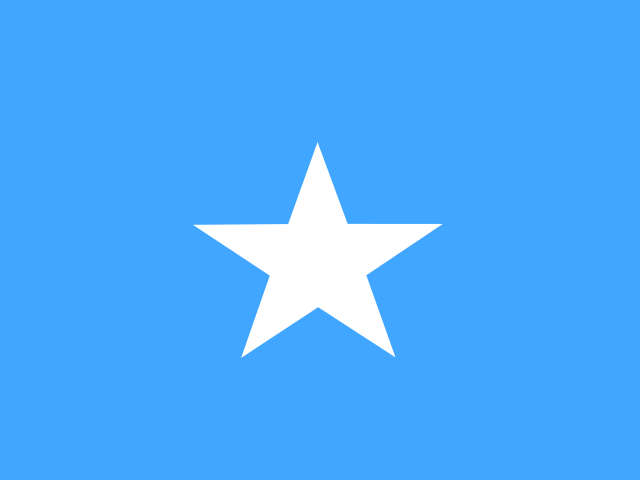
The Flag of Somalia
Africa · Adopted 12 October 1954
Somalia's flag predates the country's actual independence by six years, having been adopted on 12 October 1954 for the Trust Territory of Somaliland, the former Italian colony that Italy administered under a United Nations trusteeship from 1950 until independence in 1960 rather than as a straightforward colonial possession. That UN trusteeship status directly shaped the flag's design: the light blue field was chosen specifically to echo the pale blue of the United Nations' own flag, a deliberate visual link to the international body overseeing the territory's transition toward self-government.
The design itself — a plain light blue field with a single white five-pointed star centered on it — was created by Mohammed Awale Liban, a Somali who submitted it as part of the process of establishing symbols for the trust territory in the early 1950s. When Somalia achieved full independence on 1 July 1960, formed by the union of the former UN Trust Territory (Italian Somaliland) and the separately independent former British Somaliland Protectorate, which had gained its own independence just five days earlier, the same flag was retained as the flag of the newly unified Somali Republic.
The star's five points are the flag's most historically loaded feature: each point was originally understood to represent one of five regions where ethnic Somalis lived across the Horn of Africa — British Somaliland and Italian Somaliland, the two territories that actually did unite to form Somalia in 1960, plus French Somaliland (present-day Djibouti), the Ogaden region within Ethiopia, and the Northern Frontier District of British-administered Kenya. This reflected the mid-20th-century pan-Somali political goal, often called 'Greater Somalia,' of eventually uniting all Somali-inhabited territories in the Horn of Africa under a single state.
That unification goal was never achieved: Djibouti became its own independent country in 1977 rather than joining Somalia, the Ogaden remained part of Ethiopia despite a Somali invasion attempt in the 1977–1978 Ogaden War, and Kenya's Northern Frontier District remained Kenyan following a 1963 referendum and subsequent low-level 'Shifta War' insurgency. The flag's five-pointed star has continued to be flown ever since as a reminder of that unrealized pan-Somali ambition even though only two of the five represented territories ever actually joined the Somali state.
Somalia's central government collapsed in 1991 amid civil war, and the country went without a single, universally recognized functioning national government for well over a decade, yet the light blue flag with its white star continued to be recognized internationally as Somalia's flag throughout that period and was retained, unaltered, by the Transitional Federal Government formed in 2004 and by the Federal Government of Somalia established in 2012, giving it more than seven decades of continuous use through some of the most severe state fragmentation any country has experienced since the Second World War.
The self-declared Republic of Somaliland, the territory of the former British Somaliland Protectorate that unilaterally declared independence from Somalia in 1991 and has functioned with de facto autonomy since, without international recognition, flies its own separate flag rather than Somalia's, one of the clearer ongoing splits between the flag's original pan-Somali symbolism and the political reality of the Horn of Africa today.
The flag is flown on Independence Day, 1 July, marking the 1960 union of the two former Somali territories, and remains one of the simplest national flags in the world — a single color field and a single symbol — a design economy that has helped it remain visually recognizable even through decades in which the state it represents has struggled to maintain consistent, unified governance.
Somalia's federal member states, established under the 2012 provisional constitution as part of a federal system meant to accommodate regional and clan-based political structures — Puntland, Jubaland, South West State, Galmudug, and Hirshabelle — each fly their own regional flags alongside the national one, a layered flag arrangement that reflects the decentralized, negotiated structure of the current Somali state as it has been rebuilt since the 1991 collapse.
Mohammed Awale Liban's original 1954 design has been retained with only minor technical adjustments to its exact proportions and shade of blue over the decades since, and Somali government reference materials continue to credit him by name as the flag's designer, a level of individual attribution that, as with Nigeria's flag, is relatively unusual among mid-20th-century African national flags, many of which are credited only to unnamed government or party design committees.
Somalia's light blue has occasionally been mistaken in casual comparison for the blue used on several Pacific island nations' flags, but Somalia's shade and its single central star, without any additional bands, crosses, or constellations, make it visually distinct once compared directly rather than glanced at from a distance; the resemblance is coincidental rather than the product of any shared design history, since Somalia's blue derives specifically from its United Nations trusteeship period rather than from any Pacific or maritime tradition.
Puntland, one of Somalia's federal member states, has periodically debated modifying or replacing its own regional flag independently of the national one, but the national light-blue-and-star design flown over Mogadishu and recognized by the United Nations and African Union has not been seriously proposed for replacement even amid the country's long period of political fragmentation, remaining one of the more stable elements of Somali statehood across more than seven decades of use. The flag also continues to be flown by the large Somali diaspora communities in the Gulf states, Europe, and North America, many of whom left during the civil war years and maintain the light-blue star as a shared point of national identity despite decades of separation from a functioning central state.
The particular blue
- Dyed-through flag — The page notes the shade of blue has been adjusted only slightly over the decades and is referenced in official materials, and a printed pale blue drifting toward sky blue is the common fault in low-grade stock.
As an Amazon Associate we earn from qualifying purchases made through these links, at no extra cost to you.
Somalia at a glance
- Capital
- Mogadishu
- Population
- 19.7 million (2024)
- Currency
- Somali Shilling (SOS)
- Language(s)
- Somali and Arabic (both official)
Population figure as of 2024, source: UN World Population Prospects (2024 revision). See methodology for how facts are sourced and kept current.