Pretoria — Capital of South Africa
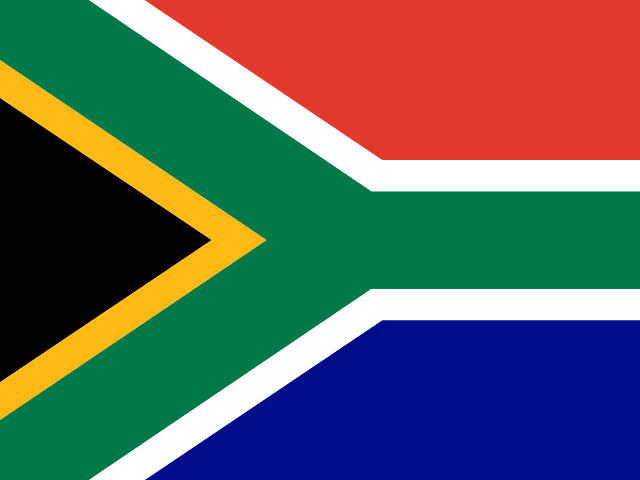
See the flag of South Africa →
Pretoria is one of three cities that share national capital functions in South Africa — Pretoria hosts the executive branch and most foreign embassies, Cape Town hosts Parliament and the legislative branch, and Bloemfontein hosts the Supreme Court of Appeal and the judicial branch — an unusual three-way split that dates to the 1910 Act of Union, when the four former British colonies (the Cape, Natal, Transvaal, and Orange Free State) merged into the Union of South Africa and divided the capital's roles among their existing major cities as a political compromise rather than concentrating all government functions in one place.
The city was founded in 1855 by Boer Voortrekker settlers and named for Andries Pretorius, a prominent Voortrekker leader and military commander during the Great Trek period, when Dutch-descended settlers migrated inland from the Cape Colony to escape British rule in the 1830s and establish independent Boer republics. Pretoria became the capital of the South African Republic (also called the Transvaal Republic) in 1860, one of two Boer republics — along with the Orange Free State — that existed as independent states before being annexed by Britain following the Second Boer War (1899–1902).
Pretoria retained its role as the Transvaal's administrative center after British annexation and was designated the administrative (executive) capital of the newly unified Union of South Africa in 1910, a status it kept through the apartheid era (1948–1994) as the seat of the National Party government that implemented and enforced the system of racial segregation, and through the transition to democracy in 1994, when Nelson Mandela was inaugurated as president at the Union Buildings, the same complex that had served as the seat of white-minority rule.
The Union Buildings themselves, completed in 1913 and designed by British architect Herbert Baker, sit on Meintjieskop hill overlooking the city and remain the official seat of the South African government and the president's main offices, their sweeping sandstone colonnades and amphitheater now most associated internationally with Mandela's 10 May 1994 inauguration, one of the most widely broadcast political events in modern South African history.
Pretoria is popularly nicknamed the 'Jacaranda City' for the tens of thousands of jacaranda trees, originally imported from South America starting in 1888, that line many of its streets and burst into a distinctive purple bloom each October and November (southern hemisphere spring) — a seasonal spectacle that has become one of the city's best-known visual identifiers, even though the trees are an introduced, non-native species now considered invasive in parts of South Africa.
Since 2000, the metropolitan municipality surrounding Pretoria has officially been named Tshwane, and there has been an ongoing, unresolved debate about renaming the city of Pretoria itself to Tshwane — a proposal approved by South Africa's Geographical Names Council in 2005 but never finalized at national government level, leaving 'Pretoria' as the city's name in most official and everyday use even as 'Tshwane' has become the standard name for the broader metro area.
Pretoria is also home to the University of Pretoria, founded in 1908 and one of South Africa's largest research universities, and to the headquarters of several major South African scientific and research bodies, including the Council for Scientific and Industrial Research, giving the city a significant role in national research and higher education alongside its administrative functions.
Quick facts
- The greater Tshwane metropolitan area surrounding Pretoria reached an estimated 2.9 million residents in 2024, ranking among South Africa's four largest urban centers alongside Johannesburg, Cape Town, and Durban.
- More than 100 foreign countries maintain embassies or high commissions in Pretoria, giving the city one of the densest concentrations of diplomatic missions anywhere on the African continent.
- Freedom Park, a heritage site and memorial to South Africa's liberation struggle, opened on a Pretoria hillside in 2007, standing in deliberate visual dialogue with the much older Voortrekker Monument on a neighboring ridge.
- University of Pretoria students have long marked the jacaranda bloom with a superstition of their own: campus lore holds that a purple blossom landing on your head during exam season brings good luck.
- Confusion over the city's name persists in everyday use: street signage, postal addresses, and most residents still say 'Pretoria,' even though the metro government and many official documents have used 'City of Tshwane' since the early 2000s.