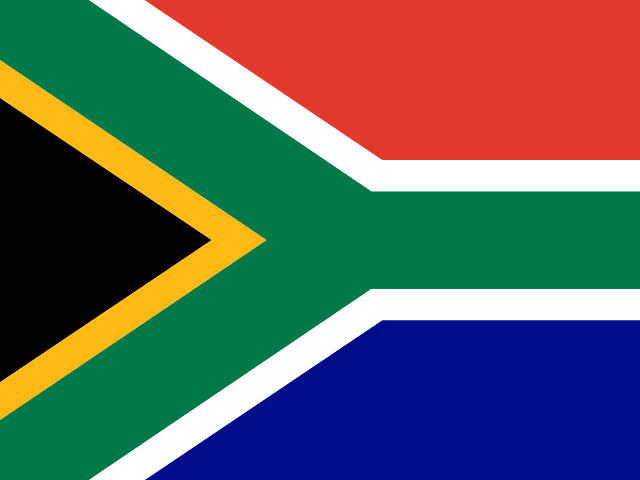
The Flag of South Africa
Africa · Adopted 27 April 1994
South Africa's flag was designed and adopted in an extraordinarily short window: with the country's first fully democratic, all-race elections scheduled for 27 April 1994 to end apartheid, the previous flag — a design dating to 1928 built around the old orange-white-blue Dutch Prinsenvlag with the flags of the pre-Union Boer republics and Britain in miniature at its center — was widely seen as unusable for the new democratic era, but by early 1994 no replacement had been agreed. State Herald Frederick Brownell was asked to produce a design at extremely short notice, reportedly within about a week, drawing on and refining an earlier sketch, and the result was approved and first flown as the country went to the polls.
The design is a horizontal, Y-shaped arrangement: a green horizontal band, edged in yellow-gold, forms a Y-shape (or, viewed from the hoist, a converging pair of diagonal bands) that splits the flag into a red band above and a blue band below at the fly end, while a black triangle edged in yellow-gold sits at the hoist, with a white band separating the black triangle from the red and blue fields beyond it. Six colors appear on the flag in total — more than almost any other national flag in the world — combining black, green, and gold associated with the African National Congress's own flag with the red, white, and blue historically associated with the old Boer republics and British colonial-era flags.
Deliberately, and unusually for a national flag, the South African government never issued an official statement assigning fixed meanings to each individual color, a choice widely understood as intentional: attaching a specific meaning to any one color risked being read as privileging one community's or one party's symbolism over another's, in a country where the flag needed to represent Black African, Afrikaner, English-speaking, and other communities simultaneously after decades of apartheid-era division. Instead, the design as a whole is generally described, including in Brownell's own explanations, as representing convergence and unity — separate historical paths and colors merging into a single forward-moving design, sometimes described as different roads converging into one.
That convergence reading is grounded directly in the design's geometry: the Y-shape, opening at the hoist and narrowing as it moves toward the fly, is meant to evoke the idea of diverse elements — the country's different peoples and political traditions — coming together and moving forward as one nation, a visual metaphor widely repeated in South African civic education material about the flag since 1994.
Although introduced as an interim flag for the 1994 election and the transitional period leading to the final 1996 constitution, the design proved popular enough, both domestically and internationally, that it was retained permanently rather than replaced, and it was formally entrenched by the 1996 constitution as South Africa's national flag going forward, an unusual case of a rushed, short-notice emergency design becoming a lasting national symbol without ever being redesigned.
The flag's crescents and converging bands are sometimes discussed by vexillologists alongside flag-symbolism more broadly covered by sites like SymbolHubs, our sister site on symbol meanings — South Africa's flag is a favorite case study there precisely because it deliberately withholds fixed color meanings, a genuinely unusual choice among national flags.
The flag is flown prominently on Freedom Day, 27 April, commemorating the 1994 election, and appears throughout national sporting events, most famously during the 1995 Rugby World Cup hosted and won by South Africa, an event closely associated in the country's public memory with President Nelson Mandela's use of the new flag and the Springboks jersey together as symbols of a still-fragile post-apartheid national unity.
The old 1928 flag, built around the orange-white-blue Prinsenvlag with the miniature British Union Jack and the flags of the two former Boer republics at its center, is now tightly restricted under South African law: the Prevention and Combating of Hate Crimes and Hate Speech Act and related regulations treat gratuitous public display of the old flag as presumptively hateful conduct following a 2019 Equality Court ruling, a legal step most other post-apartheid symbolic changes did not require, reflecting how directly that older flag remained tied to the apartheid state in ways the six-color 1994 design was specifically built to move away from.
South Africa's black, green, and gold — drawn from the ANC's own historic party flag, first adopted in 1925 — appear on several other southern African flags associated with liberation movements that had close ties to the ANC during the anti-apartheid struggle, including elements of Zimbabwe's and Kenya's flags, a shared color heritage that reflects decades of pan-African liberation-movement solidarity rather than coincidence, even though each country's final flag design and specific arrangement of those colors developed independently.
The negotiations that produced the 1994 flag took place against a genuinely uncertain backdrop: South Africa's first democratic election was itself nearly derailed by right-wing Afrikaner resistance and violence in the weeks before the vote, and the flag's rushed finalization was one of dozens of last-minute compromises — alongside the interim constitution, the electoral system, and power-sharing arrangements — that collectively made the April 1994 transition possible without the large-scale civil conflict many observers had feared throughout the early 1990s.
South Africa's national sports teams display the flag with particular intensity, and the country's ongoing 'quota' and transformation debates in cricket and rugby — sports historically dominated by white South Africans under apartheid — are frequently discussed in the media in direct relation to the flag's own convergence symbolism, with commentators regularly invoking the 1994 design's 'many paths becoming one' imagery when discussing the slower, still-incomplete process of genuine racial integration in national sport.
Six colours meeting at a Y
- Stitched multi-panel flag — Six colours converge on one Y-shaped junction, which is the hardest point on any flag to sew; a flag with a clean, flat meeting point there has been properly made.
As an Amazon Associate we earn from qualifying purchases made through these links, at no extra cost to you.
South Africa at a glance
- Capital
- Pretoria
- Population
- 64.0 million (2024)
- Currency
- South African Rand (ZAR)
- Language(s)
- 12 official languages, including isiZulu, isiXhosa, Afrikaans, English, and South African Sign Language
Population figure as of 2024, source: UN World Population Prospects (2024 revision). See methodology for how facts are sourced and kept current.