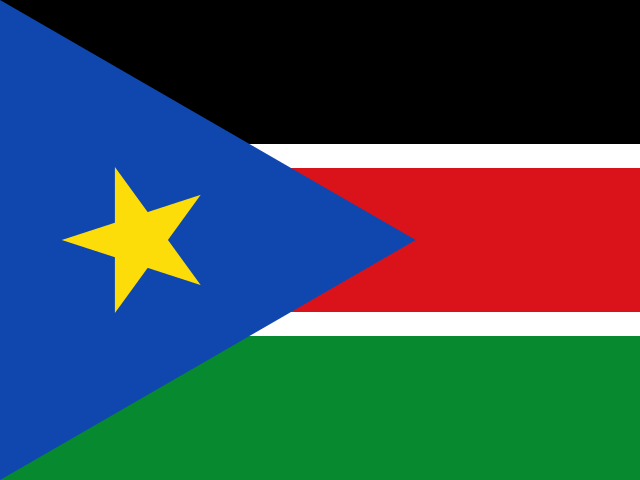
Juba — Capital of South Sudan
Juba's rise to capital city status is recent by regional standards. It began the 20th century as a modest river port on the White Nile, developed under Anglo-Egyptian rule mainly as a trading and garrison post rather than as a seat of government — for most of the colonial and early independence period, administrative functions for the south shifted between several towns, including Wau and Malakal, with no single fixed southern capital. Juba only became the administrative center of the south in a lasting way after the 2005 Comprehensive Peace Agreement created an autonomous Government of Southern Sudan, and it carried that status forward automatically when South Sudan became fully independent on 9 July 2011.
Because Juba sits within the traditional homeland of the Bari people, its selection as national capital has never been entirely uncontested among South Sudan's other major ethnic groups. The government has floated plans since shortly after independence to build a new, more centrally located and ethnically neutral capital at Ramciel, in Lakes State — a proposal similar in spirit to Nigeria's move to Abuja or Tanzania's move to Dodoma — but by 2026 the site remained largely undeveloped and Juba continued to hold both de facto and constitutionally recognized capital status.
The city's role as a river port predates its political status by decades: Juba sits at the practical head of navigation on the White Nile, the furthest point upstream that larger boats can reliably reach before rapids and shallower water complicate travel further south, which made it a natural trade and administrative hub under British rule long before it had any claim to being a capital.
Juba was hit especially hard by the civil war that broke out in December 2013, just over two years after independence, including direct fighting within the city itself — most seriously in July 2016, when clashes erupted around the presidential palace between forces loyal to President Salva Kiir and forces loyal to then–Vice President Riek Machar, displacing tens of thousands of residents in a matter of days and briefly threatening to unravel the 2015 peace agreement entirely.
The University of Juba, the country's oldest and largest, was actually founded in 1975 in Juba itself, but relocated its operations to Khartoum during the worst years of the second civil war for safety, only returning fully to its home campus after South Sudan's independence in 2011 — a displacement-and-return story that mirrors the city's broader modern history.
Juba's growth since 2005 has been dramatic and largely unplanned, as returning refugees, displaced people from other parts of the country, and an influx of international aid organizations and diplomatic missions arrived faster than the city's infrastructure could expand to accommodate them, producing a capital where large informal settlements sit close to newer diplomatic and government districts — a contrast common to several rapidly grown post-conflict African capitals but especially pronounced in Juba given how compressed its growth has been, effectively confined to the two decades since the 2005 peace agreement.
The city sits close to the border with the Democratic Republic of Congo and Uganda in the country's southern reaches, giving it a genuinely different regional orientation from much of the rest of South Sudan, whose northern regions historically had closer trade and cultural ties to Sudan itself; Juba's proximity to Uganda in particular has made it heavily dependent on the Nimule border crossing and the road north from Kampala for imported goods, especially during periods when river or air transport has been disrupted by conflict.
One of the more striking symbols of Juba's peace-process-era identity is the John Garang Mausoleum, a memorial in the city center to the SPLM/A's founding leader, who died in a helicopter crash in 2005 just months after signing the Comprehensive Peace Agreement that made the movement's own flag the basis for the country's future national symbol — Garang never lived to see South Sudan's actual independence in 2011, and the mausoleum functions as one of the capital's central sites of national commemoration.
Quick facts
- Estimates put Juba's population at close to half a million residents in recent years, though the constant back-and-forth of wartime displacement and return has made precise counts genuinely difficult to pin down over the past decade.
- The city lies on the White Nile at roughly the furthest point upstream reliably reachable by larger river vessels, which shaped its original role as a colonial-era trading post.
- Juba became the seat of the autonomous Government of Southern Sudan in 2005, six years before full national independence in 2011.
- A long-discussed plan to relocate the capital to a purpose-built site at Ramciel in Lakes State has produced no substantial construction in the two decades since it was first floated.
- Juba International Airport, expanded after 2011, is South Sudan's main gateway for humanitarian and diplomatic traffic given the country's limited road and rail infrastructure.