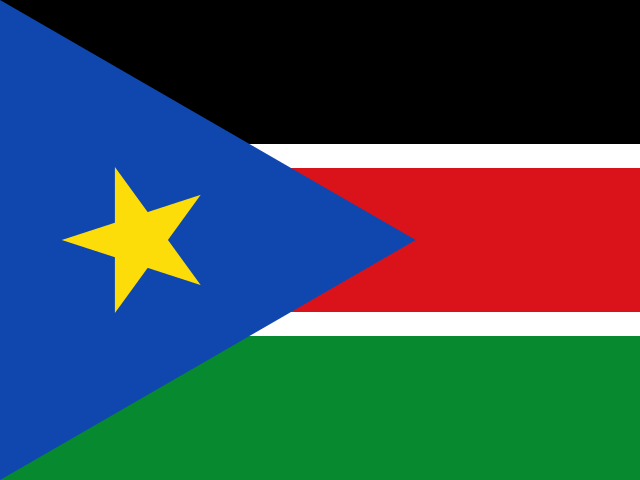
The Flag of South Sudan
Africa · Adopted 9 July 2011 (design first flown by the SPLM/A from 2005)
South Sudan's flag did not begin as a national symbol at all — it started as the banner of the Sudan People's Liberation Movement/Army (SPLM/A), the rebel movement that fought the government in Khartoum through the second Sudanese civil war (1983–2005), the longest and deadliest of the two wars fought over the south's status since Sudanese independence in 1956. The SPLM/A carried this design into the 2005 Comprehensive Peace Agreement that ended that war and granted southern Sudan a decade of autonomy ahead of an independence referendum. When southerners voted for secession by a nearly unanimous margin in January 2011, the movement's own flag simply became the new country's flag on the day independence was declared, 9 July 2011 — no design competition, no redesign, the rebellion's banner promoted directly to statehood.
The horizontal bands read less like an abstract statement of national values and more like a timeline of the struggle that produced the country. Black stands for the South Sudanese people themselves; red for the blood shed across both wars against Khartoum, fighting that by most estimates killed close to two million people between 1955 and 2005 combined; green for the land and its agricultural promise; and the white fimbriations separating the bands stand for the peace that the 2005 agreement was meant to secure, still an aspiration more than an achieved fact for much of the country.
The blue triangle at the hoist, unusual among the region's flags, represents the White Nile, the river that runs the length of the country and has shaped its trade, its ethnic geography, and its long-running political rivalry with Sudan over water and oil-transit routes since the two states split. A single gold, five-pointed star sits inside the triangle, officially read as a symbol of unity among South Sudan's diverse peoples — the Dinka, Nuer, Bari, Zande, and dozens of other ethnic groups the new state was meant to hold together as one nation rather than the SPLM/A's own wartime coalition.
Because the design combines the pan-African liberation palette of black, red, and green with a distinct blue-and-gold hoist element, it is occasionally set alongside Kenya's flag in casual comparisons — both use black, red, and green bands with white separators — though the resemblance stops at the color choice; Kenya's flag centers a Maasai shield and spears rather than a triangle, and the two flags trace to entirely separate independence movements decades apart.
The flag's own history since 2011 has been uncomfortable: the same banner meant to symbolize unity has been flown by both sides of the civil war that broke out in December 2013 between forces loyal to President Salva Kiir and forces loyal to former Vice President Riek Machar, a conflict that killed an estimated 400,000 people before a fragile peace deal in 2018 and periodic flare-ups since. Both factions continued to fly the national flag throughout, since neither side sought to replace the state's symbols — only its government.
Despite the turmoil, the design itself has never been altered since 2005. South Sudan's 2011 Transitional Constitution formally adopted the SPLM/A banner as the national flag without modification, and no subsequent government, including the unity government formed under the 2018 peace agreement, has proposed changing it — a rare point of continuity in a state whose institutions have otherwise struggled to stabilize.
The flag is flown daily above government buildings in Juba and is central to Independence Day observances each 9 July, alongside a coat of arms adopted separately in 2011 that features an African fish eagle rather than any element drawn from the flag itself.
The 2005 Comprehensive Peace Agreement that first gave the SPLM/A flag official status also set up an economic bond between north and south that has outlasted the political split: most of the oil fields that generate the bulk of South Sudan's export revenue, particularly around Unity and Upper Nile states, sit south of the border, but the only pipeline infrastructure able to move that oil to a port runs north through Sudan to Port Sudan on the Red Sea. Disputes over transit fees for using that pipeline have repeatedly strained relations between Juba and Khartoum since 2011, including a period in 2012 when South Sudan shut down oil production entirely rather than accept Sudan's proposed fees, underscoring how thoroughly economic geography still ties the two states together even though their flags now represent formally separate nations.
South Sudanese school curricula developed since independence teach the flag's design and colors as part of civic education, presenting the black-red-green-white-blue arrangement explicitly as a continuation of the SPLM/A's liberation struggle rather than as a symbol invented fresh for the new state — a framing that ties the classroom account of the flag directly to the same wartime history that produced it in 2005.
South Sudan adopted a national anthem, 'South Sudan Oyee!', alongside the flag in the run-up to independence, chosen through a competition that drew entries from students across the country's schools and universities — a participatory process the flag itself never went through, since the design had already been settled by the SPLM/A years earlier and was simply inherited rather than opened to public competition.
The unity the flag's gold star is meant to represent has to stretch across a country home to more than sixty recognized ethnic groups, among them the Dinka and Nuer as the two largest, along with the Bari, Zande, Shilluk, and dozens of smaller communities — a diversity that makes the flag's unifying symbolism aspirational in a very literal sense, given how much of South Sudan's post-independence conflict has run along lines between some of these same groups rather than against any external enemy.
A star inside the hoist triangle
- Double-sided flag — The gold star sits inside a blue triangle fixed at the hoist, so on single-layer cloth the triangle appears at the fly from behind. Two layers keep it against the pole on both faces.
As an Amazon Associate we earn from qualifying purchases made through these links, at no extra cost to you.
Often confused with
- Kenya — shares the black-red-green palette with white fimbriations, but Kenya's flag centers a Maasai shield and crossed spears rather than a blue triangle and star, and the two designs come from entirely separate independence movements decades apart. Compare side by side →
South Sudan at a glance
- Capital
- Juba
- Population
- approximately 11.1 million (2024)
- Currency
- South Sudanese Pound (SSP)
- Language(s)
- English (official); Juba Arabic and numerous indigenous languages including Dinka and Nuer widely spoken
Population figure as of 2024, source: UN World Population Prospects (2024 revision). See methodology for how facts are sourced and kept current.