Khartoum — Capital of Sudan
Khartoum was founded in 1821 as an Egyptian army outpost, established at the point where the Blue Nile and White Nile physically converge to form the single Nile that flows north through Egypt. The city's name is widely explained, though not universally confirmed by historians, as a reference to the narrow spit of land between the two rivers resembling an elephant's trunk in Arabic — a tidy etymology that may be folk explanation as much as documented fact. Through the mid-19th century the city grew into a hub of the Ottoman-Egyptian trade in ivory and enslaved people, a history modern Sudanese institutions rarely emphasize but that shaped the city's early growth.
Khartoum was destroyed in 1885, during the siege that ended with the death of the British general Charles Gordon and the fall of the city to Mahdist forces led by Muhammad Ahmad, who had declared himself the Mahdi, a redemptive figure in Islamic eschatology, and built a rival state centered not in Khartoum but across the river in Omdurman. Khartoum only rose again after Anglo-Egyptian forces defeated the Mahdist state at the 1898 Battle of Omdurman, when the British reconstructed it as the administrative capital of the new Anglo-Egyptian Condominium — colonial-era accounts describe the rebuilt street grid as deliberately laid out in a pattern resembling the Union Jack, an often-repeated claim that later historians have treated with some skepticism given the lack of a clear surviving planning document confirming intent.
What is usually called 'Khartoum' today is really a tripartite metropolitan area of three linked cities straddling the Nile confluence: Khartoum proper on the southern bank, Omdurman across the White Nile to the west — historically the larger and more culturally significant of the three, having briefly been the Mahdist capital — and Khartoum North, also called Bahri, the conurbation's industrial center, with bridges connecting all three since the early-to-mid 20th century.
Khartoum remained the capital through independence in 1956 and every government since, including Jaafar Nimeiry's rule from 1969, Omar al-Bashir's from 1989 to 2019, and the transitional governments that followed his fall. Since April 2023, the city has been the central battleground of a war between the Sudanese Armed Forces and the paramilitary Rapid Support Forces, with large parts of central Khartoum, including government ministries and the national museum, reported damaged or looted in fighting that has displaced millions of residents, producing what humanitarian agencies tracking the war through 2024 and into 2025 have called one of the largest displacement crises anywhere in the world.
Even before the current war, Khartoum held a somewhat unusual status among African capitals for having lost and regained that status once already, in the 1880s, a disruption most other colonial-era capitals on the continent never experienced.
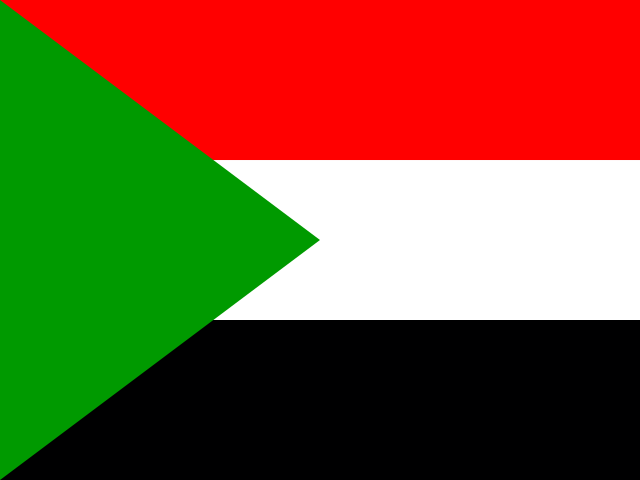
Khartoum was also the site of the 1967 Arab League summit that produced the 'Three Nos' declaration — no peace, no recognition, and no negotiation with Israel — issued in the aftermath of that year's Arab-Israeli war, a moment that briefly made the city a center of pan-Arab diplomatic attention well beyond Sudan's own borders and reflects the same pan-Arab political current that had shaped Sudan's flag just three years earlier under Nimeiry's government.
Khartoum also has a more recent history as a haven, and later a point of controversy, for figures wanted internationally: Osama bin Laden lived in Khartoum from 1991 to 1996 while Sudan was governed under an Islamist-aligned military government, running businesses in the city before US and Saudi pressure led Sudanese authorities to expel him, a chapter of the capital's history that contributed to the United States placing Sudan on its list of state sponsors of terrorism for decades afterward.
The National Museum of Sudan in Khartoum, opened in 1971, holds a substantial collection of antiquities from Sudan's ancient Nubian and Kushite civilizations, including relocated temples salvaged from Lake Nasser flooding caused by the construction of the Aswan High Dam in Egypt in the 1960s — a collection that has been reported damaged and partly looted during the fighting that has engulfed central Khartoum since April 2023, though comprehensive, verified assessments of the losses had not yet been completed as the war continued into 2025.
Quick facts
- Greater Khartoum is formally three cities — Khartoum, Omdurman, and Khartoum North (Bahri) — joined by bridges across the Nile confluence.
- The city sits at the meeting point of the Blue Nile, which originates in Ethiopia, and the White Nile, which originates in the African Great Lakes region.
- Khartoum was destroyed in the 1885 Mahdist siege and rebuilt by Anglo-Egyptian forces only after their 1898 victory at Omdurman.
- Fighting since April 2023 forced the partial relocation of some government functions to Port Sudan on the Red Sea coast, an unusual wartime shift of administrative activity away from the historic capital.
- Omdurman, across the White Nile from Khartoum proper, is generally considered Sudan's cultural and religious center, distinct from Khartoum's administrative role.