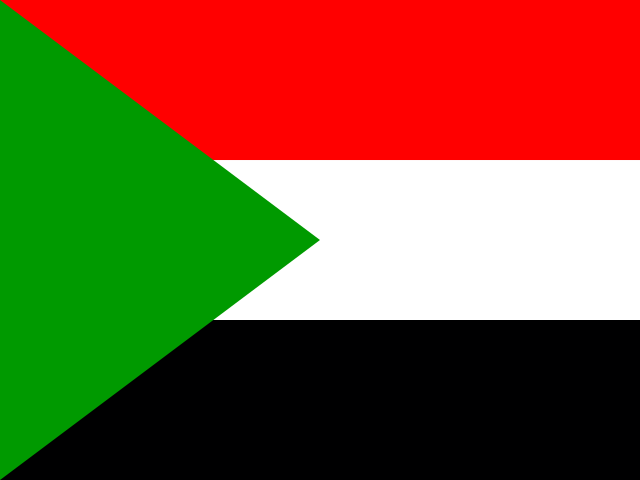
The Flag of Sudan
Africa · Adopted 20 May 1970
The flag flown over Sudan today is not the one the country gained independence with. When Sudan separated from joint British-Egyptian rule on 1 January 1956, it flew a blue-yellow-green horizontal tricolor, a design with no particular ideological loading beyond distinguishing the new state visually. That flag lasted fourteen years. After Jaafar Nimeiry seized power in a 1969 military coup, his government replaced it in May 1970 with a design built from the red-white-black-green palette known across the Arab world as the Arab Liberation Colors — deliberately repositioning Sudan within a pan-Arab political identity rather than the more regionally neutral symbolism of the independence-era flag.
Those four colors trace to the flag first raised during the 1916 Arab Revolt against Ottoman rule, and by the mid-20th century had been adopted, in varying arrangements, by Egypt, Syria, Iraq, Yemen, and several other Arab states — Sudan's 1970 flag placed it visually inside that same family for the first time. But Sudanese sources also give each color a meaning specific to Sudan's own history: red for the blood of martyrs in the country's independence struggle, black for Sudan itself — the name derives from the Arabic bilad al-sudan, 'land of the Blacks' — and echoes the black flag flown by the Mahdist state that briefly ruled Sudan in the 1880s and 1890s, white for the peace sought after decades of conflict and specifically for the White Flag League, an anti-colonial movement active in Khartoum in the 1920s, and green, filling the hoist triangle, for Islam and for agricultural prosperity.
That green triangle at the hoist is the one element that departs from the flags of Sudan's Arab neighbors, most of which use plain horizontal bands; it gives Sudan's flag a distinct silhouette even from a distance, useful for a country whose flag is regularly seen alongside others with an overlapping color palette.
The flag has not changed since 1970, remarkable given how much the state around it has changed — Nimeiry's government fell in 1985, Sudan was ruled by Omar al-Bashir from 1989 until his ouster in 2019, South Sudan seceded in 2011 taking a third of the country's territory and most of its oil reserves with it, and Sudan has been at war with itself again since April 2023, when fighting broke out in Khartoum between the Sudanese Armed Forces and the paramilitary Rapid Support Forces. Through all of it, the flag Nimeiry's government chose has remained the one both sides of every subsequent conflict have claimed to represent.
Sudan's flag is easily mistaken at a glance for several of its regional relatives that share the same four-color Arab Liberation palette in different arrangements — Palestine's flag uses the same colors with a red triangle at the hoist rather than green, and Jordan's adds a white star to a similar triangle, a family resemblance that reflects a shared 20th-century political moment rather than any direct copying between the individual states.
Because of the ongoing war, precise, verified figures for how the flag is currently being used or displayed in different parts of the country are difficult to establish with confidence as of 2024–2025; both the army-aligned government and areas under RSF control continue to use the same official flag and state symbols, since the conflict is a struggle for control of the existing state rather than a secessionist or symbol-replacing movement.
During the 2018–2019 uprising that eventually forced Omar al-Bashir from power after thirty years in office, some protesters and opposition activists deliberately displayed Sudan's earlier, pre-1970 blue-yellow-green independence flag alongside or instead of the official red-white-black-green banner, using the older, ideologically neutral design to signal rejection of the pan-Arab and Islamist political framing the 1970 flag was chosen under. That gesture never became an official movement to change the state flag itself, and the transitional and subsequent governments that followed Bashir's fall retained the 1970 design without alteration, but it illustrates how contested the flag's underlying political meaning has remained among Sudanese citizens even while its physical design has not changed in more than fifty years.
The green triangle's meaning also shifted in practice, if not in official wording, after 1983, when Nimeiry's government imposed Sharia-based law across the country in a move known as the September Laws — a policy reversal from the more secular direction of his earlier rule that gave the flag's Islamic symbolism a sharper, more contested political edge for southern and non-Muslim Sudanese than it had carried when the flag was first adopted in 1970, and that political tension over religion and law fed directly into the second civil war that broke out in 1983 and eventually produced South Sudan's own, very differently symbolized flag in 2005.
Sudan's flags before 1970 have their own layered history. Under the Anglo-Egyptian Condominium (1899–1956), the territory did not fly a single distinct national flag at all but was formally represented by Egyptian and British flags flown together, reflecting the dual, and often uneasy, colonial administration the name 'condominium' describes. Decades earlier still, the Mahdist state that controlled Khartoum and much of Sudan from 1885 to 1898 used a black flag inscribed with religious text, a design that Sudanese civic accounts of the 1970 flag's black stripe sometimes invoke as an ideological predecessor, even though the two designs share no direct visual resemblance beyond the single color.
Sudan's precise borders and even its name have themselves been unsettled since 1956 in ways that reach beyond the 2011 southern secession: an area called Abyei, on the border between Sudan and South Sudan, remains contested between the two states, its final status left unresolved by the 2005 peace agreement pending a referendum that has never conclusively taken place, a reminder that the flag adopted in 1970 now represents a state whose actual territorial extent is, in at least one specific area, still not fully settled.
Four colours, no emblem
- Indoor flag with a pole sleeve — Three horizontals and a hoist triangle with nothing printed on them is a design that hangs well indoors on a sleeve, where a flag carrying a fine emblem needs to be flown out to be read at all.
As an Amazon Associate we earn from qualifying purchases made through these links, at no extra cost to you.
Often confused with
- Palestine — uses the same red-white-black-green Arab Liberation palette from the 1916 Arab Revolt flag, but arranges it as a red triangle at the hoist against black-white-green bands rather than Sudan's green triangle on red-white-black. Compare side by side →
Sudan at a glance
- Capital
- Khartoum
- Population
- approximately 50.4 million (2024)
- Currency
- Sudanese Pound (SDG)
- Language(s)
- Arabic and English (official); dozens of regional languages spoken across Sudan's ethnically diverse states
Population figure as of 2024, source: UN World Population Prospects (2024 revision); mass displacement from the 2023– civil war makes precise current figures difficult to verify. See methodology for how facts are sourced and kept current.