Dushanbe — Capital of Tajikistan
Dushanbe's name comes from the Tajik word for Monday (dushanbe literally breaks down to 'two' plus 'shanbe,' a Persian-derived weekday-counting pattern), because the settlement began as a small village known for hosting a weekly Monday market — a far more modest origin than most national capitals, which typically trace their status to ancient fortresses, royal seats, or major trade-route hubs rather than a recurring bazaar day.
The city was essentially built up from that small village by Soviet planners after Tajikistan became a Soviet republic in the 1920s; it was chosen as the capital of the Tajik Autonomous Soviet Socialist Republic in 1924 and elevated further when Tajikistan became a full union republic in 1929, at which point it was renamed Stalinabad in honor of Joseph Stalin — a name it held until 1961, when it reverted to Dushanbe during the broader Soviet de-Stalinization period following Khrushchev's 1956 denunciation of Stalin's cult of personality.
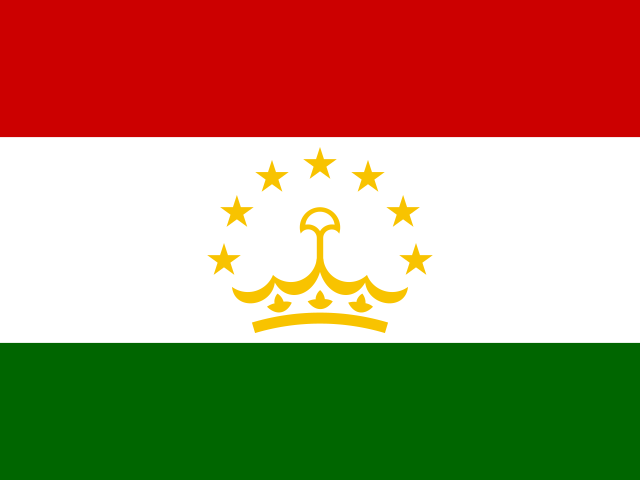
As a Soviet-planned city, Dushanbe's layout reflects mid-20th-century Soviet urban design: wide boulevards, large public squares, and Soviet-era administrative and cultural buildings, many still standing and functioning today even as the government has added post-independence monuments and buildings reflecting Tajik national identity rather than Soviet symbolism, including one of the tallest flagpoles in the world at one point, built specifically to fly a giant Tajik national flag.
Dushanbe suffered serious damage and depopulation during Tajikistan's 1992–1997 civil war, when fighting between the government and opposition factions reached the capital itself in the early 1990s, before a UN-brokered peace process concluded in 1997 and the city began a period of reconstruction and growth that has continued since.
The city sits in the Hisor Valley in western Tajikistan, near the borders with Uzbekistan, at a lower and more temperate elevation than much of the rest of mountainous Tajikistan, one of the most mountainous countries in the world, which has made the Hisor Valley one of the country's most agriculturally productive and densely populated regions and a natural site for the capital despite the country's rugged geography overall.
A large statue and monument to Ismail Samani, founder of the medieval Samanid Empire honored on Tajikistan's national flag, stands prominently in central Dushanbe, part of a broader post-independence effort to visibly connect the modern capital's civic landscape with the pre-Soviet, pre-Turkic Persian-Tajik historical lineage the government has emphasized since 1991.
Rudaki Avenue, Dushanbe's main central boulevard, is named for Abu Abdullah Rudaki, a 9th–10th-century poet regarded as the father of Persian-language poetry and closely associated with the Samanid court, another example of how the capital's public naming and monuments consistently reach back to the same Samanid-era cultural touchstones referenced on the national flag rather than drawing on more recent Soviet-era history for civic symbolism.
Dushanbe's population grew rapidly through the Soviet period as the government relocated administrative functions, industry, and settlers to the city, and it continued growing after independence despite the disruption of the 1992–1997 civil war, remaining by far the largest urban center in a country where the great majority of the population still lives in smaller towns and rural mountain valleys rather than in Dushanbe itself.
Dushanbe's flagpole in the city's central park, completed in 2011 at a height of 165 meters, held the Guinness World Record for the tallest freestanding flagpole in the world until it was surpassed by a taller flagpole in Jeddah, Saudi Arabia, in 2014 — a record the government pursued deliberately as a symbol of post-independence national pride comparable to Turkmenistan's marble-building record or Uzbekistan's Tashkent Tower. The National Museum of Tajikistan, opened in a large new building in 2013, houses one of the country's most significant archaeological collections, including a 13-meter reclining Buddha statue excavated from the Ajina-Tepa Buddhist monastery site, a reminder of the region's pre-Islamic Buddhist history along the historic Silk Road before Persian and later Turkic Islamic influence became dominant in the area.
Dushanbe's Soviet-era planners laid out the city with an unusually high proportion of parks and tree-lined boulevards relative to its size, a legacy of mid-20th-century Soviet urban greening policy that still gives much of the capital's central district a noticeably leafier character than many other former Soviet Central Asian capitals.
Quick facts
- Dushanbe's National Library, opened in 2012 as part of a broader capital redevelopment push, is one of the largest libraries in Central Asia by both collection size and building footprint.
- The Ayni Opera and Ballet Theatre, opened in Dushanbe in 1939 under Soviet rule, remains Tajikistan's principal venue for classical performing arts.
- Dushanbe's population, now estimated at around 1 million, sits well ahead of any other urban center in a country where most residents still live in smaller towns and mountain valleys.
- An estimated several hundred thousand residents are thought to have fled Dushanbe at the peak of the 1992-1997 civil war, with the city's population only recovering fully after the 1997 peace accord.
- Dushanbe's Botanical Garden, established in 1933, is one of the oldest and largest in Central Asia and holds an extensive collection of native and imported plant species.