The Flag of Tajikistan
Asia · Adopted 24 November 1992
Tajikistan adopted its current flag on 24 November 1992, a year after independence from the dissolving Soviet Union, but the choice of design came in the middle of a brutal civil war (1992–1997) between the post-Soviet government and an opposition coalition of Islamist, democratic, and regional factions — meaning the flag was settled while the country that flew it was actively fighting over what kind of state it would become, rather than in a period of settled national consensus.
The design replaced the Tajik Soviet Socialist Republic's flag, a red field with a horizontal blue-white-blue stripe near the bottom and the Soviet hammer-and-sickle in the upper corner, standard for a Soviet republic flag of the era. The new flag kept the same red-white-green horizontal band structure the Tajik SSR flag had used since 1953 (red and green with a thin white-bordered blue stripe), reflecting genuine continuity in color choice even as the Soviet symbolism was stripped out — one of several post-Soviet Central Asian states to retain elements of its SSR-era palette rather than adopting something entirely new.
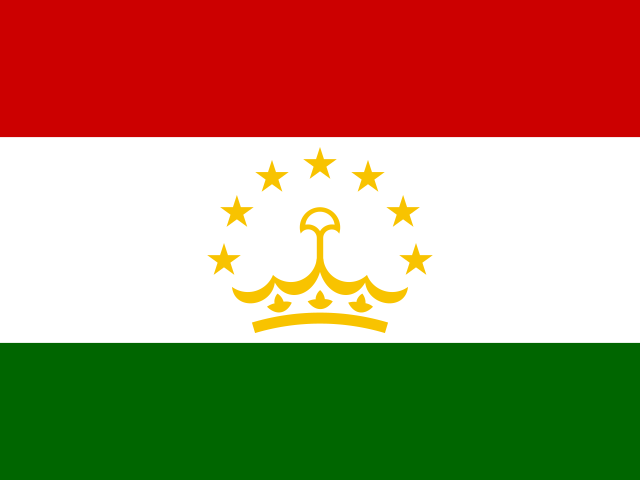
Red, the top and widest stripe, is officially described as representing the unity of the Tajik nation and, in some government descriptions, the historic struggle and victory of the Tajik people; white, the central stripe, represents cotton, one of Tajikistan's most important agricultural exports and a crop tied to Soviet-era irrigation projects across Central Asia, as well as purity and moral clarity in some readings; green, the bottom stripe, represents both the country's agriculture and, in Islamic symbolism widely used across the region, nature and the future.
The centered gold crown topped by an arc of seven five-pointed stars is the flag's most distinctive feature. The crown is generally read as a reference to Tajik national sovereignty and to the medieval Samanid Empire (819–999 CE), a Persian-speaking dynasty based in Bukhara that Tajik national historiography treats as the golden age of Tajik statehood and cultural achievement, predating the region's later absorption into Turkic and then Russian/Soviet spheres. The seven stars arcing above the crown are officially explained as representing unity among Tajikistan's peoples, though some sources also connect the number to traditional regional or numerological significance in Central Asian culture.
Tajikistan is the only Central Asian republic whose titular population is predominantly Persian-speaking (Tajik, a Persian dialect) rather than Turkic, unlike Uzbekistan, Turkmenistan, Kazakhstan, and Kyrgyzstan — a linguistic and cultural distinction the Samanid-era crown symbol is meant to underscore, tying the modern state to a specifically Persian rather than Turkic historical lineage in the region.
The flag's exact proportions and color specifications were formalized by law in 1992 and have not been redesigned since, even though the civil war that was ongoing at the time of adoption did not conclude until a 1997 peace agreement; the flag's stability through that conflict, compared to the government and constitutional upheaval of the period, is sometimes cited by Tajik officials as evidence the national symbol itself transcended the factional divide.
Because it shares a red-white-green horizontal band structure loosely reminiscent of several other post-Soviet and Persian-influenced flags, Tajikistan's flag is occasionally confused at a glance with Iran's tricolor, though the two share no design lineage — Iran's stripes are green-white-red in a different order with an entirely different central emblem, and any resemblance is coincidental rather than historical.
The Samanid Empire referenced by the crown is treated with particular reverence in Tajik state commemoration: Tajikistan's currency, the somoni, is itself named directly after Ismail Samani, the dynasty's founder, and a large monument to him stands in Dushanbe's central square, meaning the flag's crown symbol connects to a broader, deliberately constructed state narrative of Persian-Tajik continuity that extends well beyond the flag itself into currency, monuments, and school history curricula.
Unlike neighboring Uzbekistan and Turkmenistan, which each redesigned or added elements to their post-Soviet flags at points after their initial independence-era adoption, Tajikistan has kept its 1992 design completely unaltered, a stability some Tajik commentators attribute to the flag having been settled before, rather than during or after, the most divisive phase of the civil war's political realignments, giving it a kind of neutral, pre-factional legitimacy that later government symbols occasionally lacked.
Tajikistan's 1992–1997 civil war pitted a government coalition rooted largely in the Kulob and Leninabad (Khujand) regions against a United Tajik Opposition drawing support from Islamist groups, democratic reformers, and Pamiri and Gharmi regional factions, a conflict that killed tens of thousands and displaced hundreds of thousands more before the UN-brokered 1997 General Agreement on the Establishment of Peace and National Accord ended large-scale fighting — meaning the flag adopted in November 1992 was designed and legally fixed only months after the war's outbreak, under active wartime conditions rather than in a period of post-conflict reflection.
The specific gold used for the crown and stars is described in Tajik government color specifications as a distinct shade from the red field, intended to stand out clearly against both the red stripe it sits within and the flag as a whole, and Tajik state ceremonies mark Flag Day on 24 November, the anniversary of the 1992 adoption, with official events distinct from Independence Day, observed separately on 9 September to commemorate the 1991 break from the Soviet Union.
A crown under seven stars
- Detail-accurate printed flag — The seven stars arc above a crown at the centre of the white band, and the arrangement is fixed, so a listing showing a straight row of stars is showing a different flag.
As an Amazon Associate we earn from qualifying purchases made through these links, at no extra cost to you.
Often confused with
- Iran — shares a green-white-red palette, but the stripe order is reversed (Iran is green-white-red top to bottom, Tajikistan is red-white-green) and the central emblems are unrelated in origin. Compare side by side →
Tajikistan at a glance
- Capital
- Dushanbe
- Population
- 10.4 million (2024)
- Currency
- Tajikistani Somoni (TJS)
- Language(s)
- Tajik (official); Russian used in government and business
Population figure as of 2024, source: UN World Population Prospects (2024 revision). See methodology for how facts are sourced and kept current.