Dili — Capital of Timor-Leste
Dili became the capital of Portuguese Timor in 1769, when Portuguese colonial administrators relocated their seat from Lifau, further west along the coast, after tensions with local rulers and rival Dutch colonial interests made the earlier site increasingly difficult to hold. From that point Dili remained the colonial administrative center for the next two centuries of Portuguese rule, giving the city a much older claim to capital status than the modern independent state it now serves.
The city and much of the wider territory were devastated during the 1975–1999 Indonesian occupation, and particularly during the violence surrounding East Timor's 1999 independence referendum, when pro-Indonesia militias, reportedly with the involvement of elements of the Indonesian military, carried out a scorched-earth campaign that destroyed a large share of Dili's buildings and infrastructure as Indonesian forces withdrew — leaving the city that would become the new nation's capital in a state of near-total devastation just three years before formal independence in 2002.
Reconstruction after 1999 was overseen initially by a United Nations transitional administration (UNTAET), which governed the territory and rebuilt basic infrastructure and government institutions in Dili before handing full sovereignty to the newly independent Democratic Republic of Timor-Leste in May 2002, making Dili one of the few national capitals to have been substantially rebuilt under direct UN administration in the years immediately preceding independence.
The Cristo Rei statue, a large figure of Christ overlooking the city from a hill on the eastern edge of the bay, was built during the Indonesian occupation period in the 1990s and remains one of Dili's most visible landmarks, its origin as an Indonesian-era construction now sitting somewhat uneasily alongside its adopted status as a symbol of the independent city that followed.
As the capital of one of the world's newest and smallest nations, Dili remains a modest city by regional standards, with an economy still heavily shaped by the transition from subsistence and colonial-era agriculture toward a state budget substantially dependent on oil and gas revenue from the Timor Sea, revenue whose long-term management remains a central and ongoing political question for the young country.
Portuguese colonial-era buildings, including the old governor's residence and several churches reflecting the territory's predominantly Catholic population — a legacy of over four centuries of Portuguese Catholic missionary presence distinct from the largely Muslim demographics of neighboring Indonesia — still stand alongside newer government buildings constructed since 2002, giving Dili's small urban core a visibly layered colonial-to-independence architectural history despite the city's relatively small physical footprint.
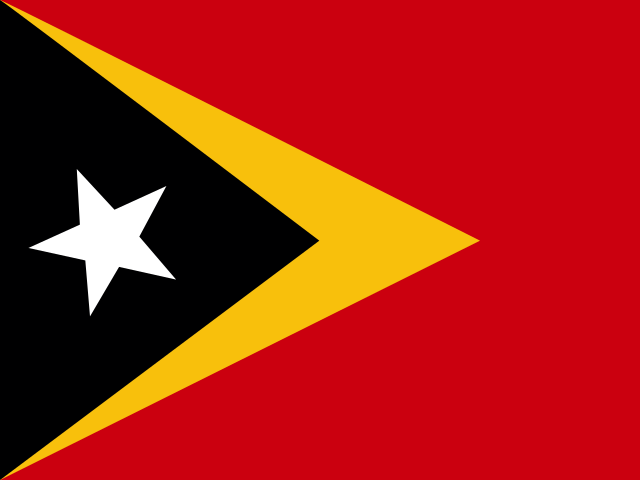
The Resistance Museum in Dili documents the 24-year Indonesian occupation and the independence struggle through personal testimony, photographs, and artifacts, including preserved items associated with the clandestine resistance movement, serving as one of the primary institutions through which the young country has formally recorded and memorialized the period the national flag's colors are meant to represent.
Dili's port and airport remain the country's principal points of connection to the outside world, and the city continues to host the bulk of Timor-Leste's small diplomatic corps, international aid organizations, and the limited number of foreign businesses operating in one of the world's newer and less internationally connected capital cities.
Timor-Leste's long push for regional integration reached a milestone in 2025, when the country was formally admitted as the eleventh member of ASEAN after more than a decade of applications and negotiations; the diplomatic groundwork for accession, including hosting a growing number of regional delegations, was handled almost entirely out of Dili's small but expanding cluster of government ministries.
Bishop Carlos Filipe Ximenes Belo, who shared the 1996 Nobel Peace Prize for his role opposing the Indonesian occupation, led the Catholic Diocese of Dili through much of that period, and the church he headed became one of the few institutions able to document human rights abuses and shelter civilians during the worst of the violence — a role that left the Catholic Church with outsized moral authority in the capital's public life after independence.
Quick facts
- Tetum and Portuguese are Timor-Leste's two official languages, but Dili's streets and markets typically mix in Indonesian and a range of local vernacular languages, a layering that reflects the territory's changing administrations over the past half-century.
- A 2015 national census put Dili municipality's population at roughly 277,000, a figure that had grown substantially by the early 2020s as reconstruction-era migration into the capital continued.
- The 2002 independence ceremony held in Dili was attended by dignitaries including then-UN Secretary-General Kofi Annan and Indonesian President Megawati Sukarnoputri, a gesture widely read as a step toward reconciliation between the two countries.
- Dili's airport, long known as Comoro Airport, was renamed Presidente Nicolau Lobato International Airport for the country's independence hero, though flight options remain limited mostly to connections through Bali and Darwin.
- Alongside Cristo Rei, Dili's waterfront includes Areia Branca, a calm-water beach popular with residents that contrasts with the rougher surf found along much of the rest of the country's coastline.