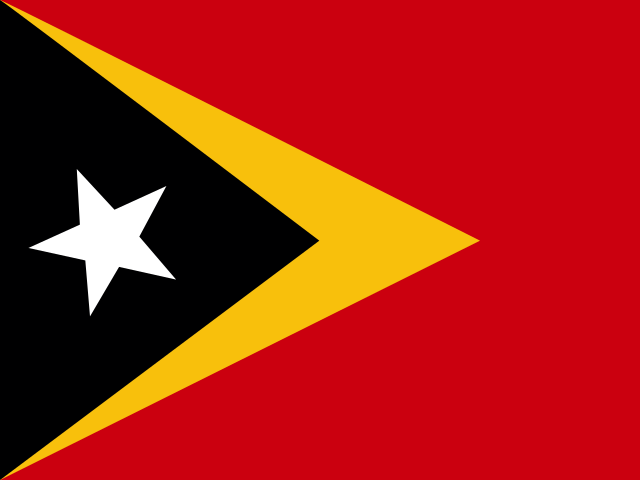
The Flag of Timor-Leste
Asia · Adopted 20 May 2002 (design dates to 28 November 1975)
Timor-Leste's flag has an unusually painful gap in its history: it was first adopted on 28 November 1975, the day the Revolutionary Front for an Independent East Timor (Fretilin) unilaterally declared independence from Portugal, but Indonesia invaded just nine days later, on 7 December 1975, and occupied the territory for the next 24 years. The flag survived that entire occupation not as a governing symbol but as a banned emblem of resistance, kept alive by the East Timorese independence movement and its supporters in exile and in clandestine networks inside the territory, until it was formally re-adopted as the flag of the newly independent nation on 20 May 2002 — the same design, unchanged, now flying over an actual sovereign state rather than a nine-day-old breakaway declaration.
The design is built from a black triangle at the hoist overlaid on a larger yellow triangle, both set against a field split diagonally into red (the larger portion) and a black-bordered white star at the very center of the black triangle. Each element carries meaning tied specifically to the independence struggle: black represents the obscurantism (backwardness and colonial subjugation) that the movement sought to overcome, yellow represents the traces of colonialism in the country's history, red represents the struggle for national liberation, and the white star represents peace and serves as a guiding light for the nation's future.
Timor-Leste's path to the flag's original 1975 design ran through more than four centuries of Portuguese colonial rule, beginning in the 16th century, during which the territory flew Portuguese colonial flags rather than any distinct local design; the 1975 flag was created specifically as part of the decolonization process after Portugal's 1974 Carnation Revolution triggered a rapid, ultimately chaotic withdrawal from its remaining overseas territories, of which East Timor was one.
During Indonesian occupation (1975–1999), the territory was forced to fly Indonesian symbols as a nominal Indonesian province, and the Fretilin flag's display was suppressed and dangerous; the 1999 UN-supervised referendum, in which East Timorese voted overwhelmingly for independence, triggered a violent scorched-earth campaign by pro-Indonesia militias before a UN transitional administration took over and prepared the territory for the full independence it achieved in 2002 — at which point the original 1975 flag design was restored with no changes to its meaning.
That continuity is unusual: most newly independent 21st-century states design a flag for the first time at independence, but Timor-Leste is one of the few nations where the flag long predates the sovereign state that now flies it by 27 years, having first existed as a symbol of a nine-day, immediately-crushed declaration before becoming the flag of an internationally recognized country.
The flag's exact color specifications and construction were formalized in Timor-Leste's 2002 constitution alongside the country's other founding symbols, and 20 May is celebrated annually as Restoration of Independence Day, distinct from 28 November, which is separately observed as the anniversary of the original 1975 proclamation — a rare case of a country marking two separate 'independence' dates because its independence was itself interrupted rather than achieved in a single continuous process.
Because it combines red, yellow, and black in a triangular arrangement, Timor-Leste's flag is occasionally mistaken at a glance for other flags using red-yellow-black color schemes from unrelated regions, though the specific diagonal split, dual triangles, and star placement are unique to Timor-Leste and were designed with the country's own independence symbolism in mind rather than borrowed from any other national flag tradition.
The white star at the flag's center is specifically five-pointed and outlined in black rather than filled solid, a detail official Timorese government descriptions tie to the idea of light guiding the nation forward out of the darkness represented by the black triangle, an intentional visual pairing of the flag's darkest and brightest elements at its literal center.
Because the 1975 flag was designed by a resistance movement rather than a government with full institutional resources, its earliest handmade and locally produced versions varied somewhat in exact proportions and shading; the 2002 constitutional adoption process fixed a single official specification, meaning that flags produced and flown clandestinely during the occupation years were not always visually identical to the standardized version legally recognized today, a small but historically meaningful inconsistency tied to the flag's underground origins.
The resistance movement that preserved the flag through the occupation years operated on several fronts simultaneously — an armed guerrilla wing (Falintil) fighting in the mountains, a clandestine urban network smuggling information and supplies, and a diplomatic front led by figures such as José Ramos-Horta and Bishop Carlos Filipe Ximenes Belo lobbying internationally for East Timorese self-determination — and accounts from that period describe the flag being kept hidden, sometimes literally buried or sewn into clothing, and brought out only for clandestine ceremonies during the 24 years it could not be legally displayed.
Timor-Leste's 2002 independence made it the first new sovereign nation of the 21st century, and its flag's continuity from a suppressed 1975 resistance symbol to an internationally recognized state emblem is frequently cited by Timorese leaders as evidence that the country's independence, however delayed by the Indonesian occupation, represents an unbroken continuation of the 1975 declaration rather than a separate, later achievement.
Proportions the early flags did not have
- Proportion-accurate flag — The page records that the earliest locally made versions varied in their proportions, and the two overlapping triangles are exactly the geometry that goes wrong when a maker is working by eye.
As an Amazon Associate we earn from qualifying purchases made through these links, at no extra cost to you.
Timor-Leste at a glance
- Capital
- Dili
- Population
- 1.4 million (2024)
- Currency
- United States Dollar (USD)
- Language(s)
- Tetum and Portuguese (official); Indonesian and English also widely used
Population figure as of 2024, source: UN World Population Prospects (2024 revision). See methodology for how facts are sourced and kept current.